

5. ONIUM COMPOUNDS
191
sible for the biosynthesis of homobetaine (from homoserine -» ß-propanolamine—»homocholine) and of ercinine from the corresponding
amino alcohol, histidinol, which has been reported as an intermediate in
the pathway of histidine biosynthesis (18, 19); scheme 2 might also
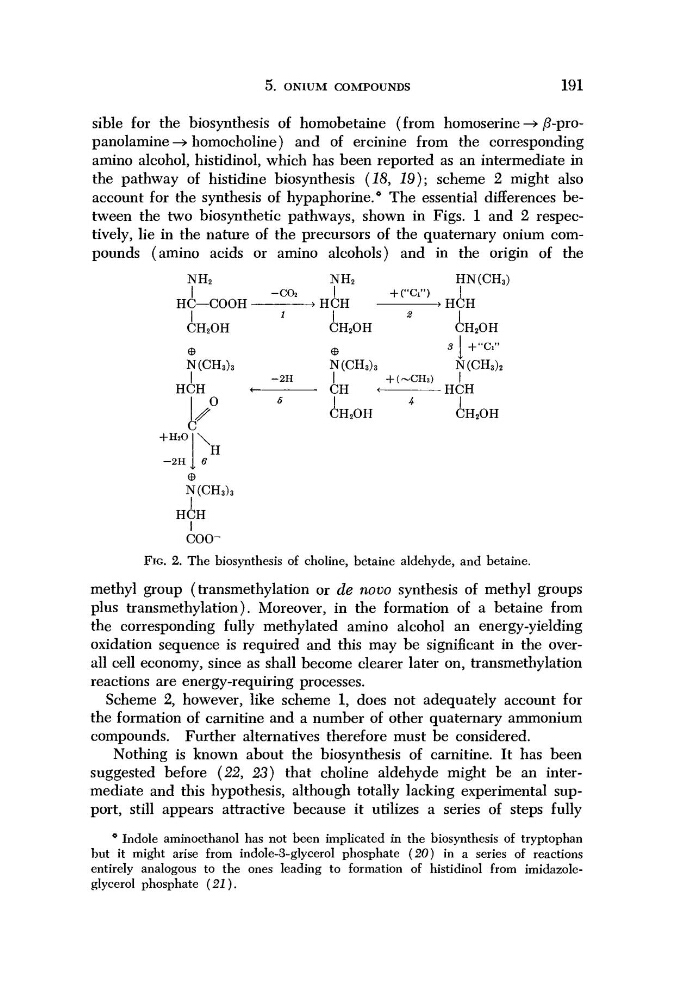
account for the synthesis of hypaphorine.* The essential differences between the two biosynthetic pathways, shown in Figs. 1 and 2 respectively, lie in the nature of the precursors of the quaternary onium compounds (amino acids or amino alcohols) and in the origin of the
NH 2
NH 2
HN(CH 3 )
I
-co 2
I
+("Ci")
I
HC—COOH
> HCH
> HCH
I
'I
*
\
CH 2 OH
CH 2 OH
CH 2 OH
Θ
Φ
s
1 +"
ci
"
N(CH 3 ) 3
N(CH 3 ) 3
N(CH 3 ) 2
I
-2H
I
+ (~CH 3 )
I
HCH
<
CH
<
HCH
0*|
*
I
\/
CH 2 OH
CH 2 OH
+Η2Ο
-2H
\
H
N(CH 3 ) 3
I
HCH
I
cooFIG. 2. The biosynthesis of choline, betaine aldehyde, and betaine.
methyl group (transmethylation or de novo synthesis of methyl groups
plus transmethylation). Moreover, in the formation of a betaine from
the corresponding fully methylated amino alcohol an energy-yielding
oxidation sequence is required and this may be significant in the overall cell economy, since as shall become clearer later on, transmethylation
reactions are energy-requiring processes.
Scheme 2, however, like scheme 1, does not adequately account for
the formation of carnitine and a number of other quaternary ammonium
compounds. Further alternatives therefore must be considered.
Nothing is known about the biosynthesis of carnitine. It has been
suggested before (22, 23) that choline aldehyde might be an intermediate and this hypothesis, although totally lacking experimental support, still appears attractive because it utilizes a series of steps fully
* Indole aminoethanol has not been implicated in the biosynthesis of tryptophan
but it might arise from indole-3-glycerol phosphate (20) in a series of reactions
entirely analogous to the ones leading to formation of histidinol from imidazoleglycerol phosphate (21).
191
sible for the biosynthesis of homobetaine (from homoserine -» ß-propanolamine—»homocholine) and of ercinine from the corresponding
amino alcohol, histidinol, which has been reported as an intermediate in
the pathway of histidine biosynthesis (18, 19); scheme 2 might also
account for the synthesis of hypaphorine.* The essential differences between the two biosynthetic pathways, shown in Figs. 1 and 2 respectively, lie in the nature of the precursors of the quaternary onium compounds (amino acids or amino alcohols) and in the origin of the
NH 2
NH 2
HN(CH 3 )
I
-co 2
I
+("Ci")
I
HC—COOH
> HCH
> HCH
I
'I
*
\
CH 2 OH
CH 2 OH
CH 2 OH
Θ
Φ
s
1 +"
ci
"
N(CH 3 ) 3
N(CH 3 ) 3
N(CH 3 ) 2
I
-2H
I
+ (~CH 3 )
I
HCH
<
CH
<
HCH
0*|
*
I
\/
CH 2 OH
CH 2 OH
+Η2Ο
-2H
\
H
N(CH 3 ) 3
I
HCH
I
cooFIG. 2. The biosynthesis of choline, betaine aldehyde, and betaine.
methyl group (transmethylation or de novo synthesis of methyl groups
plus transmethylation). Moreover, in the formation of a betaine from
the corresponding fully methylated amino alcohol an energy-yielding
oxidation sequence is required and this may be significant in the overall cell economy, since as shall become clearer later on, transmethylation
reactions are energy-requiring processes.
Scheme 2, however, like scheme 1, does not adequately account for
the formation of carnitine and a number of other quaternary ammonium
compounds. Further alternatives therefore must be considered.
Nothing is known about the biosynthesis of carnitine. It has been
suggested before (22, 23) that choline aldehyde might be an intermediate and this hypothesis, although totally lacking experimental support, still appears attractive because it utilizes a series of steps fully
* Indole aminoethanol has not been implicated in the biosynthesis of tryptophan
but it might arise from indole-3-glycerol phosphate (20) in a series of reactions
entirely analogous to the ones leading to formation of histidinol from imidazoleglycerol phosphate (21).