

192
G. L. CANTONI
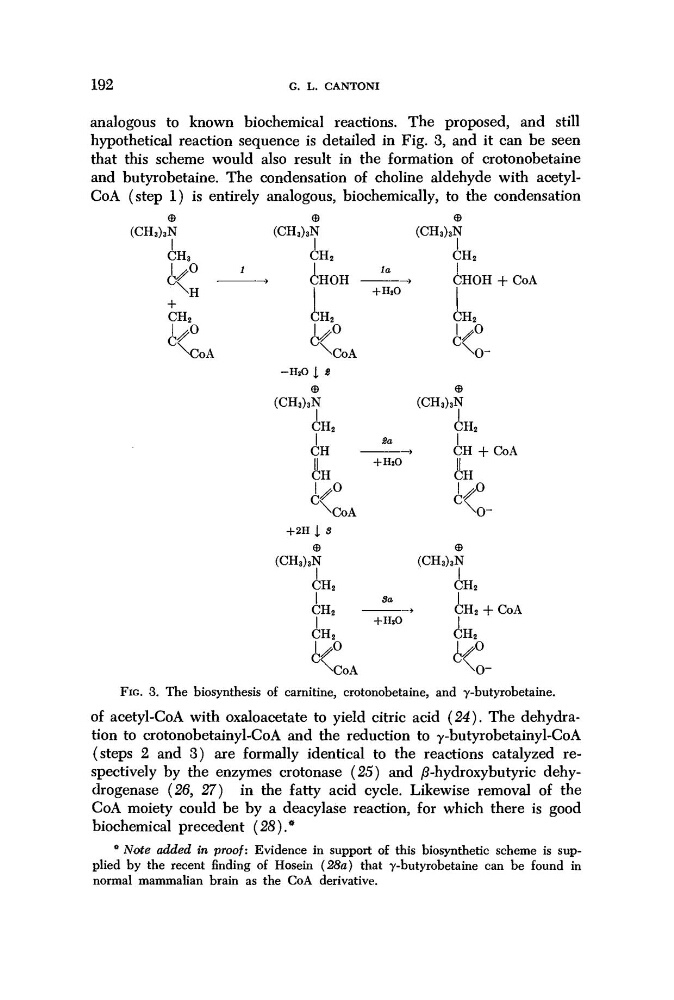
analogous to known biochemical reactions. The proposed, and still
hypothetical reaction sequence is detailed in Fig. 3, and it can be seen
that this scheme would also result in the formation of crotonobetaine
and butyrobetaine. The condensation of choline aldehyde with acetylCoA (step 1) is entirely analogous, biochemically, to the condensation
(CH 3 ) 3 N
(CH 3 ) 3 N
(CH 3 ) 3 N
i ■H 3
CH.2
CH2
.0
i
|
of
>
CHOH
>
CHOH + CoA
+
CH2
CH2
CI12
I
+Η2Ο
I
CH 2
CI
J/>
^CoA
^CoA
\)-H2O I 2
(CH 3 ) 3 N
(CH 3 ) 3 N
CH2
CH2
I
«a
I
CH
»
CH + CoA
L
+m>
Im
x CoA
x 0+2H| S
(CH 3 ) 3 N
(CH 3 ) 3 N
CH2
CH2
I
Sa
I
CH 2
♦
CH 2 + CoA
I
+H2 °
1
CH2
CH2
c<°
c<°
x CoA
x 0 ~
FIG. 3. The biosynthesis of carnitine, crotonobetaine, and γ-butyrobetaine.
of acetyl-CoA with oxaloacetate to yield citric acid (24). The dehydration to crotonobetainyl-CoA and the reduction to γ-butyrobetainyl-CoA
(steps 2 and 3) are formally identical to the reactions catalyzed respectively by the enzymes crotonase (25) and /?-hydroxybutyric dehydrogenase (26, 27) in the fatty acid cycle. Likewise removal of the
CoA moiety could be by a deacylase reaction, for which there is good
biochemical precedent (28).*
* Note added in proof: Evidence in support of this biosynthetic scheme is supplied by the recent finding of Hosein (28a) that γ-butyrobetaine can be found in
normal mammalian brain as the CoA derivative.
G. L. CANTONI
analogous to known biochemical reactions. The proposed, and still
hypothetical reaction sequence is detailed in Fig. 3, and it can be seen
that this scheme would also result in the formation of crotonobetaine
and butyrobetaine. The condensation of choline aldehyde with acetylCoA (step 1) is entirely analogous, biochemically, to the condensation
(CH 3 ) 3 N
(CH 3 ) 3 N
(CH 3 ) 3 N
i ■H 3
CH.2
CH2
.0
i
|
of
>
CHOH
>
CHOH + CoA
+
CH2
CH2
CI12
I
+Η2Ο
I
CH 2
CI
J/>
^CoA
^CoA
\)-H2O I 2
(CH 3 ) 3 N
(CH 3 ) 3 N
CH2
CH2
I
«a
I
CH
»
CH + CoA
L
+m>
Im
x CoA
x 0+2H| S
(CH 3 ) 3 N
(CH 3 ) 3 N
CH2
CH2
I
Sa
I
CH 2
♦
CH 2 + CoA
I
+H2 °
1
CH2
CH2
c<°
c<°
x CoA
x 0 ~
FIG. 3. The biosynthesis of carnitine, crotonobetaine, and γ-butyrobetaine.
of acetyl-CoA with oxaloacetate to yield citric acid (24). The dehydration to crotonobetainyl-CoA and the reduction to γ-butyrobetainyl-CoA
(steps 2 and 3) are formally identical to the reactions catalyzed respectively by the enzymes crotonase (25) and /?-hydroxybutyric dehydrogenase (26, 27) in the fatty acid cycle. Likewise removal of the
CoA moiety could be by a deacylase reaction, for which there is good
biochemical precedent (28).*
* Note added in proof: Evidence in support of this biosynthetic scheme is supplied by the recent finding of Hosein (28a) that γ-butyrobetaine can be found in
normal mammalian brain as the CoA derivative.