

190
G. L. CANTONI
Prima facie the similarity between glycine and betaine, tryptophan and
hypaphorine, histidine and ercinine, ornithine and miokinine suggests
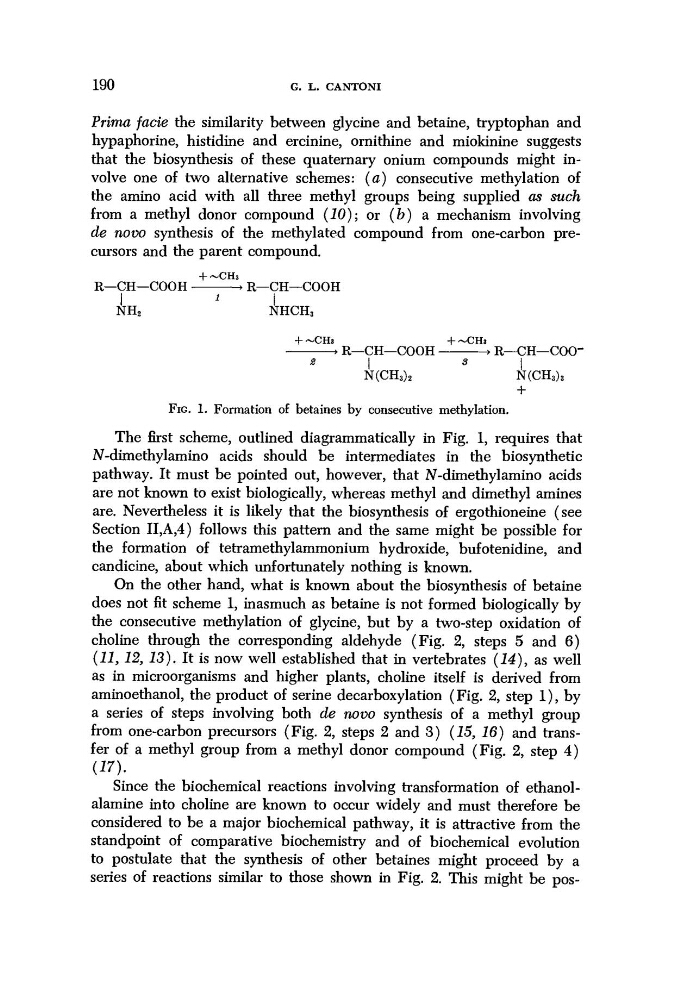
that the biosynthesis of these quaternary onium compounds might involve one of two alternative schemes: (a) consecutive methylation of
the amino acid with all three methyl groups being supplied as such
from a methyl donor compound (10); or (b) a mechanism involving
de novo synthesis of the methylated compound from one-carbon precursors and the parent compound.
+ ~CH 3
R—CH—COOH
> R—CH—COOH
I
'
I
NH 2
NHCH 3
+ ~CH 3
+ ~CH 3
> R—CH—COOH
> R—CH—COO2
\
s
\
N(CH 3 ) 2
N(CH 3 ) 3
+
FIG. 1. Formation of betaines by consecutive methylation.
The first scheme, outlined diagrammatically in Fig. 1, requires that
N-dimethylamino acids should be intermediates in the biosynthetic
pathway. It must be pointed out, however, that N-dimethylamino acids
are not known to exist biologically, whereas methyl and dimethyl amines
are. Nevertheless it is likely that the biosynthesis of ergothioneine (see
Section II,A>4) follows this pattern and the same might be possible for
the formation of tetramethylammonium hydroxide, bufotenidine, and
candicine, about which unfortunately nothing is known.
On the other hand, what is known about the biosynthesis of betaine
does not fit scheme 1, inasmuch as betaine is not formed biologically by
the consecutive methylation of glycine, but by a two-step oxidation of
choline through the corresponding aldehyde (Fig. 2, steps 5 and 6)
(11, 12, 13). It is now well established that in vertebrates (14), as well
as in microorganisms and higher plants, choline itself is derived from
aminoethanol, the product of serine decarboxylation (Fig. 2, step 1), by
a series of steps involving both de novo synthesis of a methyl group
from one-carbon precursors (Fig. 2, steps 2 and 3) (15, 16) and transfer of a methyl group from a methyl donor compound (Fig. 2, step 4)
(17).
Since the biochemical reactions involving transformation of ethanolalamine into choline are known to occur widely and must therefore be
considered to be a major biochemical pathway, it is attractive from the
standpoint of comparative biochemistry and of biochemical evolution
to postulate that the synthesis of other betaines might proceed by a
series of reactions similar to those shown in Fig. 2. This might be pos-
G. L. CANTONI
Prima facie the similarity between glycine and betaine, tryptophan and
hypaphorine, histidine and ercinine, ornithine and miokinine suggests
that the biosynthesis of these quaternary onium compounds might involve one of two alternative schemes: (a) consecutive methylation of
the amino acid with all three methyl groups being supplied as such
from a methyl donor compound (10); or (b) a mechanism involving
de novo synthesis of the methylated compound from one-carbon precursors and the parent compound.
+ ~CH 3
R—CH—COOH
> R—CH—COOH
I
'
I
NH 2
NHCH 3
+ ~CH 3
+ ~CH 3
> R—CH—COOH
> R—CH—COO2
\
s
\
N(CH 3 ) 2
N(CH 3 ) 3
+
FIG. 1. Formation of betaines by consecutive methylation.
The first scheme, outlined diagrammatically in Fig. 1, requires that
N-dimethylamino acids should be intermediates in the biosynthetic
pathway. It must be pointed out, however, that N-dimethylamino acids
are not known to exist biologically, whereas methyl and dimethyl amines
are. Nevertheless it is likely that the biosynthesis of ergothioneine (see
Section II,A>4) follows this pattern and the same might be possible for
the formation of tetramethylammonium hydroxide, bufotenidine, and
candicine, about which unfortunately nothing is known.
On the other hand, what is known about the biosynthesis of betaine
does not fit scheme 1, inasmuch as betaine is not formed biologically by
the consecutive methylation of glycine, but by a two-step oxidation of
choline through the corresponding aldehyde (Fig. 2, steps 5 and 6)
(11, 12, 13). It is now well established that in vertebrates (14), as well
as in microorganisms and higher plants, choline itself is derived from
aminoethanol, the product of serine decarboxylation (Fig. 2, step 1), by
a series of steps involving both de novo synthesis of a methyl group
from one-carbon precursors (Fig. 2, steps 2 and 3) (15, 16) and transfer of a methyl group from a methyl donor compound (Fig. 2, step 4)
(17).
Since the biochemical reactions involving transformation of ethanolalamine into choline are known to occur widely and must therefore be
considered to be a major biochemical pathway, it is attractive from the
standpoint of comparative biochemistry and of biochemical evolution
to postulate that the synthesis of other betaines might proceed by a
series of reactions similar to those shown in Fig. 2. This might be pos-