

5. ONIUM COMPOUNDS
189
Although this reaction (Eq. 5) has not been demonstrated biologically,
its existence would provide a facile explanation for the mechanism
(CH 3 ) 3 —N—CH 2 —COO- -* (CH 3 ) 2 —N—CH 2 —COO—CH 3
(5)
of biosynthesis of certain compounds. Furthermore, under strongly
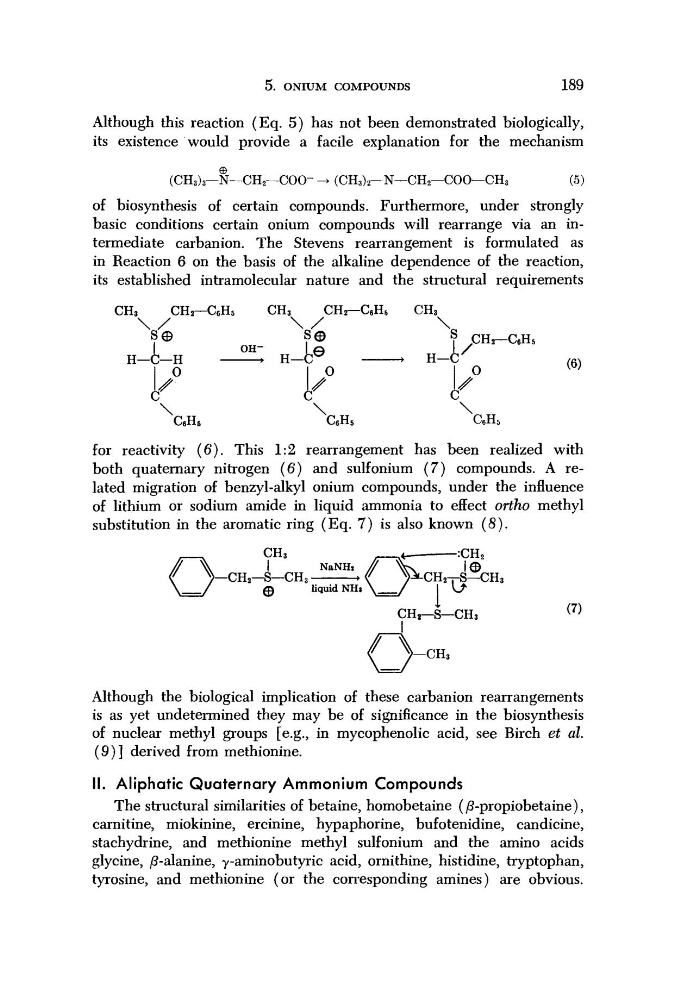
basic conditions certain onium compounds will rearrange via an intermediate carbanion. The Stevens rearrangement is formulated as
in Reaction 6 on the basis of the alkaline dependence of the reaction,
its established intramolecular nature and the structural requirements
CH3
CH2—CeHö
CH 3
CH2—Cells
CH 3
\ /
\ /
v
S®
S©
S CH 2 -C 6 H 5
I
OHI Θ
I /
H—C—H
► H—C°
► H—C
m
10
10
10
W
V
V
V
C 6 H 5
C 6 H 5
C 6 H 5
for reactivity (6). This 1:2 rearrangement has been realized with
both quaternary nitrogen (6) and sulfonium (7) compounds. A related migration of benzyl-alkyl onium compounds, under the influence
of lithium or sodium amide in liquid ammonia to effect ortho methyl
substitution in the aromatic ring (Eq. 7) is also known (8).
CH 3
, ^
:CH :
* 2
ff
\V-CHf—S—CH,
>((
X
)^-CH
21
-S—CH
3
φ
Uquid NHi \
/
I L^
CH2—S—CH 3
(7)
Although the biological implication of these carbanion rearrangements
is as yet undetermined they may be of significance in the biosynthesis
of nuclear methyl groups [e.g., in mycophenolic acid, see Birch et al.
(9)] derived from methionine.
II. Aliphatic Quaternary Ammonium Compounds
The structural similarities of betaine, homobetaine (β-propiobetaine),
carnitine, miokinine, ercinine, hypaphorine, bufotenidine, candicine,
stachydrine, and methionine methyl sulfonium and the amino acids
glycine, /?-alanine, γ-aminobutyric acid, ornithine, histidine, tryptophan,
tyrosine, and methionine (or the corresponding amines) are obvious.
189
Although this reaction (Eq. 5) has not been demonstrated biologically,
its existence would provide a facile explanation for the mechanism
(CH 3 ) 3 —N—CH 2 —COO- -* (CH 3 ) 2 —N—CH 2 —COO—CH 3
(5)
of biosynthesis of certain compounds. Furthermore, under strongly
basic conditions certain onium compounds will rearrange via an intermediate carbanion. The Stevens rearrangement is formulated as
in Reaction 6 on the basis of the alkaline dependence of the reaction,
its established intramolecular nature and the structural requirements
CH3
CH2—CeHö
CH 3
CH2—Cells
CH 3
\ /
\ /
v
S®
S©
S CH 2 -C 6 H 5
I
OHI Θ
I /
H—C—H
► H—C°
► H—C
m
10
10
10
W
V
V
V
C 6 H 5
C 6 H 5
C 6 H 5
for reactivity (6). This 1:2 rearrangement has been realized with
both quaternary nitrogen (6) and sulfonium (7) compounds. A related migration of benzyl-alkyl onium compounds, under the influence
of lithium or sodium amide in liquid ammonia to effect ortho methyl
substitution in the aromatic ring (Eq. 7) is also known (8).
CH 3
, ^
:CH :
* 2
ff
\V-CHf—S—CH,
>((
X
)^-CH
21
-S—CH
3
φ
Uquid NHi \
/
I L^
CH2—S—CH 3
(7)
Although the biological implication of these carbanion rearrangements
is as yet undetermined they may be of significance in the biosynthesis
of nuclear methyl groups [e.g., in mycophenolic acid, see Birch et al.
(9)] derived from methionine.
II. Aliphatic Quaternary Ammonium Compounds
The structural similarities of betaine, homobetaine (β-propiobetaine),
carnitine, miokinine, ercinine, hypaphorine, bufotenidine, candicine,
stachydrine, and methionine methyl sulfonium and the amino acids
glycine, /?-alanine, γ-aminobutyric acid, ornithine, histidine, tryptophan,
tyrosine, and methionine (or the corresponding amines) are obvious.