

188
G. L. CANTONI
As might be expected the reaction can proceed simultaneously by
both of the above mechanisms, the relative preponderance of substitution over elimination depending on the relationship between the nucleophilic nature of the attacking group (its affinity for an atomic nucleus)
and its basicity (affinity for a proton). With a strongly basic nucleophilic reagent, such as hydroxide ion, elimination might be expected to
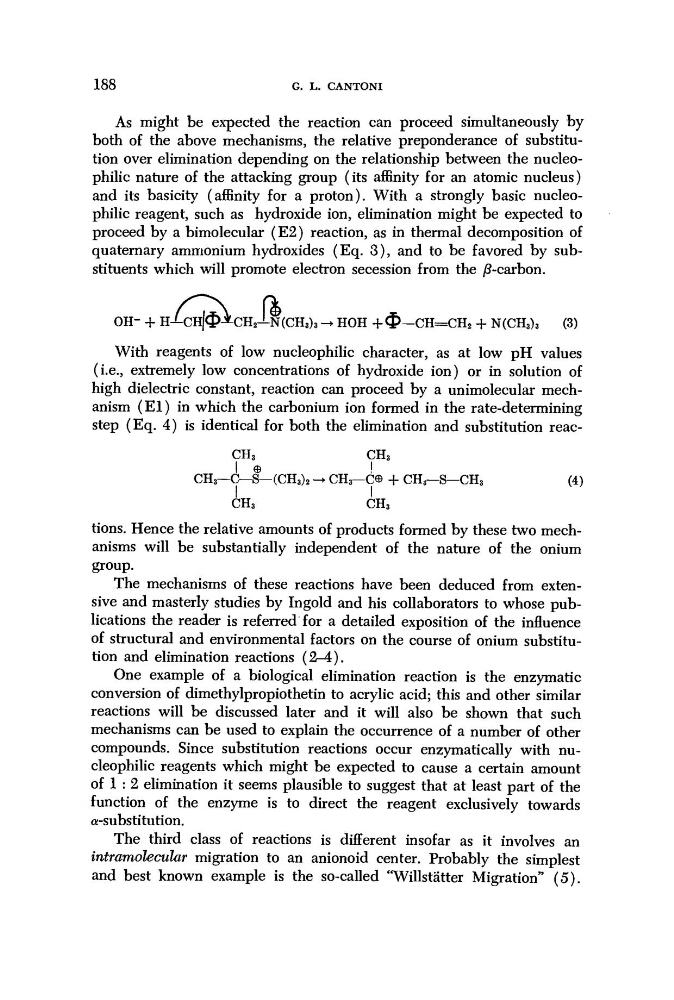
proceed by a bimolecular (E2) reaction, as in thermal decomposition of
quaternary ammonium hydroxides (Eq. 3), and to be favored by substituents which will promote electron secession from the ß-carbon.
OH- + Η-^ΟΗ|Φ-^ΟΗ 2 -ίΝ(ΟΗ 3 )3 -» HÖH + Φ— CH=CH 2 + N(CH 3 ) 3 (3)
With reagents of low nucleophilic character, as at low pH values
(i.e., extremely low concentrations of hydroxide ion) or in solution of
high dielectric constant, reaction can proceed by a unimolecular mechanism (El) in which the carbonium ion formed in the rate-determining
step (Eq. 4) is identical for both the elimination and substitution reacCH 3
CH3
I e
!
CH 3 —C—S—(CH 3 ) 2 -> CH 3 —ΟΘ + CH S —S—CH 3
(4)
CH3
CH3
tions. Hence the relative amounts of products formed by these two mechanisms will be substantially independent of the nature of the onium
group.
The mechanisms of these reactions have been deduced from extensive and masterly studies by Ingold and his collaborators to whose publications the reader is referred for a detailed exposition of the influence
of structural and environmental factors on the course of onium substitution and elimination reactions (2-4).
One example of a biological elimination reaction is the enzymatic
conversion of dimethylpropiothetin to acrylic acid; this and other similar
reactions will be discussed later and it will also be shown that such
mechanisms can be used to explain the occurrence of a number of other
compounds. Since substitution reactions occur enzymatically with nucleophilic reagents which might be expected to cause a certain amount
of 1 : 2 elimination it seems plausible to suggest that at least part of the
function of the enzyme is to direct the reagent exclusively towards
«-substitution.
The third class of reactions is different insofar as it involves an
intramolecular migration to an anionoid center. Probably the simplest
and best known example is the so-called "Willstätter Migration" (5).
G. L. CANTONI
As might be expected the reaction can proceed simultaneously by
both of the above mechanisms, the relative preponderance of substitution over elimination depending on the relationship between the nucleophilic nature of the attacking group (its affinity for an atomic nucleus)
and its basicity (affinity for a proton). With a strongly basic nucleophilic reagent, such as hydroxide ion, elimination might be expected to
proceed by a bimolecular (E2) reaction, as in thermal decomposition of
quaternary ammonium hydroxides (Eq. 3), and to be favored by substituents which will promote electron secession from the ß-carbon.
OH- + Η-^ΟΗ|Φ-^ΟΗ 2 -ίΝ(ΟΗ 3 )3 -» HÖH + Φ— CH=CH 2 + N(CH 3 ) 3 (3)
With reagents of low nucleophilic character, as at low pH values
(i.e., extremely low concentrations of hydroxide ion) or in solution of
high dielectric constant, reaction can proceed by a unimolecular mechanism (El) in which the carbonium ion formed in the rate-determining
step (Eq. 4) is identical for both the elimination and substitution reacCH 3
CH3
I e
!
CH 3 —C—S—(CH 3 ) 2 -> CH 3 —ΟΘ + CH S —S—CH 3
(4)
CH3
CH3
tions. Hence the relative amounts of products formed by these two mechanisms will be substantially independent of the nature of the onium
group.
The mechanisms of these reactions have been deduced from extensive and masterly studies by Ingold and his collaborators to whose publications the reader is referred for a detailed exposition of the influence
of structural and environmental factors on the course of onium substitution and elimination reactions (2-4).
One example of a biological elimination reaction is the enzymatic
conversion of dimethylpropiothetin to acrylic acid; this and other similar
reactions will be discussed later and it will also be shown that such
mechanisms can be used to explain the occurrence of a number of other
compounds. Since substitution reactions occur enzymatically with nucleophilic reagents which might be expected to cause a certain amount
of 1 : 2 elimination it seems plausible to suggest that at least part of the
function of the enzyme is to direct the reagent exclusively towards
«-substitution.
The third class of reactions is different insofar as it involves an
intramolecular migration to an anionoid center. Probably the simplest
and best known example is the so-called "Willstätter Migration" (5).