

4. ENERGY-RICH COMPOUNDS
159
lated as an enzyme-bound intermediate in the oxidation of 3-phosphoglyceraldehyde (discussed in section III,A,3,Z? of this chapter).
In bacterial systems (401), acyl lipoates have been identified as
intermediates in the oxidative decarboxylation of a-ketoglutarate,
α-ketobutyrate, and pyruvate. Lipoic acid is the acceptor for the acyl
group in the above reactions, and the acyl group is subsequently transferred to CoA by a reaction similar to that shown in Eq. 69.
c. Function. Acyl thioesters represent an "activated form" for the
acyl group in a variety of metabolic reactions. As with other coenzymes,
CoA may be considered as a reversible carrier for a mobile metabolic
group (407), in this instance the acyl moiety. The transfer of the acyl
group may be written in two steps:
O
O
II
II
R—C—donor + CoA ^ R—C—S—CoA + donor
(70)
O
O
R—C—S—CoA + acceptor ^± R—C—acceptor + CoA
(71)
This formulation accounts for the many reactions where acetate, acetyl
phosphate, citrate, acetoacetate, ß-ketoadipate, and α-methyl acetoacetate serve as acetyl donors, while oxaloacetate (to form citrate), formate
(to form pyruvate), glucosamine (to form N-acetyl glucosamine),
amino acids (to form N-acetyl amino acids), choline (to form acetyl
choline), sulfanilamide and aromatic amines (to form the N-acetyl
amines), or acetyl-CoA (to form acetoacetyl-CoA) serve as acetyl acceptors.
Similarly, α-ketoglutarate and succinate may act as succinyl donors.
Glycine (to form a-amino-ß-ketoadipic acid) and acetyl-CoA (to form
/?-ketoadipic acid) are succinyl acceptors. Succinyl-CoA may also function in the formation of propionate by bacteria and in the oxidation of
propionate by mammalian tissues. The function of the other principal
acyl thioesters, namely acyl derivatives of glutathione and lipoic acid,
is also that of acyl transfer.
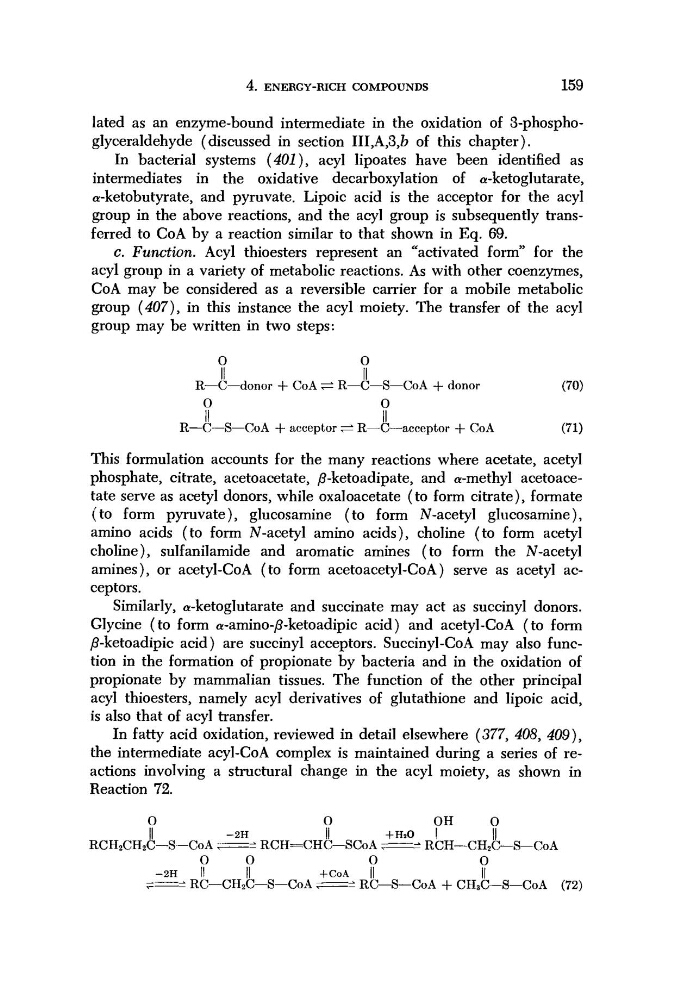
In fatty acid oxidation, reviewed in detail elsewhere (377, 408, 409),
the intermediate acyl-CoA complex is maintained during a series of reactions involving a structural change in the acyl moiety, as shown in
Reaction 72.
O
O
OH
O
II
-2H
||
4-H2O !
II
RCH 2 CH 2 C—S—CoA ; = ± RCH=CHC—SCoA ^=±
RCH—CH 2 C—S—CoA
0
0
O
O
-2H
II
||
+CoA
||
II
; = = ± RC—CH 2 C—S—CoA ; = RC—S—CoA + CH 3 C—S—CoA (72)
159
lated as an enzyme-bound intermediate in the oxidation of 3-phosphoglyceraldehyde (discussed in section III,A,3,Z? of this chapter).
In bacterial systems (401), acyl lipoates have been identified as
intermediates in the oxidative decarboxylation of a-ketoglutarate,
α-ketobutyrate, and pyruvate. Lipoic acid is the acceptor for the acyl
group in the above reactions, and the acyl group is subsequently transferred to CoA by a reaction similar to that shown in Eq. 69.
c. Function. Acyl thioesters represent an "activated form" for the
acyl group in a variety of metabolic reactions. As with other coenzymes,
CoA may be considered as a reversible carrier for a mobile metabolic
group (407), in this instance the acyl moiety. The transfer of the acyl
group may be written in two steps:
O
O
II
II
R—C—donor + CoA ^ R—C—S—CoA + donor
(70)
O
O
R—C—S—CoA + acceptor ^± R—C—acceptor + CoA
(71)
This formulation accounts for the many reactions where acetate, acetyl
phosphate, citrate, acetoacetate, ß-ketoadipate, and α-methyl acetoacetate serve as acetyl donors, while oxaloacetate (to form citrate), formate
(to form pyruvate), glucosamine (to form N-acetyl glucosamine),
amino acids (to form N-acetyl amino acids), choline (to form acetyl
choline), sulfanilamide and aromatic amines (to form the N-acetyl
amines), or acetyl-CoA (to form acetoacetyl-CoA) serve as acetyl acceptors.
Similarly, α-ketoglutarate and succinate may act as succinyl donors.
Glycine (to form a-amino-ß-ketoadipic acid) and acetyl-CoA (to form
/?-ketoadipic acid) are succinyl acceptors. Succinyl-CoA may also function in the formation of propionate by bacteria and in the oxidation of
propionate by mammalian tissues. The function of the other principal
acyl thioesters, namely acyl derivatives of glutathione and lipoic acid,
is also that of acyl transfer.
In fatty acid oxidation, reviewed in detail elsewhere (377, 408, 409),
the intermediate acyl-CoA complex is maintained during a series of reactions involving a structural change in the acyl moiety, as shown in
Reaction 72.
O
O
OH
O
II
-2H
||
4-H2O !
II
RCH 2 CH 2 C—S—CoA ; = ± RCH=CHC—SCoA ^=±
RCH—CH 2 C—S—CoA
0
0
O
O
-2H
II
||
+CoA
||
II
; = = ± RC—CH 2 C—S—CoA ; = RC—S—CoA + CH 3 C—S—CoA (72)