

158
F. M. HUENNEKENS AND H. R. WHITELEY
alkali, followed by an estimation of the liberated thiol group using the
quantitative nitroprusside (390) or p-chloromercuribenzoate (391)
method.
b. Biosynthesis. A number of acyl derivatives of CoA originate by
two general enzymatic reactions: the direct activation of the organic
acid (the mechanism of Reaction 67 has been discussed in Section
III,A,3,c of this chapter), and the transphorase reaction (Eq. 68).
0
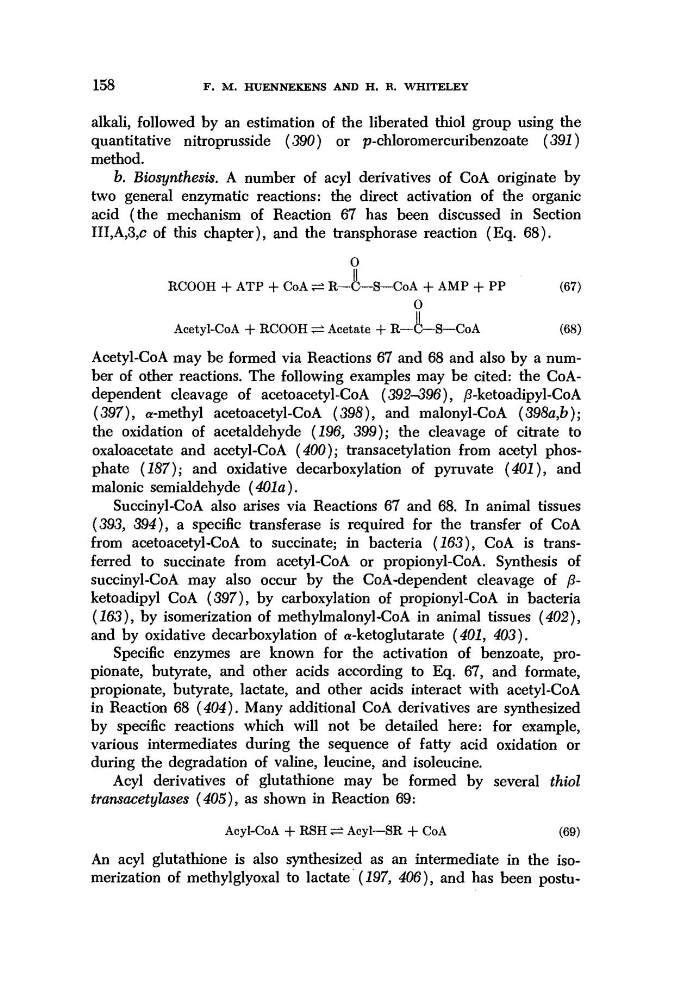
RCOOH + ATP + CoA ;=± R—C—S—CoA + AMP + PP
(67)
0
Acetyl-CoA + RCOOH ^± Acetate + R—C—S—CoA
(68)
Acetyl-CoA may be formed via Reactions 67 and 68 and also by a number of other reactions. The following examples may be cited: the CoAdependent cleavage of acetoacetyl-CoA (392-396), ß-ketoadipyl-CoA
(397), α-methyl acetoacetyl-CoA (398), and malonyl-CoA (398a,b);
the oxidation of acetaldehyde (196, 399); the cleavage of citrate to
oxaloacetate and acetyl-CoA (400); transacetylation from acetyl phosphate (187); and oxidative decarboxylation of pyruvate (401), and
malonic semialdehyde (401a).
Succinyl-CoA also arises via Reactions 67 and 68. In animal tissues
(393, 394), a specific transferase is required for the transfer of CoA
from acetoacetyl-CoA to succinate; in bacteria (163), CoA is transferred to succinate from acetyl-CoA or propionyl-CoA. Synthesis of
succinyl-CoA may also occur by the CoA-dependent cleavage of ßketoadipyl CoA (397), by carboxylation of propionyl-CoA in bacteria
(163), by isomerization of methylmalonyl-CoA in animal tissues (402),
and by oxidative decarboxylation of a-ketoglutarate (401, 403).
Specific enzymes are known for the activation of benzoate, propionate, butyrate, and other acids according to Eq. 67, and formate,
propionate, butyrate, lactate, and other acids interact with acetyl-CoA
in Reaction 68 (404). Many additional CoA derivatives are synthesized
by specific reactions which will not be detailed here: for example,
various intermediates during the sequence of fatty acid oxidation or
during the degradation of valine, leucine, and isoleucine.
Acyl derivatives of glutathione may be formed by several thiol
transacetylases (405), as shown in Reaction 69:
Acyl-CoA + RSH ;=± Acyl—SR + CoA
(69)
An acyl glutathione is also synthesized as an intermediate in the isomerization of methylglyoxal to lactate (197, 406), and has been postu-
F. M. HUENNEKENS AND H. R. WHITELEY
alkali, followed by an estimation of the liberated thiol group using the
quantitative nitroprusside (390) or p-chloromercuribenzoate (391)
method.
b. Biosynthesis. A number of acyl derivatives of CoA originate by
two general enzymatic reactions: the direct activation of the organic
acid (the mechanism of Reaction 67 has been discussed in Section
III,A,3,c of this chapter), and the transphorase reaction (Eq. 68).
0
RCOOH + ATP + CoA ;=± R—C—S—CoA + AMP + PP
(67)
0
Acetyl-CoA + RCOOH ^± Acetate + R—C—S—CoA
(68)
Acetyl-CoA may be formed via Reactions 67 and 68 and also by a number of other reactions. The following examples may be cited: the CoAdependent cleavage of acetoacetyl-CoA (392-396), ß-ketoadipyl-CoA
(397), α-methyl acetoacetyl-CoA (398), and malonyl-CoA (398a,b);
the oxidation of acetaldehyde (196, 399); the cleavage of citrate to
oxaloacetate and acetyl-CoA (400); transacetylation from acetyl phosphate (187); and oxidative decarboxylation of pyruvate (401), and
malonic semialdehyde (401a).
Succinyl-CoA also arises via Reactions 67 and 68. In animal tissues
(393, 394), a specific transferase is required for the transfer of CoA
from acetoacetyl-CoA to succinate; in bacteria (163), CoA is transferred to succinate from acetyl-CoA or propionyl-CoA. Synthesis of
succinyl-CoA may also occur by the CoA-dependent cleavage of ßketoadipyl CoA (397), by carboxylation of propionyl-CoA in bacteria
(163), by isomerization of methylmalonyl-CoA in animal tissues (402),
and by oxidative decarboxylation of a-ketoglutarate (401, 403).
Specific enzymes are known for the activation of benzoate, propionate, butyrate, and other acids according to Eq. 67, and formate,
propionate, butyrate, lactate, and other acids interact with acetyl-CoA
in Reaction 68 (404). Many additional CoA derivatives are synthesized
by specific reactions which will not be detailed here: for example,
various intermediates during the sequence of fatty acid oxidation or
during the degradation of valine, leucine, and isoleucine.
Acyl derivatives of glutathione may be formed by several thiol
transacetylases (405), as shown in Reaction 69:
Acyl-CoA + RSH ;=± Acyl—SR + CoA
(69)
An acyl glutathione is also synthesized as an intermediate in the isomerization of methylglyoxal to lactate (197, 406), and has been postu-