

160
F. M. HUENNEKENS AND H. R. WHITELEY
From the standpoint of energetics, acyl thioesters are essentially
isoenergetic with ATP (cf. Table I), and there is little doubt that, besides the specific metabolic functions indicated above, these compounds
play a major role in energy storage and utilization.
d. Distribution. Except for acetyl-CoA, acyl-CoA derivatives have
not been isolated, as such, from tissues, and it is probable that their
steady-state level is rather low. However, the existence of many enzymes that produce or utilize acyl derivatives of CoA suggests that
these intermediates actually are present in a wide variety of tissues and
cells. Perhaps more significant is the fact that the vitamin component of
CoA, pantothenic acid, is ubiquitously distributed in nature (410). The
level of CoA in tissues, as estimated by the sulfanilamide-acetylating
enzyme systems, is given in a review by Novelli (411).
2. Acetyl Imidazole
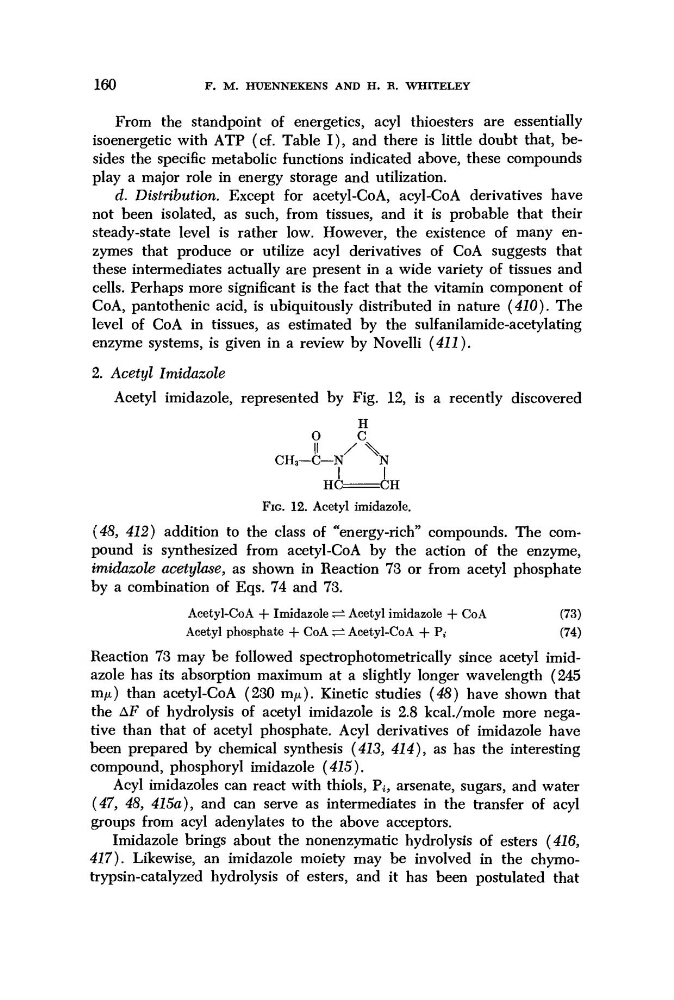
Acetyl imidazole, represented by Fig. 12, is a recently discovered
H
O
C
II /
\
CH 3 —C—N
N
HC
CH
FIG. 12. Acetyl imidazole.
(48, 412) addition to the class of "energy-rich" compounds. The compound is synthesized from acetyl-CoA by the action of the enzyme,
imidazole acetylase, as shown in Reaction 73 or from acetyl phosphate
by a combination of Eqs. 74 and 73.
Acetyl-CoA + Imidazole ;=± Acetyl imidazole + CoA
(73)
Acetyl phosphate + CoA ^± Acetyl-CoA -f P»
(74)
Reaction 73 may be followed spectrophotometrically since acetyl imidazole has its absorption maximum at a slightly longer wavelength (245
τημ) than acetyl-CoA (230 m^). Kinetic studies (48) have shown that
the AF of hydrolysis of acetyl imidazole is 2.8 kcal./mole more negative than that of acetyl phosphate. Acyl derivatives of imidazole have
been prepared by chemical synthesis (413, 414), as has the interesting
compound, phosphoryl imidazole (415).
Acyl imidazoles can react with thiols, Pi, arsenate, sugars, and water
(47, 48, 415a), and can serve as intermediates in the transfer of acyl
groups from acyl adenylates to the above acceptors.
Imidazole brings about the nonenzymatic hydrolysis of esters (416,
417). Likewise, an imidazole moiety may be involved in the chymotrypsin-catalyzed hydrolysis of esters, and it has been postulated that
F. M. HUENNEKENS AND H. R. WHITELEY
From the standpoint of energetics, acyl thioesters are essentially
isoenergetic with ATP (cf. Table I), and there is little doubt that, besides the specific metabolic functions indicated above, these compounds
play a major role in energy storage and utilization.
d. Distribution. Except for acetyl-CoA, acyl-CoA derivatives have
not been isolated, as such, from tissues, and it is probable that their
steady-state level is rather low. However, the existence of many enzymes that produce or utilize acyl derivatives of CoA suggests that
these intermediates actually are present in a wide variety of tissues and
cells. Perhaps more significant is the fact that the vitamin component of
CoA, pantothenic acid, is ubiquitously distributed in nature (410). The
level of CoA in tissues, as estimated by the sulfanilamide-acetylating
enzyme systems, is given in a review by Novelli (411).
2. Acetyl Imidazole
Acetyl imidazole, represented by Fig. 12, is a recently discovered
H
O
C
II /
\
CH 3 —C—N
N
HC
CH
FIG. 12. Acetyl imidazole.
(48, 412) addition to the class of "energy-rich" compounds. The compound is synthesized from acetyl-CoA by the action of the enzyme,
imidazole acetylase, as shown in Reaction 73 or from acetyl phosphate
by a combination of Eqs. 74 and 73.
Acetyl-CoA + Imidazole ;=± Acetyl imidazole + CoA
(73)
Acetyl phosphate + CoA ^± Acetyl-CoA -f P»
(74)
Reaction 73 may be followed spectrophotometrically since acetyl imidazole has its absorption maximum at a slightly longer wavelength (245
τημ) than acetyl-CoA (230 m^). Kinetic studies (48) have shown that
the AF of hydrolysis of acetyl imidazole is 2.8 kcal./mole more negative than that of acetyl phosphate. Acyl derivatives of imidazole have
been prepared by chemical synthesis (413, 414), as has the interesting
compound, phosphoryl imidazole (415).
Acyl imidazoles can react with thiols, Pi, arsenate, sugars, and water
(47, 48, 415a), and can serve as intermediates in the transfer of acyl
groups from acyl adenylates to the above acceptors.
Imidazole brings about the nonenzymatic hydrolysis of esters (416,
417). Likewise, an imidazole moiety may be involved in the chymotrypsin-catalyzed hydrolysis of esters, and it has been postulated that