

4. ENERGY-RICH COMPOUNDS
143
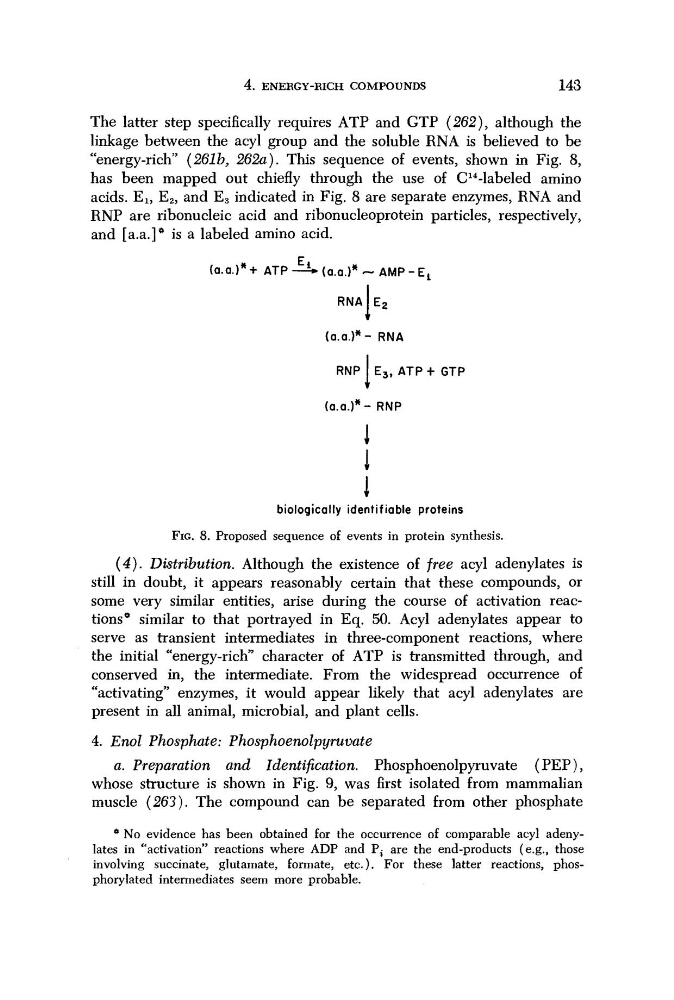
The latter step specifically requires ATP and GTP (262), although the
linkage between the acyl group and the soluble RNA is believed to be
"energy-rich" (261b, 262a). This sequence of events, shown in Fig. 8,
has been mapped out chiefly through the use of C
14 -labeled amino
acids. E l5 E 2 , and E 3 indicated in Fig. 8 are separate enzymes, RNA and
RNP are ribonucleic acid and ribonucleoprotein particles, respectively,
and [a.a.]* is a labeled amino acid.
(α.α.)* + ATP —^ (α.α.)* ~ AMP - E L
RNA|E 2
(α.α.)*- RNA
RNP I E 3 , ATP + GTP
(α.α.)*- RNP
1
i
1
biologically identifiable proteins
FIG. 8. Proposed sequence of events in protein synthesis.
(4). Distribution. Although the existence of free acyl adenylates is
still in doubt, it appears reasonably certain that these compounds, or
some very similar entities, arise during the course of activation reactions* similar to that portrayed in Eq. 50. Acyl adenylates appear to
serve as transient intermediates in three-component reactions, where
the initial "energy-rich" character of ATP is transmitted through, and
conserved in, the intermediate. From the widespread occurrence of
"activating" enzymes, it would appear likely that acyl adenylates are
present in all animal, microbial, and plant cells.
4. Enol Phosphate:
Phosphoenolpyruvate
a. Preparation and Identification.
Phosphoenolpyruvate (PEP),
whose structure is shown in Fig. 9, was first isolated from mammalian
muscle (263). The compound can be separated from other phosphate
* No evidence has been obtained for the occurrence of comparable acyl adenylates in "activation" reactions where ADP and P^ are the end-products (e.g., those
involving succinate, glutamate, formate, etc.). For these latter reactions, phosphorylated intermediates seem more probable.
143
The latter step specifically requires ATP and GTP (262), although the
linkage between the acyl group and the soluble RNA is believed to be
"energy-rich" (261b, 262a). This sequence of events, shown in Fig. 8,
has been mapped out chiefly through the use of C
14 -labeled amino
acids. E l5 E 2 , and E 3 indicated in Fig. 8 are separate enzymes, RNA and
RNP are ribonucleic acid and ribonucleoprotein particles, respectively,
and [a.a.]* is a labeled amino acid.
(α.α.)* + ATP —^ (α.α.)* ~ AMP - E L
RNA|E 2
(α.α.)*- RNA
RNP I E 3 , ATP + GTP
(α.α.)*- RNP
1
i
1
biologically identifiable proteins
FIG. 8. Proposed sequence of events in protein synthesis.
(4). Distribution. Although the existence of free acyl adenylates is
still in doubt, it appears reasonably certain that these compounds, or
some very similar entities, arise during the course of activation reactions* similar to that portrayed in Eq. 50. Acyl adenylates appear to
serve as transient intermediates in three-component reactions, where
the initial "energy-rich" character of ATP is transmitted through, and
conserved in, the intermediate. From the widespread occurrence of
"activating" enzymes, it would appear likely that acyl adenylates are
present in all animal, microbial, and plant cells.
4. Enol Phosphate:
Phosphoenolpyruvate
a. Preparation and Identification.
Phosphoenolpyruvate (PEP),
whose structure is shown in Fig. 9, was first isolated from mammalian
muscle (263). The compound can be separated from other phosphate
* No evidence has been obtained for the occurrence of comparable acyl adenylates in "activation" reactions where ADP and P^ are the end-products (e.g., those
involving succinate, glutamate, formate, etc.). For these latter reactions, phosphorylated intermediates seem more probable.