

144
F. M. HUENNEKENS AND H. R. WHITELEY
esters and identified by chromatography on paper (264, 265) or on ion
exchange resins (266). Chemical synthesis of PEP may be achieved by
phosphorylation of pyruvate in quinoline with POCl 3 (267-270), or by
phosphorylation of ß-chlorolactate in dimethylaniline with POCl 3 , followed by addition of alcoholic KOH (271, 272). In either synthesis,
CH 2 O
i-O-i-OH
COOH OH
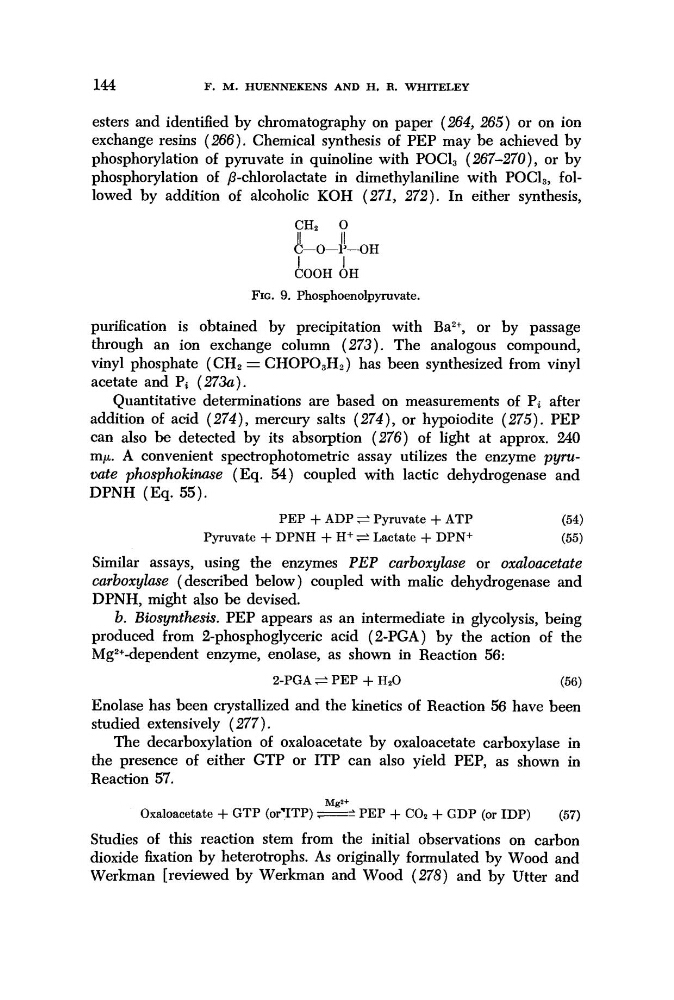
FIG. 9. Phosphoenolpyruvate.
purification is obtained by precipitation with Ba
2+ , or by passage
through an ion exchange column (273). The analogous compound,
vinyl phosphate (CH 2 = CHOP0 3 H 2 ) has been synthesized from vinyl
acetate and Pi (273a).
Quantitative determinations are based on measurements of Pi after
addition of acid (274), mercury salts (274), or hypoiodite (275). PEP
can also be detected by its absorption (276) of light at approx. 240
τημ. A convenient spectrophotometric assay utilizes the enzyme pyruvate phosphokinase (Eq. 54) coupled with lactic dehydrogenase and
DPNH (Eq. 55).
PEP + ADP ^± Pyruvate + ATP
(54)
Pyruvate + DPNH + H
+ ^ Lactate + DPN+
(55)
Similar assays, using the enzymes PEP carboxylase or oxaloacetate
carboxylase (described below) coupled with malic dehydrogenase and
DPNH, might also be devised.
b. Biosynthesis. PEP appears as an intermediate in glycolysis, being
produced from 2-phosphoglyceric acid (2-PGA) by the action of the
Mg
2+ -dependent enzyme, enolase, as shown in Reaction 56:
2-PGA ;=± PEP + H 2 0
(56)
Enolase has been crystallized and the kinetics of Reaction 56 have been
studied extensively (277).
The decarboxylation of oxaloacetate by oxaloacetate carboxylase in
the presence of either GTP or ITP can also yield PEP, as shown in
Reaction 57.
Mg2+
Oxaloacetate + GTP (ΟΓΊΤΡ) ;=± PEP + C0 2 + GDP (or IDP)
(57)
Studies of this reaction stem from the initial observations on carbon
dioxide fixation by heterotrophs. As originally formulated by Wood and
Werkman [reviewed by Werkman and Wood (278) and by Utter and
F. M. HUENNEKENS AND H. R. WHITELEY
esters and identified by chromatography on paper (264, 265) or on ion
exchange resins (266). Chemical synthesis of PEP may be achieved by
phosphorylation of pyruvate in quinoline with POCl 3 (267-270), or by
phosphorylation of ß-chlorolactate in dimethylaniline with POCl 3 , followed by addition of alcoholic KOH (271, 272). In either synthesis,
CH 2 O
i-O-i-OH
COOH OH
FIG. 9. Phosphoenolpyruvate.
purification is obtained by precipitation with Ba
2+ , or by passage
through an ion exchange column (273). The analogous compound,
vinyl phosphate (CH 2 = CHOP0 3 H 2 ) has been synthesized from vinyl
acetate and Pi (273a).
Quantitative determinations are based on measurements of Pi after
addition of acid (274), mercury salts (274), or hypoiodite (275). PEP
can also be detected by its absorption (276) of light at approx. 240
τημ. A convenient spectrophotometric assay utilizes the enzyme pyruvate phosphokinase (Eq. 54) coupled with lactic dehydrogenase and
DPNH (Eq. 55).
PEP + ADP ^± Pyruvate + ATP
(54)
Pyruvate + DPNH + H
+ ^ Lactate + DPN+
(55)
Similar assays, using the enzymes PEP carboxylase or oxaloacetate
carboxylase (described below) coupled with malic dehydrogenase and
DPNH, might also be devised.
b. Biosynthesis. PEP appears as an intermediate in glycolysis, being
produced from 2-phosphoglyceric acid (2-PGA) by the action of the
Mg
2+ -dependent enzyme, enolase, as shown in Reaction 56:
2-PGA ;=± PEP + H 2 0
(56)
Enolase has been crystallized and the kinetics of Reaction 56 have been
studied extensively (277).
The decarboxylation of oxaloacetate by oxaloacetate carboxylase in
the presence of either GTP or ITP can also yield PEP, as shown in
Reaction 57.
Mg2+
Oxaloacetate + GTP (ΟΓΊΤΡ) ;=± PEP + C0 2 + GDP (or IDP)
(57)
Studies of this reaction stem from the initial observations on carbon
dioxide fixation by heterotrophs. As originally formulated by Wood and
Werkman [reviewed by Werkman and Wood (278) and by Utter and