

142
F. M. HUENNEKENS AND H. R. WHITELEY
ß-alanine to give pantothenate (234), ß-alanyl-AMP reacts with histidine to yield carnosine (245), and "active sulfate" may be transferred
to phenols, steriods, hexosamines, galactose, etc., (232, 232a).
It should be noted that "active sulfate" (PAPS, below) is formed in
two steps, i.e.,
S0 4
2 ~ + ATP ^± Adenosine-5'-phosphosulfate (APS) + PP
(52a)
APS + ATP ^ 3'-Phosphoadenosine-5'-phosphosulfate (PAPS) + ADP (52b)
The properties of the enzyme, ATP sulfurylase, which mediates Reaction 52a have been determined, and the enzyme has been partially
purified (44c, 229b). APS has also been synthesized chemically (245a,
b). In addition to being transferred to the acceptors listed above, PAPS
(and also APS) has been implicated as an intermediate in the enzymatic
reduction of sulfate (245c-245e).
(3). Function. The role of acetyl-AMP in acetate activation has
been indicated above; other acyl adenylates may be formed in similar
reactions. Special mention should be made of the role of amino acyl
adenylates in protein synthesis. Amino acid activating systems were
first encountered in extracts of rat liver (220, 243), bacteria (221), and
yeast (222). Subsequent investigation revealed the widespread distribution of these systems in many bacteria (237, 246-248b), vertebrate
tissues (239, 249-252), invertebrate tissues (253), yeast (254), molds
(247), plants (247, 252, 255), and protozoa (256). The "activation" of
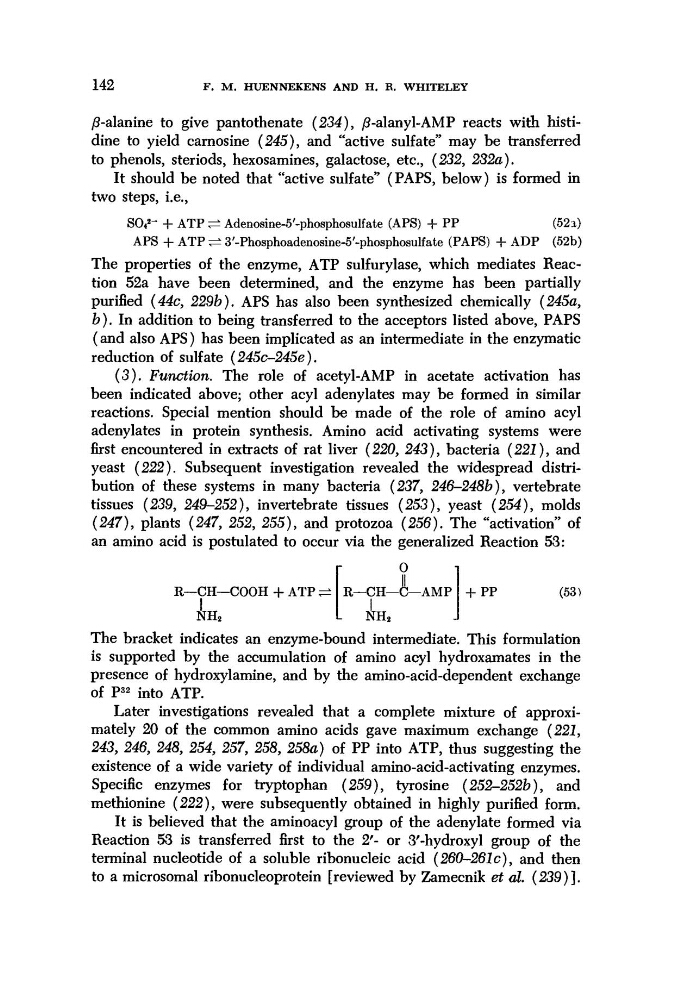
an amino acid is postulated to occur via the generalized Reaction 53:
R—CH—COOH + ATP ^
NH 2
O
R—CH—C—AMP
I
NH 2
+ PP
(53)
The bracket indicates an enzyme-bound intermediate. This formulation
is supported by the accumulation of amino acyl hydroxamates in the
presence of hydroxylamine, and by the amino-acid-dependent exchange
of P
32 into ATP.
Later investigations revealed that a complete mixture of approximately 20 of the common amino acids gave maximum exchange (221,
243, 246, 248, 254, 257, 258, 258a) of PP into ATP, thus suggesting the
existence of a wide variety of individual amino-acid-activating enzymes.
Specific enzymes for tryptophan (259), tyrosine (252-252b),
and
methionine (222), were subsequently obtained in highly purified form.
It is believed that the aminoacyl group of the adenylate formed via
Reaction 53 is transferred first to the 2'- or 3'-hydroxyl group of the
terminal nucleotide of a soluble ribonucleic acid (260-261c), and then
to a microsomal ribonucleoprotein [reviewed by Zamecnik et al. (239)].
F. M. HUENNEKENS AND H. R. WHITELEY
ß-alanine to give pantothenate (234), ß-alanyl-AMP reacts with histidine to yield carnosine (245), and "active sulfate" may be transferred
to phenols, steriods, hexosamines, galactose, etc., (232, 232a).
It should be noted that "active sulfate" (PAPS, below) is formed in
two steps, i.e.,
S0 4
2 ~ + ATP ^± Adenosine-5'-phosphosulfate (APS) + PP
(52a)
APS + ATP ^ 3'-Phosphoadenosine-5'-phosphosulfate (PAPS) + ADP (52b)
The properties of the enzyme, ATP sulfurylase, which mediates Reaction 52a have been determined, and the enzyme has been partially
purified (44c, 229b). APS has also been synthesized chemically (245a,
b). In addition to being transferred to the acceptors listed above, PAPS
(and also APS) has been implicated as an intermediate in the enzymatic
reduction of sulfate (245c-245e).
(3). Function. The role of acetyl-AMP in acetate activation has
been indicated above; other acyl adenylates may be formed in similar
reactions. Special mention should be made of the role of amino acyl
adenylates in protein synthesis. Amino acid activating systems were
first encountered in extracts of rat liver (220, 243), bacteria (221), and
yeast (222). Subsequent investigation revealed the widespread distribution of these systems in many bacteria (237, 246-248b), vertebrate
tissues (239, 249-252), invertebrate tissues (253), yeast (254), molds
(247), plants (247, 252, 255), and protozoa (256). The "activation" of
an amino acid is postulated to occur via the generalized Reaction 53:
R—CH—COOH + ATP ^
NH 2
O
R—CH—C—AMP
I
NH 2
+ PP
(53)
The bracket indicates an enzyme-bound intermediate. This formulation
is supported by the accumulation of amino acyl hydroxamates in the
presence of hydroxylamine, and by the amino-acid-dependent exchange
of P
32 into ATP.
Later investigations revealed that a complete mixture of approximately 20 of the common amino acids gave maximum exchange (221,
243, 246, 248, 254, 257, 258, 258a) of PP into ATP, thus suggesting the
existence of a wide variety of individual amino-acid-activating enzymes.
Specific enzymes for tryptophan (259), tyrosine (252-252b),
and
methionine (222), were subsequently obtained in highly purified form.
It is believed that the aminoacyl group of the adenylate formed via
Reaction 53 is transferred first to the 2'- or 3'-hydroxyl group of the
terminal nucleotide of a soluble ribonucleic acid (260-261c), and then
to a microsomal ribonucleoprotein [reviewed by Zamecnik et al. (239)].