

100
P. K. STUMPF AND G. A. BARBER
For example, Penicillium glaucum, Aspergillus niger, and A. fumigatus,
when incubated with the indicated substrates, give some of the methyl
ketones shown in the tabulation.
BREAKDOWN OF FATTY ACIDS TO CORRESPONDING METHYL KETONES BY MOLDS
Fatty acids
Methyl ketones
Butyric acid (C 4 )
Acetone
Isovaleric acid (C 6 )
Acetone
Valeric acid (C5)
Methylethylketone
Caproic acid (C 6 )
Methylpropylketone
Heptanoic acid (C7)
Methylbutylketone
Caprylic acid (C 8 )
Methylamylketone
Pelargonie acid (C9)
Methylhexylketone
Capric acid (C10)
Methylheptylketone
Undecylic acid (Cn)
Methyloctylketone
Laurie acid (C12)
Methylnonylketone
Myristic acid (C14)
Methylundecylketone
In the course of the original observations of methyl ketone formation
(74) a carbon-chain length optimum of C 8 to Ci 2 in the fatty acid substrate was indicated. It was discovered later, however, that the optimum
chain length is influenced by the strain used and also by the conditions
of growth (74). Recently (75) it has been shown that mycelial suspensions of Penicillium roqueforti can produce methyl ketones from fatty
acids with from 4- to 12-carbon chains. The longer fatty acids, palmitic,
stearic, and oleic, have never been found to be active substrates in
these fungi. These acids tend to exert toxic effects on the organism.
Very little is known as yet about the intermediates of these reactions
or of the enzymes involved. β-Unsaturated and ß-hydroxy fatty acids
serve as substrates for methyl ketone formation in Penicillium glaucum
(74), suggesting their participation in the oxidative process. Mukherjee
(76) using growing cultures and mycelial suspensions of an Aspergillus
species found that butyric, crotonic, and ß-hydroxy butyric acids supplied as substrates gave rise to acetoacetate or acetone. Butyric acid
also yields a small amount of crotonic and /?-hydroxy butyric acids. In
the presence of HCN the oxidation of substrate crotonic acid was inhibited completely, butyrate was inhibited 46%, and the oxidation of
ß-hydroxy butyrate was not inhibited at all. In addition, HCN enhanced
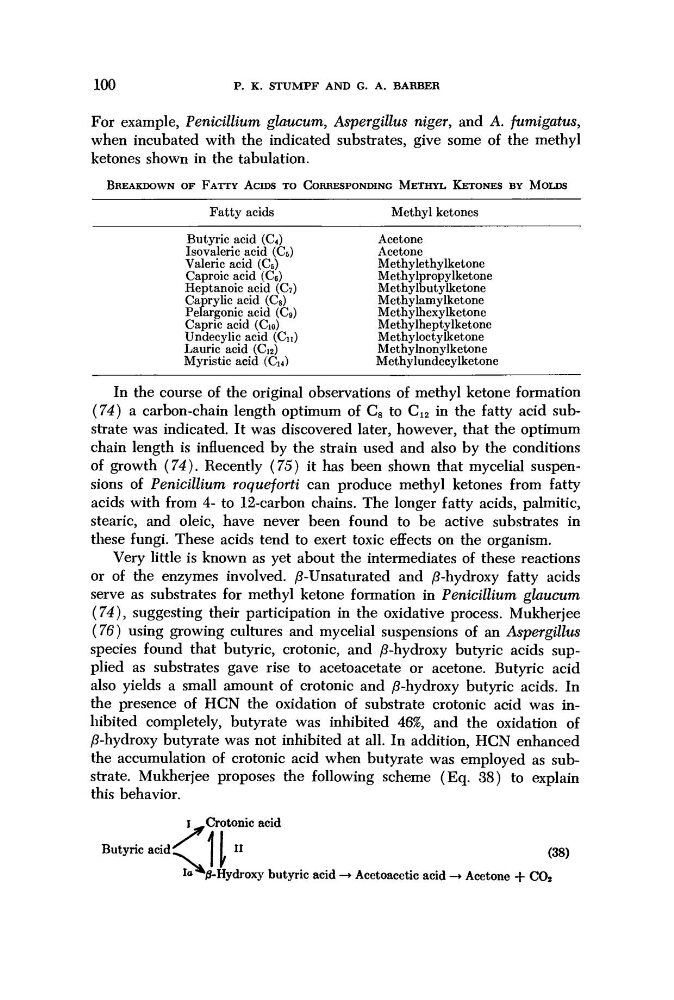
the accumulation of crotonic acid when butyrate was employed as substrate. Mukherjee proposes the following scheme (Eq. 38) to explain
this behavior.
I _ Crotonic acid
Butyric acid^
I I Π
φφ
Ιβ ^/3-Hydroxy butyric acid -* Acetoacetic acid —> Acetone -f- C0 2
P. K. STUMPF AND G. A. BARBER
For example, Penicillium glaucum, Aspergillus niger, and A. fumigatus,
when incubated with the indicated substrates, give some of the methyl
ketones shown in the tabulation.
BREAKDOWN OF FATTY ACIDS TO CORRESPONDING METHYL KETONES BY MOLDS
Fatty acids
Methyl ketones
Butyric acid (C 4 )
Acetone
Isovaleric acid (C 6 )
Acetone
Valeric acid (C5)
Methylethylketone
Caproic acid (C 6 )
Methylpropylketone
Heptanoic acid (C7)
Methylbutylketone
Caprylic acid (C 8 )
Methylamylketone
Pelargonie acid (C9)
Methylhexylketone
Capric acid (C10)
Methylheptylketone
Undecylic acid (Cn)
Methyloctylketone
Laurie acid (C12)
Methylnonylketone
Myristic acid (C14)
Methylundecylketone
In the course of the original observations of methyl ketone formation
(74) a carbon-chain length optimum of C 8 to Ci 2 in the fatty acid substrate was indicated. It was discovered later, however, that the optimum
chain length is influenced by the strain used and also by the conditions
of growth (74). Recently (75) it has been shown that mycelial suspensions of Penicillium roqueforti can produce methyl ketones from fatty
acids with from 4- to 12-carbon chains. The longer fatty acids, palmitic,
stearic, and oleic, have never been found to be active substrates in
these fungi. These acids tend to exert toxic effects on the organism.
Very little is known as yet about the intermediates of these reactions
or of the enzymes involved. β-Unsaturated and ß-hydroxy fatty acids
serve as substrates for methyl ketone formation in Penicillium glaucum
(74), suggesting their participation in the oxidative process. Mukherjee
(76) using growing cultures and mycelial suspensions of an Aspergillus
species found that butyric, crotonic, and ß-hydroxy butyric acids supplied as substrates gave rise to acetoacetate or acetone. Butyric acid
also yields a small amount of crotonic and /?-hydroxy butyric acids. In
the presence of HCN the oxidation of substrate crotonic acid was inhibited completely, butyrate was inhibited 46%, and the oxidation of
ß-hydroxy butyrate was not inhibited at all. In addition, HCN enhanced
the accumulation of crotonic acid when butyrate was employed as substrate. Mukherjee proposes the following scheme (Eq. 38) to explain
this behavior.
I _ Crotonic acid
Butyric acid^
I I Π
φφ
Ιβ ^/3-Hydroxy butyric acid -* Acetoacetic acid —> Acetone -f- C0 2