

3. MECHANISMS FOR FATTY ACID OXIDATION
101
Reaction la (in Eq. 38) is without analogy. Most probably CoA-Sderivatives of these compounds are involved in the system. The interpretation given to the results is therefore in question, since only the
free acids have been tested as substrates.
Recently Byrde and associates (77) supplied ω-(2-naphthoxy) fatty
acid substrates to mycelial mats of Aspergillus niger. The nature of the
oxidation products separated by paper chromatography indicated the
substituted fatty acids had been degraded by oxidation at the β position.
In the course of this oxidation an OH group was also formed at position
6 of the molecule:
O—(CH 2 ) COOH
D. HIGHER PLANTS AND ANIMAL TISSUES
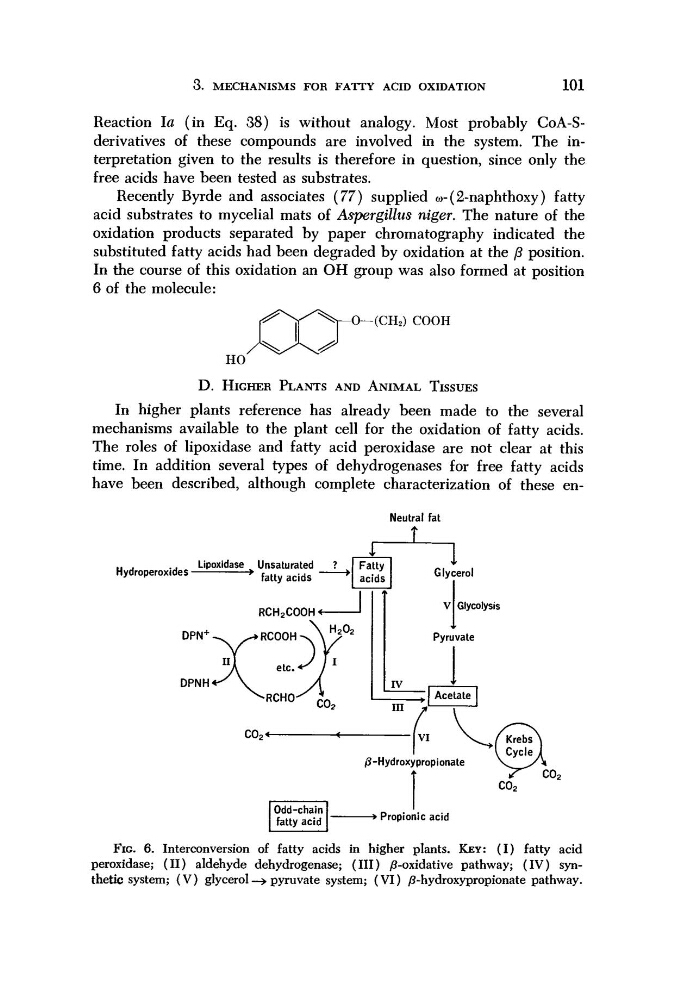
In higher plants reference has already been made to the several
mechanisms available to the plant cell for the oxidation of fatty acids.
The roles of lipoxidase and fatty acid peroxidase are not clear at this
time. In addition several types of dehydrogenases for free fatty acids
have been described, although complete characterization of these en,, .
..
Lipoxidase Unsaturated
Hydroperox.des
> fatty acids
DPN
4
DPNH
RCH2C00H<
\ H 2 0
RCOOH-χλ } '
Κ
ΊΟΟΟΗ N\ ;
C02
-> Propionic acid
FIG. 6. Interconversion of fatty acids in higher plants. KEY: (I) fatty acid
peroxidase; (II) aldehyde dehydrogenase; (III) /?-oxidative pathway; (IV) synthetic system; (V) glycerol —> pyruvate system; (VI) /?-hydroxypropionate pathway.
101
Reaction la (in Eq. 38) is without analogy. Most probably CoA-Sderivatives of these compounds are involved in the system. The interpretation given to the results is therefore in question, since only the
free acids have been tested as substrates.
Recently Byrde and associates (77) supplied ω-(2-naphthoxy) fatty
acid substrates to mycelial mats of Aspergillus niger. The nature of the
oxidation products separated by paper chromatography indicated the
substituted fatty acids had been degraded by oxidation at the β position.
In the course of this oxidation an OH group was also formed at position
6 of the molecule:
O—(CH 2 ) COOH
D. HIGHER PLANTS AND ANIMAL TISSUES
In higher plants reference has already been made to the several
mechanisms available to the plant cell for the oxidation of fatty acids.
The roles of lipoxidase and fatty acid peroxidase are not clear at this
time. In addition several types of dehydrogenases for free fatty acids
have been described, although complete characterization of these en,, .
..
Lipoxidase Unsaturated
Hydroperox.des
> fatty acids
DPN
4
DPNH
RCH2C00H<
\ H 2 0
RCOOH-χλ } '
Κ
ΊΟΟΟΗ N\ ;
C02
-> Propionic acid
FIG. 6. Interconversion of fatty acids in higher plants. KEY: (I) fatty acid
peroxidase; (II) aldehyde dehydrogenase; (III) /?-oxidative pathway; (IV) synthetic system; (V) glycerol —> pyruvate system; (VI) /?-hydroxypropionate pathway.