

88
P. K. STUMPF AND G. A. BARBER
per minute per 100,000 gm. of enzyme at pH 7 and 25°. For the reduction of acetoacetyl-CoA the optimum pH is 6-7; for the oxidation
of L( + )-ß-hydroxybutyryl-CoA pH 9.6. At the respective pH optima,
reduction of acetoacetyl CoA is five times that of the oxidation of ßhydroxybutyryl-CoA. At pH 7 the ratio is 18:1; at 9.6, 1:2.7. The enzyme has a rather broad specificity for substrates. The D( — ) isomers
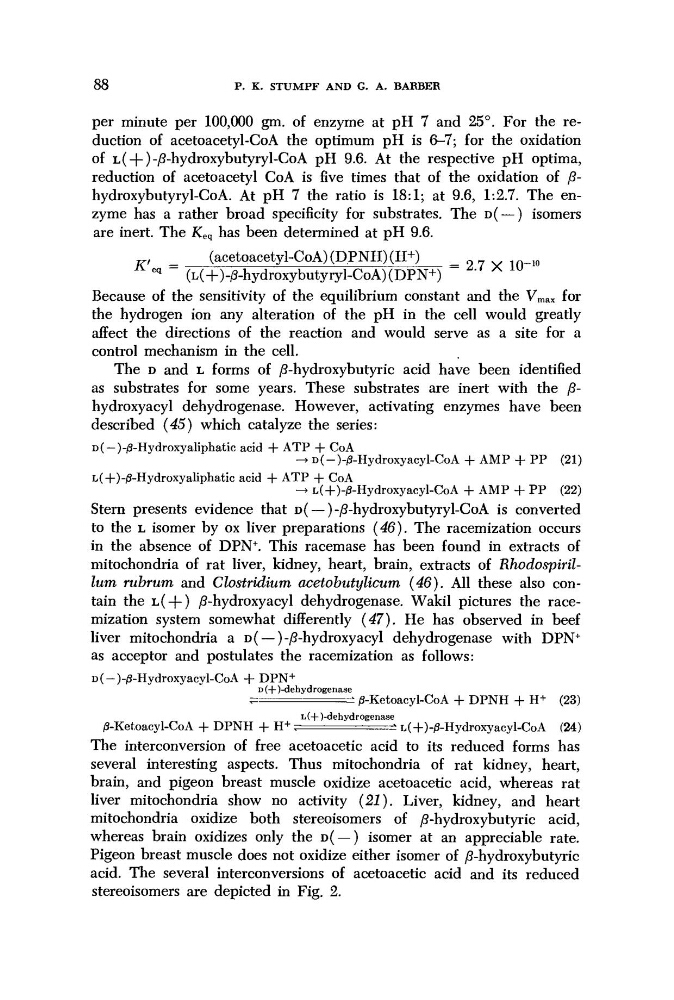
are inert. The K eq has been determined at pH 9.6.
K , =
(acetoacetyl-CoA) (D.PNH) (H+)
eq
(L(+)i8-hydroxybutyryl-CoA)(DPN+)
Because of the sensitivity of the equilibrium constant and the V max for
the hydrogen ion any alteration of the pH in the cell would greatly
affect the directions of the reaction and would serve as a site for a
control mechanism in the cell.
The D and L forms of ß-hydroxybutyric acid have been identified
as substrates for some years. These substrates are inert with the ßhydroxyacyl dehydrogenase. However, activating enzymes have been
described (45) which catalyze the series:
D( —)-/3-Hydroxyaliphatic acid + ATP + CoA
-> D(-)-/?-Hydroxyacyl-CoA + AMP + PP (21)
L(+)-jS-Hydroxyaliphatic acid + ATP + CoA
-* L(+)-,3-Hydroxyacyl-CoA + AMP + PP (22)
Stern presents evidence that D( —) -ß-hydroxybutyryl-CoA is converted
to the L isomer by ox liver preparations (46). The racemization occurs
in the absence of DPN
+ . This racemase has been found in extracts of
mitochondria of rat liver, kidney, heart, brain, extracts of Rhodospirillum rubrum and Clostridium acetobutylicum (46). All these also contain the L( + ) ß-hydroxyacyl dehydrogenase. Wakil pictures the racemization system somewhat diiferently (47). He has observed in beef
liver mitochondria a D( — )-/Mrydroxyacyl dehydrogenase with DPN
+
as acceptor and postulates the racemization as follows:
D(-)-/3-Hydroxyacyl-CoA + DPN+
D (+ )-dehydrogenase
;=
- /3-Ketoacyl-CoA + DPNH + H
+
(23)
L (+ )-dehydrogenase
0-Ketoacyl-CoA + DPNH + H+ r
=± L(+)-/3-Hydroxyacyl-CoA (24)
The interconversion of free acetoacetic acid to its reduced forms has
several interesting aspects. Thus mitochondria of rat kidney, heart,
brain, and pigeon breast muscle oxidize acetoacetic acid, whereas rat
liver mitochondria show no activity (21). Liver, kidney, and heart
mitochondria oxidize both stereoisomers of ß-hydroxybutyric acid,
whereas brain oxidizes only the D( — ) isomer at an appreciable rate.
Pigeon breast muscle does not oxidize either isomer of ß-hydroxybutyric
acid. The several interconversions of acetoacetic acid and its reduced
stereoisomers are depicted in Fig. 2.
P. K. STUMPF AND G. A. BARBER
per minute per 100,000 gm. of enzyme at pH 7 and 25°. For the reduction of acetoacetyl-CoA the optimum pH is 6-7; for the oxidation
of L( + )-ß-hydroxybutyryl-CoA pH 9.6. At the respective pH optima,
reduction of acetoacetyl CoA is five times that of the oxidation of ßhydroxybutyryl-CoA. At pH 7 the ratio is 18:1; at 9.6, 1:2.7. The enzyme has a rather broad specificity for substrates. The D( — ) isomers
are inert. The K eq has been determined at pH 9.6.
K , =
(acetoacetyl-CoA) (D.PNH) (H+)
eq
(L(+)i8-hydroxybutyryl-CoA)(DPN+)
Because of the sensitivity of the equilibrium constant and the V max for
the hydrogen ion any alteration of the pH in the cell would greatly
affect the directions of the reaction and would serve as a site for a
control mechanism in the cell.
The D and L forms of ß-hydroxybutyric acid have been identified
as substrates for some years. These substrates are inert with the ßhydroxyacyl dehydrogenase. However, activating enzymes have been
described (45) which catalyze the series:
D( —)-/3-Hydroxyaliphatic acid + ATP + CoA
-> D(-)-/?-Hydroxyacyl-CoA + AMP + PP (21)
L(+)-jS-Hydroxyaliphatic acid + ATP + CoA
-* L(+)-,3-Hydroxyacyl-CoA + AMP + PP (22)
Stern presents evidence that D( —) -ß-hydroxybutyryl-CoA is converted
to the L isomer by ox liver preparations (46). The racemization occurs
in the absence of DPN
+ . This racemase has been found in extracts of
mitochondria of rat liver, kidney, heart, brain, extracts of Rhodospirillum rubrum and Clostridium acetobutylicum (46). All these also contain the L( + ) ß-hydroxyacyl dehydrogenase. Wakil pictures the racemization system somewhat diiferently (47). He has observed in beef
liver mitochondria a D( — )-/Mrydroxyacyl dehydrogenase with DPN
+
as acceptor and postulates the racemization as follows:
D(-)-/3-Hydroxyacyl-CoA + DPN+
D (+ )-dehydrogenase
;=
- /3-Ketoacyl-CoA + DPNH + H
+
(23)
L (+ )-dehydrogenase
0-Ketoacyl-CoA + DPNH + H+ r
=± L(+)-/3-Hydroxyacyl-CoA (24)
The interconversion of free acetoacetic acid to its reduced forms has
several interesting aspects. Thus mitochondria of rat kidney, heart,
brain, and pigeon breast muscle oxidize acetoacetic acid, whereas rat
liver mitochondria show no activity (21). Liver, kidney, and heart
mitochondria oxidize both stereoisomers of ß-hydroxybutyric acid,
whereas brain oxidizes only the D( — ) isomer at an appreciable rate.
Pigeon breast muscle does not oxidize either isomer of ß-hydroxybutyric
acid. The several interconversions of acetoacetic acid and its reduced
stereoisomers are depicted in Fig. 2.