

3. MECHANISMS FOR FATTY ACID OXIDATION
87
Further evidence based on nuclear magnetic resonance measurements
suggests that the addition of water to the ethylenic bond is from a eis
position or from the same side, presumably from the side nearest the
protein, since addition is under stereochemical control (41).
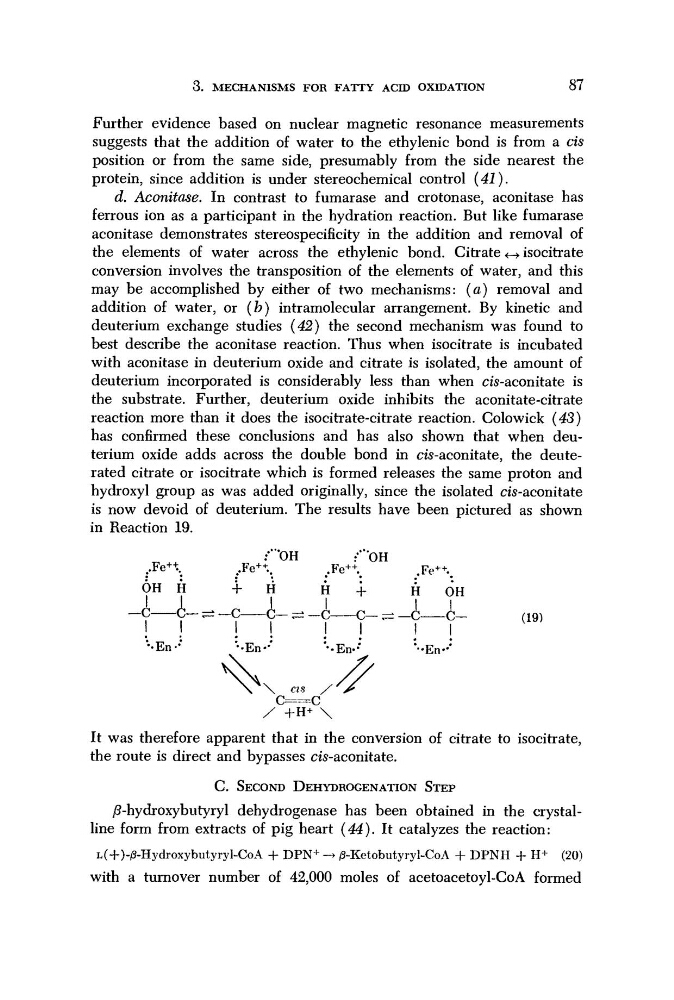
d. Aconitase. In contrast to fumarase and crotonase, aconitase has
ferrous ion as a participant in the hydration reaction. But like fumarase
aconitase demonstrates stereospecificity in the addition and removal of
the elements of water across the ethylenic bond. Citrate <_> isocitrate
conversion involves the transposition of the elements of water, and this
may be accomplished by either of two mechanisms: (a) removal and
addition of water, or (b) intramolecular arrangement. By kinetic and
deuterium exchange studies (42) the second mechanism was found to
best describe the aconitase reaction. Thus when isocitrate is incubated
with aconitase in deuterium oxide and citrate is isolated, the amount of
deuterium incorporated is considerably less than when ds-aconitate is
the substrate. Further, deuterium oxide inhibits the aconitate-citrate
reaction more than it does the isocitrate-citrate reaction. Colowick (43)
has confirmed these conclusions and has also shown that when deuterium oxide adds across the double bond in cis-aconitate, the deuterated citrate or isocitrate which is formed releases the same proton and
hydroxyl group as was added originally, since the isolated cis-aconitate
is now devoid of deuterium. The results have been pictured as shown
in Reaction 19.
.•'"'OH
/"OH
..Fe
+ \
/
Fe++ ·.
.Fe
+ \
4H
H
+
H OH
~!~H"H"
=H"
a
"
"••En··"
"••En··*
: -En-'"
\^\
CIS
/'/
/ +H+ \
It was therefore apparent that in the conversion of citrate to isocitrate,
the route is direct and bypasses cis-aconitate.
C. SECOND DEHYDROGENATION STEP
β-hydroxybutyryl dehydrogenase has been obtained in the crystalline form from extracts of pig heart (44). It catalyzes the reaction:
L(+)-/?-Hydroxybutyryl-CoA + DPN+ -> 0-Ketobutyryl-CoA + DPNH + H+ (20)
with a turnover number of 42,000 moles of acetoacetoyl-CoA formed
..Fen
OH H
•Εη·
;
87
Further evidence based on nuclear magnetic resonance measurements
suggests that the addition of water to the ethylenic bond is from a eis
position or from the same side, presumably from the side nearest the
protein, since addition is under stereochemical control (41).
d. Aconitase. In contrast to fumarase and crotonase, aconitase has
ferrous ion as a participant in the hydration reaction. But like fumarase
aconitase demonstrates stereospecificity in the addition and removal of
the elements of water across the ethylenic bond. Citrate <_> isocitrate
conversion involves the transposition of the elements of water, and this
may be accomplished by either of two mechanisms: (a) removal and
addition of water, or (b) intramolecular arrangement. By kinetic and
deuterium exchange studies (42) the second mechanism was found to
best describe the aconitase reaction. Thus when isocitrate is incubated
with aconitase in deuterium oxide and citrate is isolated, the amount of
deuterium incorporated is considerably less than when ds-aconitate is
the substrate. Further, deuterium oxide inhibits the aconitate-citrate
reaction more than it does the isocitrate-citrate reaction. Colowick (43)
has confirmed these conclusions and has also shown that when deuterium oxide adds across the double bond in cis-aconitate, the deuterated citrate or isocitrate which is formed releases the same proton and
hydroxyl group as was added originally, since the isolated cis-aconitate
is now devoid of deuterium. The results have been pictured as shown
in Reaction 19.
.•'"'OH
/"OH
..Fe
+ \
/
Fe++ ·.
.Fe
+ \
4H
H
+
H OH
~!~H"H"
=H"
a
"
"••En··"
"••En··*
: -En-'"
\^\
CIS
/'/
/ +H+ \
It was therefore apparent that in the conversion of citrate to isocitrate,
the route is direct and bypasses cis-aconitate.
C. SECOND DEHYDROGENATION STEP
β-hydroxybutyryl dehydrogenase has been obtained in the crystalline form from extracts of pig heart (44). It catalyzes the reaction:
L(+)-/?-Hydroxybutyryl-CoA + DPN+ -> 0-Ketobutyryl-CoA + DPNH + H+ (20)
with a turnover number of 42,000 moles of acetoacetoyl-CoA formed
..Fen
OH H
•Εη·
;