

300
LIONEL F. JAFFE
THALLUS
i
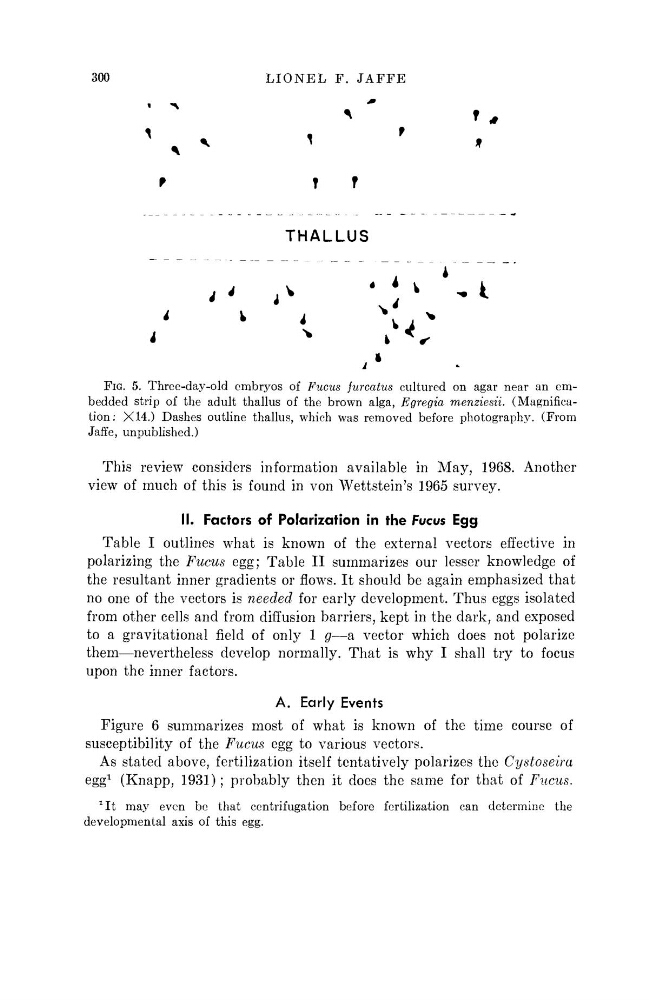
FIG. 5. Three-day-old embryos of Fucus jurcatus cultured on agar near an embedded strip of the adult thallus of the brown alga, Egregia menziesii. (Magnification: X14.) Dashes outline thallus, which was removed before photography. (From
Jaffe, unpublished.)
This review considers information available in May, 1968. Another
view of much of this is found in von Wettstein's 1965 survey.
II. Factors of Polarization in the Fucus Egg
Table I outlines what is known of the external vectors effective in
polarizing the Fucus egg; Table II summarizes our lesser knowledge of
the resultant inner gradients or flows. It should be again emphasized that
no one of the vectors is needed for early development. Thus eggs isolated
from other cells and from diffusion barriers, kept in the dark, and exposed
to a gravitational field of only 1 g—a vector which does not polarize
them—nevertheless develop normally. That is why I shall try to focus
upon the inner factors.
A. Early Events
Figure 6 summarizes most of what is known of the time course of
susceptibility of the Fucus egg to various vectors.
As stated above, fertilization itself tentatively polarizes the Cystoseira
egg
1
(Knapp, 1931); probably then it does the same for that of Fucus.
*It may even be that centrifugation before fertilization can determine the
developmental axis of this egg.
LIONEL F. JAFFE
THALLUS
i
FIG. 5. Three-day-old embryos of Fucus jurcatus cultured on agar near an embedded strip of the adult thallus of the brown alga, Egregia menziesii. (Magnification: X14.) Dashes outline thallus, which was removed before photography. (From
Jaffe, unpublished.)
This review considers information available in May, 1968. Another
view of much of this is found in von Wettstein's 1965 survey.
II. Factors of Polarization in the Fucus Egg
Table I outlines what is known of the external vectors effective in
polarizing the Fucus egg; Table II summarizes our lesser knowledge of
the resultant inner gradients or flows. It should be again emphasized that
no one of the vectors is needed for early development. Thus eggs isolated
from other cells and from diffusion barriers, kept in the dark, and exposed
to a gravitational field of only 1 g—a vector which does not polarize
them—nevertheless develop normally. That is why I shall try to focus
upon the inner factors.
A. Early Events
Figure 6 summarizes most of what is known of the time course of
susceptibility of the Fucus egg to various vectors.
As stated above, fertilization itself tentatively polarizes the Cystoseira
egg
1
(Knapp, 1931); probably then it does the same for that of Fucus.
*It may even be that centrifugation before fertilization can determine the
developmental axis of this egg.