

2 9 8
L I O N E L F . J A F F E
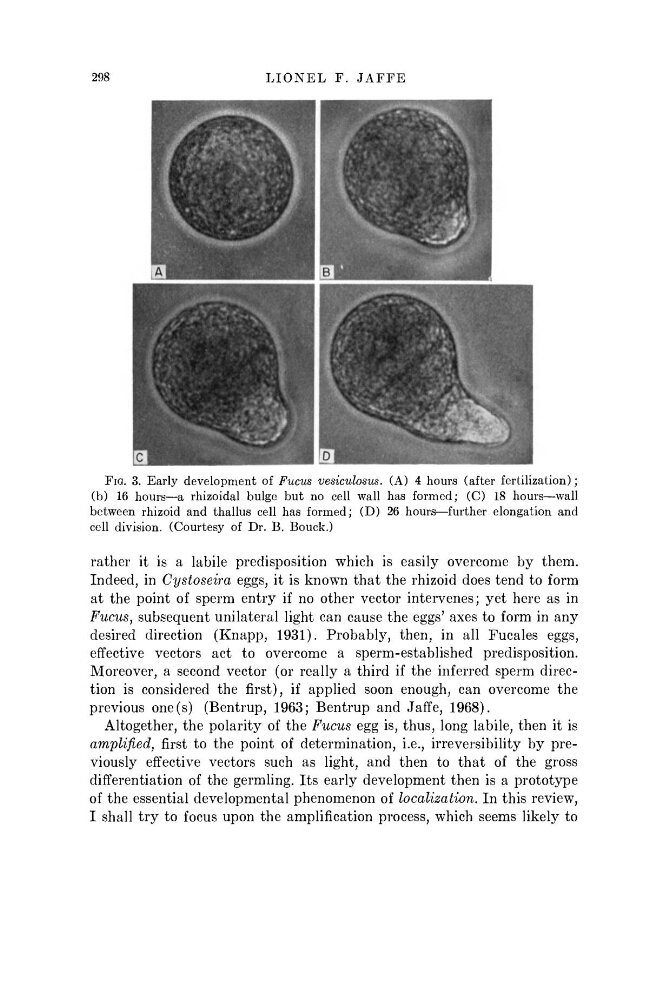
FIG. 3 . Early development of Fucus vesiculosus. ( A ) 4 hours (after fertilization);
(b) 1 6 hours—a rhizoidal bulge but no cell wall has formed; ( C ) 1 8 hours—wall
between rhizoid and thallus cell has formed; ( D ) 2 6 hours—further elongation and
cell division. (Courtesy of Dr. B. Bouck.)
rather it is a labile predisposition which is easily overcome b y them.
Indeed, in Cystoseira eggs, it is known that the rhizoid does tend to form
at the point of sperm entry if no other vector intervenes; yet here as in
Fucus, subsequent unilateral light can cause the eggs' axes to form in any
desired direction (Knapp, 1931). Probably, then, in all Fucales eggs,
effective vectors act to overcome a sperm-established predisposition.
Moreover, a second vector (or really a third if the inferred sperm direction is considered the first), if applied soon enough, can overcome the
previous one(s) (Bentrup, 1963; Bentrup and Jaffe, 1968).
Altogether, the polarity of the Fucus egg is, thus, long labile, then it is
amplified, first to the point of determination, i.e., irreversibility b y previously effective vectors such as light, and then to that of the gross
differentiation of the germling. Its early development then is a prototype
of the essential developmental phenomenon of localization. In this review,
I shall try to focus upon the amplification process, which seems likely to
L I O N E L F . J A F F E
FIG. 3 . Early development of Fucus vesiculosus. ( A ) 4 hours (after fertilization);
(b) 1 6 hours—a rhizoidal bulge but no cell wall has formed; ( C ) 1 8 hours—wall
between rhizoid and thallus cell has formed; ( D ) 2 6 hours—further elongation and
cell division. (Courtesy of Dr. B. Bouck.)
rather it is a labile predisposition which is easily overcome b y them.
Indeed, in Cystoseira eggs, it is known that the rhizoid does tend to form
at the point of sperm entry if no other vector intervenes; yet here as in
Fucus, subsequent unilateral light can cause the eggs' axes to form in any
desired direction (Knapp, 1931). Probably, then, in all Fucales eggs,
effective vectors act to overcome a sperm-established predisposition.
Moreover, a second vector (or really a third if the inferred sperm direction is considered the first), if applied soon enough, can overcome the
previous one(s) (Bentrup, 1963; Bentrup and Jaffe, 1968).
Altogether, the polarity of the Fucus egg is, thus, long labile, then it is
amplified, first to the point of determination, i.e., irreversibility b y previously effective vectors such as light, and then to that of the gross
differentiation of the germling. Its early development then is a prototype
of the essential developmental phenomenon of localization. In this review,
I shall try to focus upon the amplification process, which seems likely to