

196
PAUL BRIEN
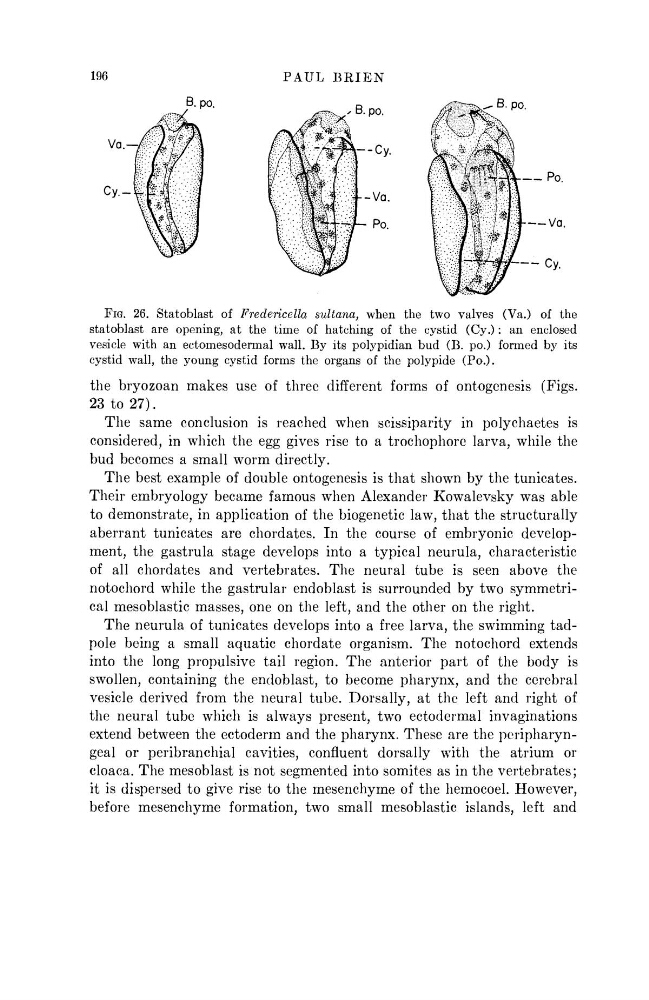
FIG. 26. Statoblast of Fredericella
sultana, when the two valves (Va.) of the
statoblast are opening, at the time of hatching of the cystid (Cy.): an enclosed
vesicle with an ectomesodermal wall. By its polypidian bud (B. po.) formed by its
cystid wall, the young cystid forms the organs of the polypide (Po.).
the bryozoan makes use of three different forms of ontogenesis (Figs.
23 to 27).
The same conclusion is reached when scissiparity in polychaetes is
considered, in which the egg gives rise to a trochophore larva, while the
bud becomes a small worm directly.
The best example of double ontogenesis is that shown by the tunicates.
Their embryology became famous when Alexander Kowalevsky was able
to demonstrate, in application of the biogenetic law, that the structurally
aberrant tunicates are chordates. In the course of embryonic development, the gastrula stage develops into a typical neurula, characteristic
of all chordates and vertebrates. The neural tube is seen above the
notochord while the gastrular endoblast is surrounded by two symmetrical mesoblastic masses, one on the left, and the other on the right.
The neurula of tunicates develops into a free larva, the swimming tadpole being a small aquatic chordate organism. The notochord extends
into the long propulsive tail region. The anterior part of the body is
swollen, containing the endoblast, to become pharynx, and the cerebral
vesicle derived from the neural tube. Dorsally, at the left and right of
the neural tube which is always present, two ectodermal invaginations
extend between the ectoderm and the pharynx. These are the peripharyngeal or peribranchial cavities, confluent dorsally with the atrium or
cloaca. The mesoblast is not segmented into somites as in the vertebrates;
it is dispersed to give rise to the mesenchyme of the hemocoel. However,
before mesenchyme formation, two small mesoblastic islands, left and
-Po.
-Va.
-Cy.
PAUL BRIEN
FIG. 26. Statoblast of Fredericella
sultana, when the two valves (Va.) of the
statoblast are opening, at the time of hatching of the cystid (Cy.): an enclosed
vesicle with an ectomesodermal wall. By its polypidian bud (B. po.) formed by its
cystid wall, the young cystid forms the organs of the polypide (Po.).
the bryozoan makes use of three different forms of ontogenesis (Figs.
23 to 27).
The same conclusion is reached when scissiparity in polychaetes is
considered, in which the egg gives rise to a trochophore larva, while the
bud becomes a small worm directly.
The best example of double ontogenesis is that shown by the tunicates.
Their embryology became famous when Alexander Kowalevsky was able
to demonstrate, in application of the biogenetic law, that the structurally
aberrant tunicates are chordates. In the course of embryonic development, the gastrula stage develops into a typical neurula, characteristic
of all chordates and vertebrates. The neural tube is seen above the
notochord while the gastrular endoblast is surrounded by two symmetrical mesoblastic masses, one on the left, and the other on the right.
The neurula of tunicates develops into a free larva, the swimming tadpole being a small aquatic chordate organism. The notochord extends
into the long propulsive tail region. The anterior part of the body is
swollen, containing the endoblast, to become pharynx, and the cerebral
vesicle derived from the neural tube. Dorsally, at the left and right of
the neural tube which is always present, two ectodermal invaginations
extend between the ectoderm and the pharynx. These are the peripharyngeal or peribranchial cavities, confluent dorsally with the atrium or
cloaca. The mesoblast is not segmented into somites as in the vertebrates;
it is dispersed to give rise to the mesenchyme of the hemocoel. However,
before mesenchyme formation, two small mesoblastic islands, left and
-Po.
-Va.
-Cy.