

ROLE OF mRNA IN EMBRYONIC DEVELOPMENT
137
conclusions drawn from the second pulse-chase experiment (Fig. 13) are
thus confirmed.
C. Chase Experiments with the Anucleolate Mutant
The existence of stable mRNA in late embryos was also observed by
Brown and Gurdon (1966). These authors studied the anucleolate mutant
of Xenopus laevis that, as already stated, does not synthesize any rRNA
and does not develop beyond the tadpole stage. Brown and Gurdon
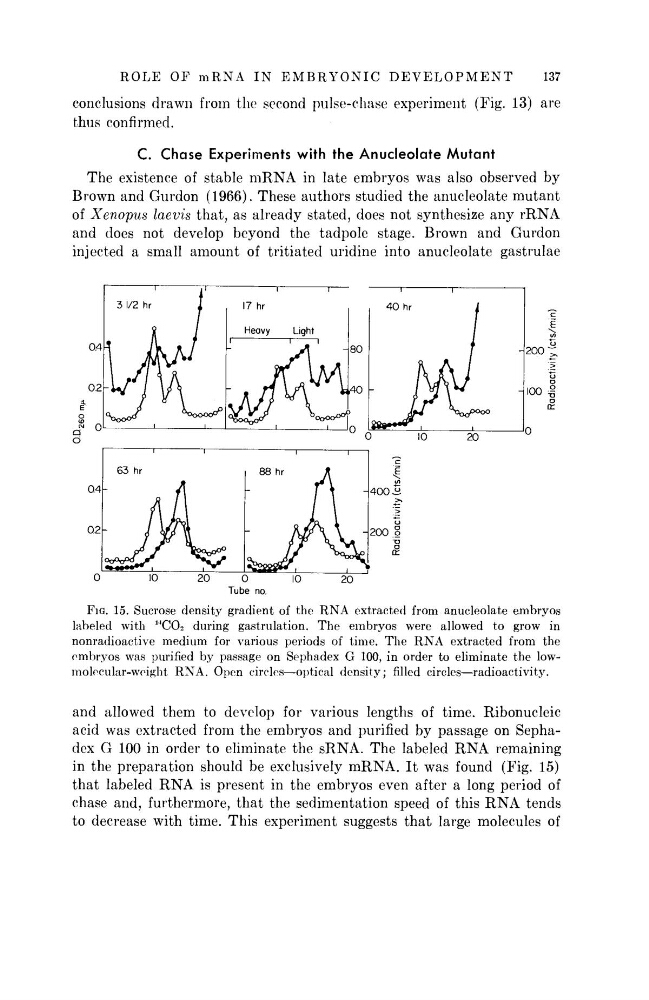
injected a small amount of tritiated uridine into anucleolate gastrulae
Tube no.
FIG. 15. Sucrose density gradient of the RNA extracted from anucleolate embryos
labeled with
1 4
C0 2 during gastrulation. The embryos were allowed to grow in
nonradioactive medium for various periods of time. The RNA extracted from the
embryos was purified by passage on Sephadex G 100, in order to eliminate the lowmolecular-weight RNA. Open circles—optical density; filled circles—radioactivity.
and allowed them to develop for various lengths of time. Ribonucleic
acid was extracted from the embryos and purified by passage on Sephadex G 100 in order to eliminate the sRNA. The labeled RNA remaining
in the preparation should be exclusively mRNA. It was found (Fig. 15)
that labeled RNA is present in the embryos even after a long period of
chase and, furthermore, that the sedimentation speed of this RNA tends
to decrease with time. This experiment suggests that large molecules of
QD
260
m
M
Radioactivity (cts/min)
137
conclusions drawn from the second pulse-chase experiment (Fig. 13) are
thus confirmed.
C. Chase Experiments with the Anucleolate Mutant
The existence of stable mRNA in late embryos was also observed by
Brown and Gurdon (1966). These authors studied the anucleolate mutant
of Xenopus laevis that, as already stated, does not synthesize any rRNA
and does not develop beyond the tadpole stage. Brown and Gurdon
injected a small amount of tritiated uridine into anucleolate gastrulae
Tube no.
FIG. 15. Sucrose density gradient of the RNA extracted from anucleolate embryos
labeled with
1 4
C0 2 during gastrulation. The embryos were allowed to grow in
nonradioactive medium for various periods of time. The RNA extracted from the
embryos was purified by passage on Sephadex G 100, in order to eliminate the lowmolecular-weight RNA. Open circles—optical density; filled circles—radioactivity.
and allowed them to develop for various lengths of time. Ribonucleic
acid was extracted from the embryos and purified by passage on Sephadex G 100 in order to eliminate the sRNA. The labeled RNA remaining
in the preparation should be exclusively mRNA. It was found (Fig. 15)
that labeled RNA is present in the embryos even after a long period of
chase and, furthermore, that the sedimentation speed of this RNA tends
to decrease with time. This experiment suggests that large molecules of
QD
260
m
M
Radioactivity (cts/min)