

138
HERMAN DENIS
mRNA are synthesized at the beginning of the experiment and are progressively degraded into smaller molecules as time goes by.
The experiment just described is not, however, completely conclusive,
since the RNA precursor pool remains radioactive throughout the period
of chase. The small RNA molecules that appear at the end of the experiment might, therefore, be synthesized de novo and not result from the
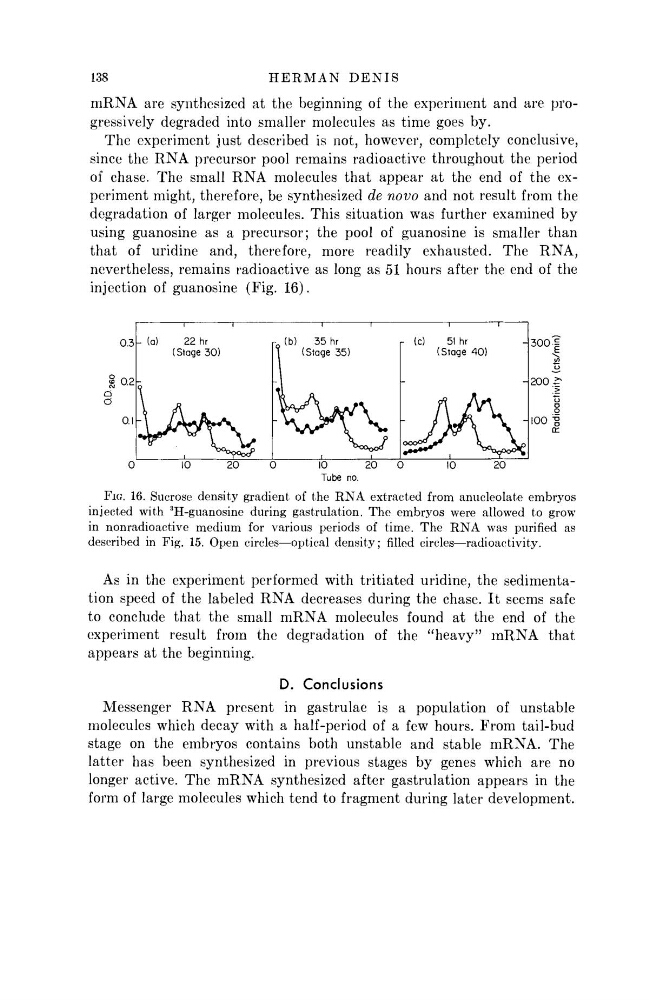
degradation of larger molecules. This situation was further examined by
using guanosine as a precursor; the pool of guanosine is smaller than
that of uridine and, therefore, more readily exhausted. The RNA,
nevertheless, remains radioactive as long as 51 hours after the end of the
injection of guanosine (Fig. 16).
0.3
d
a
1
1
- (a)
22 hr
t
i
r (b)
35 hr
i
i
r
(c)
51 hr
(Stage 30)
1
(Stage 35)
(Stage 40)
0
10
20
10
Tube no.
20
10
20
FIG. 16. Sucrose density gradient of the RNA extracted from anucleolate embryos
injected with
3
H-guanosine during gastrulation. The embryos were allowed to grow
in nonradioactive medium for various periods of time. The RNA was purified as
described in Fig. 15. Open circles—optical density; filled circles—radioactivity.
As in the experiment performed with tritiated uridine, the sedimentation speed of the labeled RNA decreases during the chase. It seems safe
to conclude that the small mRNA molecules found at the end of the
experiment result from the degradation of the "heavy" mRNA that
appears at the beginning.
D. Conclusions
Messenger RNA present in gastrulae is a population of unstable
molecules which decay with a half-period of a few hours. From tail-bud
stage on the embryos contains both unstable and stable mRNA. The
latter has been synthesized in previous stages by genes which are no
longer active. The mRNA synthesized after gastrulation appears in the
form of large molecules which tend to fragment during later development.
8 8 8
Radioactivity (cts/min)
la
ci
O
0
HERMAN DENIS
mRNA are synthesized at the beginning of the experiment and are progressively degraded into smaller molecules as time goes by.
The experiment just described is not, however, completely conclusive,
since the RNA precursor pool remains radioactive throughout the period
of chase. The small RNA molecules that appear at the end of the experiment might, therefore, be synthesized de novo and not result from the
degradation of larger molecules. This situation was further examined by
using guanosine as a precursor; the pool of guanosine is smaller than
that of uridine and, therefore, more readily exhausted. The RNA,
nevertheless, remains radioactive as long as 51 hours after the end of the
injection of guanosine (Fig. 16).
0.3
d
a
1
1
- (a)
22 hr
t
i
r (b)
35 hr
i
i
r
(c)
51 hr
(Stage 30)
1
(Stage 35)
(Stage 40)
0
10
20
10
Tube no.
20
10
20
FIG. 16. Sucrose density gradient of the RNA extracted from anucleolate embryos
injected with
3
H-guanosine during gastrulation. The embryos were allowed to grow
in nonradioactive medium for various periods of time. The RNA was purified as
described in Fig. 15. Open circles—optical density; filled circles—radioactivity.
As in the experiment performed with tritiated uridine, the sedimentation speed of the labeled RNA decreases during the chase. It seems safe
to conclude that the small mRNA molecules found at the end of the
experiment result from the degradation of the "heavy" mRNA that
appears at the beginning.
D. Conclusions
Messenger RNA present in gastrulae is a population of unstable
molecules which decay with a half-period of a few hours. From tail-bud
stage on the embryos contains both unstable and stable mRNA. The
latter has been synthesized in previous stages by genes which are no
longer active. The mRNA synthesized after gastrulation appears in the
form of large molecules which tend to fragment during later development.
8 8 8
Radioactivity (cts/min)
la
ci
O
0