

136
HERMAN DENIS
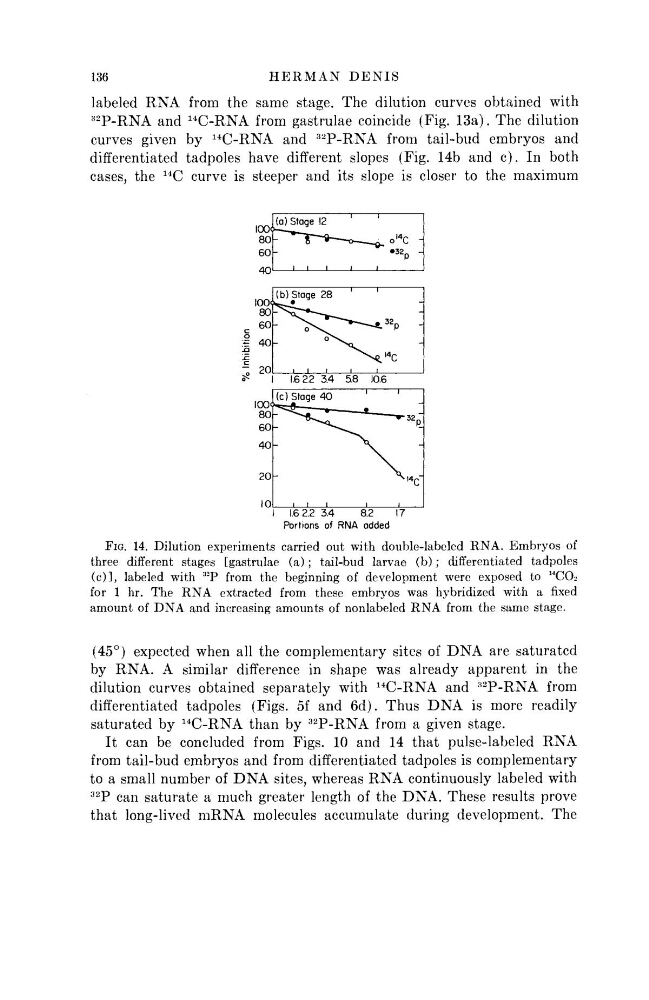
labeled RNA from the same stage. The dilution curves obtained with
3 2
P-RNA and
1 4
C-RNA from gastrulae coincide (Fig. 13a). The dilution
curves given by
1 4
C-RNA and
3 2
P-RNA from tail-bud embryos and
differentiated tadpoles have different slopes (Fig. 14b and c). In both
cases, the
1 4
C curve is steeper and its slope is closer to the maximum
00<
80
(a) Stage 12
o-_^o
, 4
C
-
60
• 3 2 p
-
AT\
i
i i
i
i
00<
80
(b) Stage 28
'
$ 8
20
i
l l
i
i
1.6 2.2 3.4 5.8 10.6
00<
80
60
(c) Stage 40
1
1
40
"
\
"
20
\ -
10
I
I I
1
1
"l
1.6 2.2 3.4
8.2
17
Portions of RNA added
FIG. 14. Dilution experiments carried out with double-labeled RNA. Embryos of
three different stages [gastrulae (a); tail-bud larvae (b); differentiated tadpoles
(c)], labeled with
3 2
P from the beginning of development were exposed to
1 4
COfor 1 hr. The RNA extracted from these embryos was hybridized with a fixed
amount of DNA and increasing amounts of nonlabeled RNA from the same stage.
(45°) expected when all the complementary sites of DNA are saturated
by RNA. A similar difference in shape was already apparent in the
dilution curves obtained separately with
1 4
C-RNA and
3 2
P-RNA from
differentiated tadpoles (Figs. 5f and 6d). Thus DNA is more readily
saturated by
1 4
C-RNA than by
3 2
P-RNA from a given stage.
It can be concluded from Figs. 10 and 14 that pulse-labeled RNA
from tail-bud embryos and from differentiated tadpoles is complementary
to a small number of DNA sites, whereas RNA continuously labeled with
3 2
P can saturate a much greater length of the DNA. These results prove
that long-lived mRNA molecules accumulate during development. The
% Inhibition
HERMAN DENIS
labeled RNA from the same stage. The dilution curves obtained with
3 2
P-RNA and
1 4
C-RNA from gastrulae coincide (Fig. 13a). The dilution
curves given by
1 4
C-RNA and
3 2
P-RNA from tail-bud embryos and
differentiated tadpoles have different slopes (Fig. 14b and c). In both
cases, the
1 4
C curve is steeper and its slope is closer to the maximum
00<
80
(a) Stage 12
o-_^o
, 4
C
-
60
• 3 2 p
-
AT\
i
i i
i
i
00<
80
(b) Stage 28
'
$ 8
20
i
l l
i
i
1.6 2.2 3.4 5.8 10.6
00<
80
60
(c) Stage 40
1
1
40
"
\
"
20
\ -
10
I
I I
1
1
"l
1.6 2.2 3.4
8.2
17
Portions of RNA added
FIG. 14. Dilution experiments carried out with double-labeled RNA. Embryos of
three different stages [gastrulae (a); tail-bud larvae (b); differentiated tadpoles
(c)], labeled with
3 2
P from the beginning of development were exposed to
1 4
COfor 1 hr. The RNA extracted from these embryos was hybridized with a fixed
amount of DNA and increasing amounts of nonlabeled RNA from the same stage.
(45°) expected when all the complementary sites of DNA are saturated
by RNA. A similar difference in shape was already apparent in the
dilution curves obtained separately with
1 4
C-RNA and
3 2
P-RNA from
differentiated tadpoles (Figs. 5f and 6d). Thus DNA is more readily
saturated by
1 4
C-RNA than by
3 2
P-RNA from a given stage.
It can be concluded from Figs. 10 and 14 that pulse-labeled RNA
from tail-bud embryos and from differentiated tadpoles is complementary
to a small number of DNA sites, whereas RNA continuously labeled with
3 2
P can saturate a much greater length of the DNA. These results prove
that long-lived mRNA molecules accumulate during development. The
% Inhibition