

ROLE OF mRNA IN EMBRYONIC DEVELOPMENT
133
centage of labeled RNA which can be hybridized with DNA drops from
9.7 at the beginning of gastrulation to 1 at the end of development. It
can be concluded that hybridizable RNA turns over more rapidly than
nonhybridizable RNA. This type of RNA consists mainly of rRNA and
sRNA, which are metabolically stable and accumulate during embryonic
development.
The experiment described in Fig. 11 merely shows that mRNA turns
over more rapidly than the other types of RNA present in the embryos.
This experiment, however, gives no indication about the decay rate of
mRNA at different stages of development. To get some information on
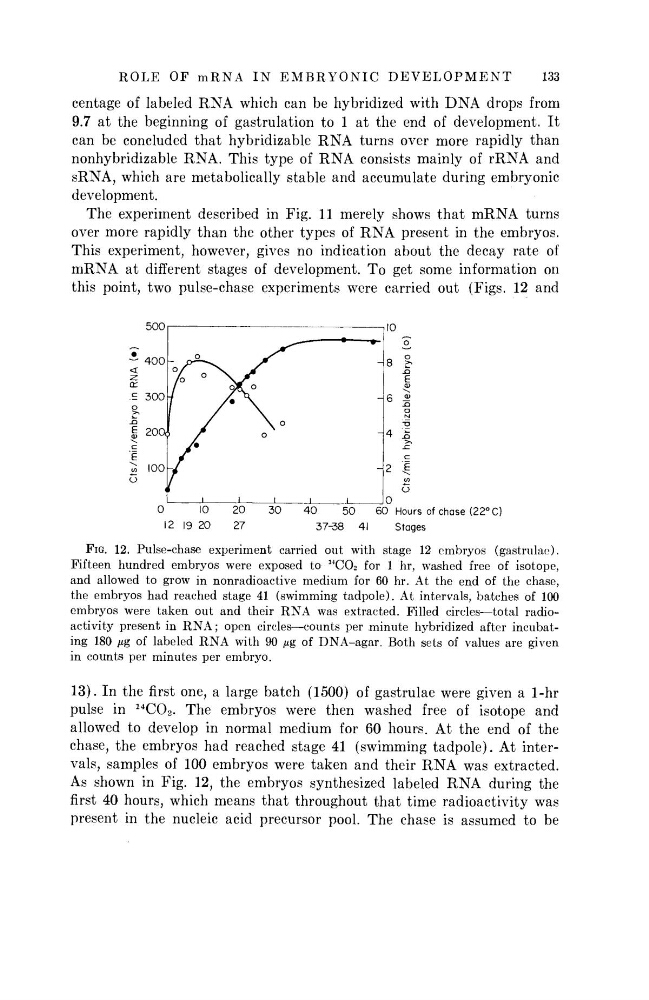
this point, two pulse-chase experiments were carried out (Figs. 12 and
12 19 20
27
37-38
41
Stages
FIG. 12. Pulse-chase experiment carried out with stage 12 embryos (gastrulae).
Fifteen hundred embryos were exposed to
1 4
C0 2 for 1 hr, washed free of isotope,
and allowed to grow in nonradioactive medium for 60 hr. At the end of the chase,
the embryos had reached stage 41 (swimming tadpole). At intervals, batches of 100
embryos were taken out and their RNA was extracted. Filled circles—total radioactivity present in RNA; open circles—counts per minute hybridized after incubating 180 ng of labeled RNA with 90 ,ug of DNA-agar. Both sets of values are given
in counts per minutes per embryo.
13). In the first one, a large batch (1500) of gastrulae were given a 1-hr
pulse in
1 4
C0 2 . The embryos were then washed free of isotope and
allowed to develop in normal medium for 60 hours. At the end of the
chase, the embryos had reached stage 41 (swimming tadpole). At intervals, samples of 100 embryos were taken and their RNA was extracted.
As shown in Fig. 12, the embryos synthesized labeled RNA during the
first 40 hours, which means that throughout that time radioactivity was
present in the nucleic acid precursor pool. The chase is assumed to be
Cts/min/embryo in RNA (•)
Hours of chase (2.2° C)
Cts/min hybridizable/embryo (o)
133
centage of labeled RNA which can be hybridized with DNA drops from
9.7 at the beginning of gastrulation to 1 at the end of development. It
can be concluded that hybridizable RNA turns over more rapidly than
nonhybridizable RNA. This type of RNA consists mainly of rRNA and
sRNA, which are metabolically stable and accumulate during embryonic
development.
The experiment described in Fig. 11 merely shows that mRNA turns
over more rapidly than the other types of RNA present in the embryos.
This experiment, however, gives no indication about the decay rate of
mRNA at different stages of development. To get some information on
this point, two pulse-chase experiments were carried out (Figs. 12 and
12 19 20
27
37-38
41
Stages
FIG. 12. Pulse-chase experiment carried out with stage 12 embryos (gastrulae).
Fifteen hundred embryos were exposed to
1 4
C0 2 for 1 hr, washed free of isotope,
and allowed to grow in nonradioactive medium for 60 hr. At the end of the chase,
the embryos had reached stage 41 (swimming tadpole). At intervals, batches of 100
embryos were taken out and their RNA was extracted. Filled circles—total radioactivity present in RNA; open circles—counts per minute hybridized after incubating 180 ng of labeled RNA with 90 ,ug of DNA-agar. Both sets of values are given
in counts per minutes per embryo.
13). In the first one, a large batch (1500) of gastrulae were given a 1-hr
pulse in
1 4
C0 2 . The embryos were then washed free of isotope and
allowed to develop in normal medium for 60 hours. At the end of the
chase, the embryos had reached stage 41 (swimming tadpole). At intervals, samples of 100 embryos were taken and their RNA was extracted.
As shown in Fig. 12, the embryos synthesized labeled RNA during the
first 40 hours, which means that throughout that time radioactivity was
present in the nucleic acid precursor pool. The chase is assumed to be
Cts/min/embryo in RNA (•)
Hours of chase (2.2° C)
Cts/min hybridizable/embryo (o)