

134
HERMAN DENIS
finished after 40 hr since the total amount of radioactivity present in
RNA does not change later on. The amount of radioactivity found in
hybridizable RNA increases rapidly during the first 10 hr of chase and
then drops steeply (Fig. 12).
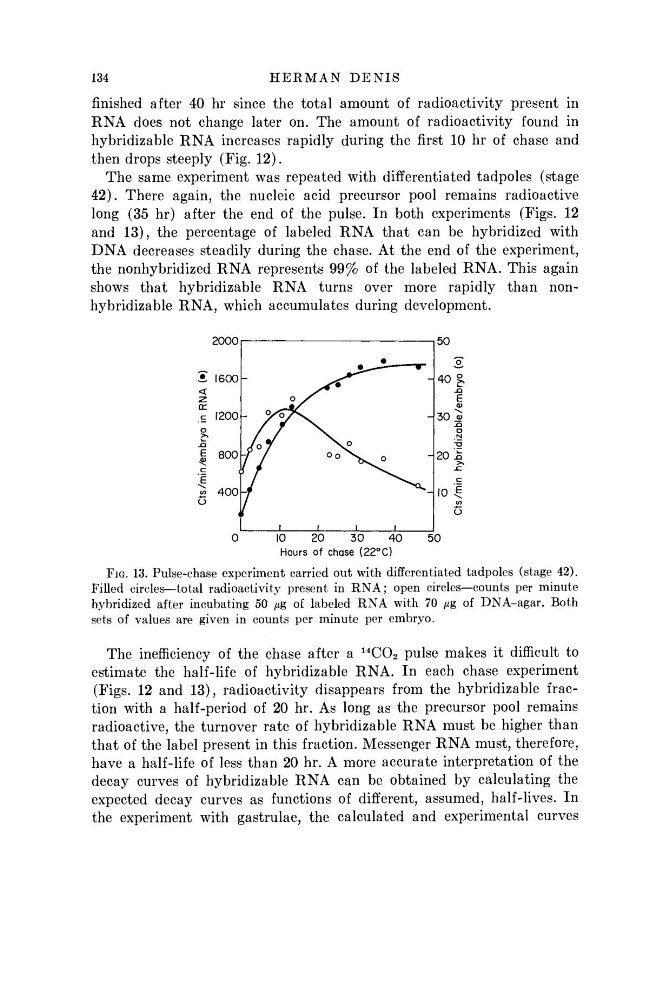
The same experiment was repeated with differentiated tadpoles (stage
42). There again, the nucleic acid precursor pool remains radioactive
long (35 hr) after the end of the pulse. In both experiments (Figs. 12
and 13), the percentage of labeled RNA that can be hybridized with
DNA decreases steadily during the chase. At the end of the experiment,
the nonhybridized RNA represents 99% of the labeled RNA. This again
shows that hybridizable RNA turns over more rapidly than nonhybridizable RNA, which accumulates during development.
Hours of chase (22°C)
FIG. 13. Pulse-chase experiment carried out with differentiated tadpoles (stage 42).
Filled circles—total radioactivity present in RNA; open circles—counts per minute
hybridized after incubating 50 fig of labeled RNA with 70 fig of DNA-agar. Both
sets of values are given in counts per minute per embryo.
The inefficiency of the chase after a
1 4
C0 2 pulse makes it difficult to
estimate the half-life of hybridizable RNA. In each chase experiment
(Figs. 12 and 13), radioactivity disappears from the hybridizable fraction with a half-period of 20 hr. As long as the precursor pool remains
radioactive, the turnover rate of hybridizable RNA must be higher than
that of the label present in this fraction. Messenger RNA must, therefore,
have a half-life of less than 20 hr. A more accurate interpretation of the
decay curves of hybridizable RNA can be obtained by calculating the
expected decay curves as functions of different, assumed, half-lives. In
the experiment with gastrulae, the calculated and experimental curves
Cts/min/embryo in RNA (•)
Cts/min hybridizable/embryo (o)
HERMAN DENIS
finished after 40 hr since the total amount of radioactivity present in
RNA does not change later on. The amount of radioactivity found in
hybridizable RNA increases rapidly during the first 10 hr of chase and
then drops steeply (Fig. 12).
The same experiment was repeated with differentiated tadpoles (stage
42). There again, the nucleic acid precursor pool remains radioactive
long (35 hr) after the end of the pulse. In both experiments (Figs. 12
and 13), the percentage of labeled RNA that can be hybridized with
DNA decreases steadily during the chase. At the end of the experiment,
the nonhybridized RNA represents 99% of the labeled RNA. This again
shows that hybridizable RNA turns over more rapidly than nonhybridizable RNA, which accumulates during development.
Hours of chase (22°C)
FIG. 13. Pulse-chase experiment carried out with differentiated tadpoles (stage 42).
Filled circles—total radioactivity present in RNA; open circles—counts per minute
hybridized after incubating 50 fig of labeled RNA with 70 fig of DNA-agar. Both
sets of values are given in counts per minute per embryo.
The inefficiency of the chase after a
1 4
C0 2 pulse makes it difficult to
estimate the half-life of hybridizable RNA. In each chase experiment
(Figs. 12 and 13), radioactivity disappears from the hybridizable fraction with a half-period of 20 hr. As long as the precursor pool remains
radioactive, the turnover rate of hybridizable RNA must be higher than
that of the label present in this fraction. Messenger RNA must, therefore,
have a half-life of less than 20 hr. A more accurate interpretation of the
decay curves of hybridizable RNA can be obtained by calculating the
expected decay curves as functions of different, assumed, half-lives. In
the experiment with gastrulae, the calculated and experimental curves
Cts/min/embryo in RNA (•)
Cts/min hybridizable/embryo (o)