

126
HERMAN
DENIS
% Hybridization
|_(a) Stage 0-7 (cleavage)
—x
•
•
•
1(b) Stage 24 (neurula)
1.6 2.2 3.4 5.8 10.6 20.2
Portions of RNA added
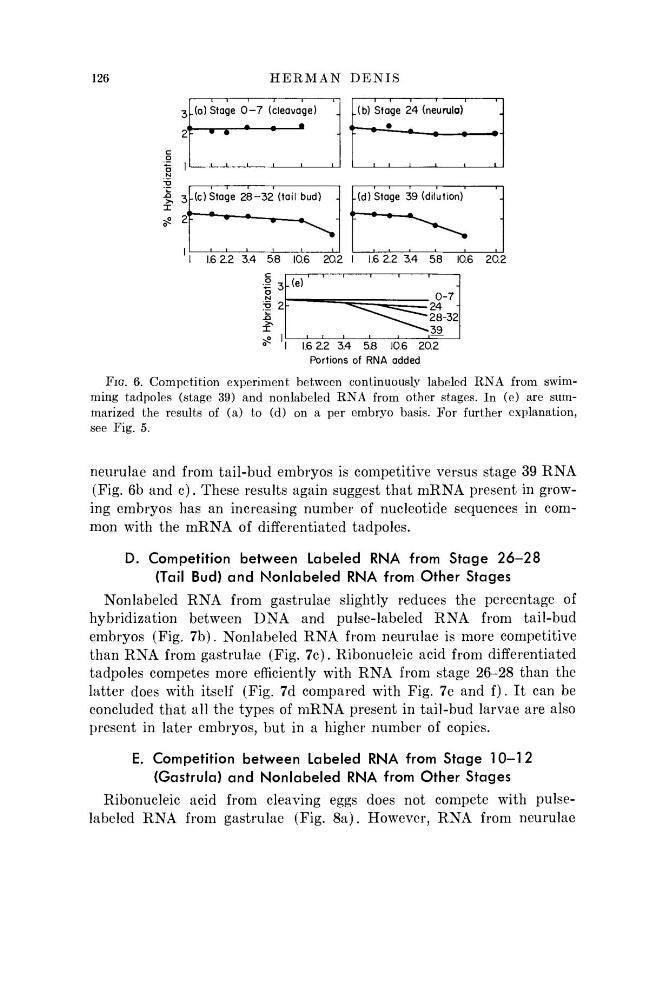
FIG. 6. Competition experiment between continuously labeled RNA from swimming tadpoles (stage 39) and nonlabeled RNA from other stages. In (e) are summarized the results of (a) to (d) on a per embryo basis. For further explanation,
see Fig. 5.
neurulae and from tail-bud embryos is competitive versus stage 39 RNA
(Fig. 6b and c). These results again suggest that mRNA present in growing embryos has an increasing number of nucleotide sequences in common with the mRNA of differentiated tadpoles.
D. Competition between Labeled RNA from Stage 26-28
(Tail Bud) and Nonlabeled RNA from Other Stages
Nonlabeled RNA from gastrulae slightly reduces the percentage of
hybridization between DNA and pulse-labeled RNA from tail-bud
embryos (Fig. 7b). Nonlabeled RNA from neurulae is more competitive
than RNA from gastrulae (Fig. 7c). Ribonucleic acid from differentiated
tadpoles competes more efficiently with RNA from stage 26-28 than the
latter does with itself (Fig. 7d compared with Fig. 7e and f). It can be
concluded that all the types of mRNA present in tail-bud larvae are also
present in later embryos, but in a higher number of copies.
E. Competition between Labeled RNA from Stage 10-12
(Gastrula) and Nonlabeled RNA from Other Stages
Ribonucleic acid from cleaving eggs does not compete with pulselabeled RNA from gastrulae (Fig. 8a). However, RNA from neurulae
% Hybridization
HERMAN
DENIS
% Hybridization
|_(a) Stage 0-7 (cleavage)
—x
•
•
•
1(b) Stage 24 (neurula)
1.6 2.2 3.4 5.8 10.6 20.2
Portions of RNA added
FIG. 6. Competition experiment between continuously labeled RNA from swimming tadpoles (stage 39) and nonlabeled RNA from other stages. In (e) are summarized the results of (a) to (d) on a per embryo basis. For further explanation,
see Fig. 5.
neurulae and from tail-bud embryos is competitive versus stage 39 RNA
(Fig. 6b and c). These results again suggest that mRNA present in growing embryos has an increasing number of nucleotide sequences in common with the mRNA of differentiated tadpoles.
D. Competition between Labeled RNA from Stage 26-28
(Tail Bud) and Nonlabeled RNA from Other Stages
Nonlabeled RNA from gastrulae slightly reduces the percentage of
hybridization between DNA and pulse-labeled RNA from tail-bud
embryos (Fig. 7b). Nonlabeled RNA from neurulae is more competitive
than RNA from gastrulae (Fig. 7c). Ribonucleic acid from differentiated
tadpoles competes more efficiently with RNA from stage 26-28 than the
latter does with itself (Fig. 7d compared with Fig. 7e and f). It can be
concluded that all the types of mRNA present in tail-bud larvae are also
present in later embryos, but in a higher number of copies.
E. Competition between Labeled RNA from Stage 10-12
(Gastrula) and Nonlabeled RNA from Other Stages
Ribonucleic acid from cleaving eggs does not compete with pulselabeled RNA from gastrulae (Fig. 8a). However, RNA from neurulae
% Hybridization