

ROLE OF mRNA IN EMBRYONIC DEVELOPMENT
125
5
4
3
2
1—i
1
1
r~
(a) Stage 6-8 (cleavage)
L
1—1
*
-
.(g)
1 '
1
1
1
—15-1926-28
-
X.
^35-36
1
i
^\42
I
1.6 2.2 3.4 5.8 10.6
Portions of RNA added
0.5 L_
I
1.6 2.2 3.4
5.8 10.6
Portions of RNA added
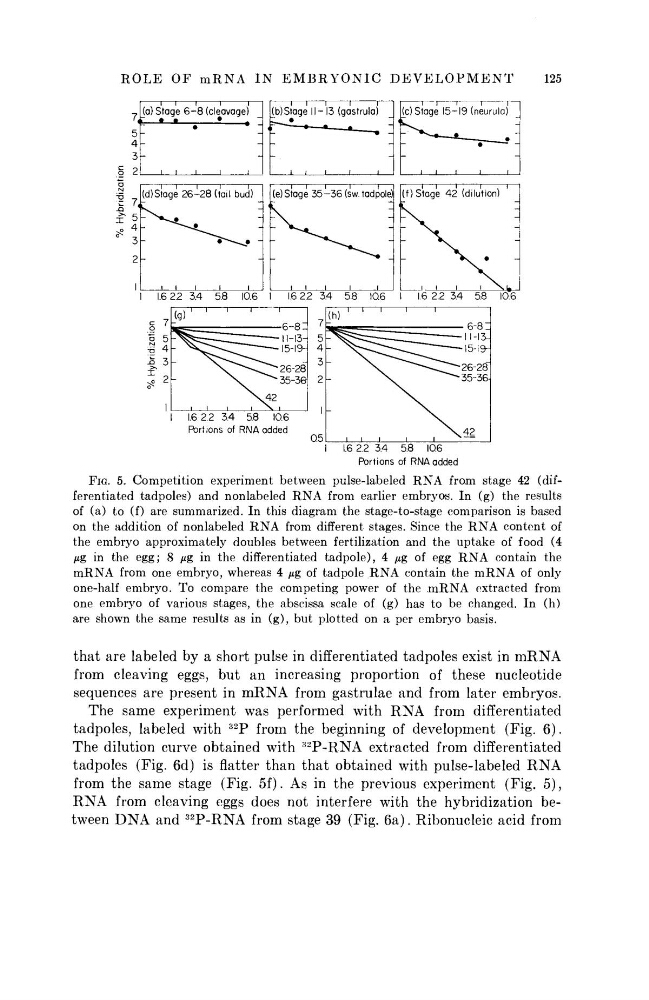
FIG. 5. Competition experiment between pulse-labeled RNA from stage 42 (differentiated tadpoles) and nonlabeled RNA from earlier embryos. In (g) the results
of (a) to (f) are summarized. In this diagram the stage-to-stage comparison is based
on the addition of nonlabeled RNA from different stages. Since the RNA content of
the embryo approximately doubles between fertilization and the uptake of food (4
fig in the egg; 8 /ig in the differentiated tadpole), 4 fig of egg RNA contain the
mRNA from one embryo, whereas 4 fig of tadpole RNA contain the mRNA of only
one-half embryo. To compare the competing power of the mRNA extracted from
one embryo of various stages, the abscissa scale of (g) has to be changed. In (h)
are shown the same results as in (g), but plotted on a per embryo basis.
that are labeled by a short pulse in differentiated tadpoles exist in mRNA
from cleaving eggs, but an increasing proportion of these nucleotide
sequences are present in mRNA from gastrulae and from later embryos.
The same experiment was performed with RNA from differentiated
tadpoles, labeled with
3 2
P from the beginning of development (Fig. 6).
The dilution curve obtained with
3 2
P-RNA extracted from differentiated
tadpoles (Fig. 6d) is flatter than that obtained with pulse-labeled RNA
from the same stage (Fig. 5f). As in the previous experiment (Fig. 5),
RNA from cleaving eggs does not interfere with the hybridization between DNA and
3 2
P-RNA from stage 39 (Fig. 6a). Ribonucleic acid from
% Hybridization
— ro w -ken -s i
% Hybridization
125
5
4
3
2
1—i
1
1
r~
(a) Stage 6-8 (cleavage)
L
1—1
*
-
.(g)
1 '
1
1
1
—15-1926-28
-
X.
^35-36
1
i
^\42
I
1.6 2.2 3.4 5.8 10.6
Portions of RNA added
0.5 L_
I
1.6 2.2 3.4
5.8 10.6
Portions of RNA added
FIG. 5. Competition experiment between pulse-labeled RNA from stage 42 (differentiated tadpoles) and nonlabeled RNA from earlier embryos. In (g) the results
of (a) to (f) are summarized. In this diagram the stage-to-stage comparison is based
on the addition of nonlabeled RNA from different stages. Since the RNA content of
the embryo approximately doubles between fertilization and the uptake of food (4
fig in the egg; 8 /ig in the differentiated tadpole), 4 fig of egg RNA contain the
mRNA from one embryo, whereas 4 fig of tadpole RNA contain the mRNA of only
one-half embryo. To compare the competing power of the mRNA extracted from
one embryo of various stages, the abscissa scale of (g) has to be changed. In (h)
are shown the same results as in (g), but plotted on a per embryo basis.
that are labeled by a short pulse in differentiated tadpoles exist in mRNA
from cleaving eggs, but an increasing proportion of these nucleotide
sequences are present in mRNA from gastrulae and from later embryos.
The same experiment was performed with RNA from differentiated
tadpoles, labeled with
3 2
P from the beginning of development (Fig. 6).
The dilution curve obtained with
3 2
P-RNA extracted from differentiated
tadpoles (Fig. 6d) is flatter than that obtained with pulse-labeled RNA
from the same stage (Fig. 5f). As in the previous experiment (Fig. 5),
RNA from cleaving eggs does not interfere with the hybridization between DNA and
3 2
P-RNA from stage 39 (Fig. 6a). Ribonucleic acid from
% Hybridization
— ro w -ken -s i
% Hybridization