

64
MICHAEL LOCKE
bristles also serves as a marker for the origin of a graft, since they vary
slightly in form between different segments and appendages. Operations
were performed on the fifth instar and the effects observed on adults.
Although there is not normally a pattern of ripples on the appendages,
it was found that grafts which had not been incorporated in the host
pattern were surrounded by a series of raised ridges. Grafts were cut and
exchanged as in Fig. 35A and C. The bristles are arranged in longitudinal
Fifth
r i
=^=
A<
_f
180°
Adult
18
17
16
15
14
13
12
11
10
9
8
7
6
5
4
3
A
A
A
p
k
k is
k
K
S
k
17
18
19
20
Ï
2
3
4
~^l
N \
NJ
A
A
A /\
/
/
/
/
\
s
s
\
18
17
16
15
14
13
12
11
10
9
8
7
6
5
4
3
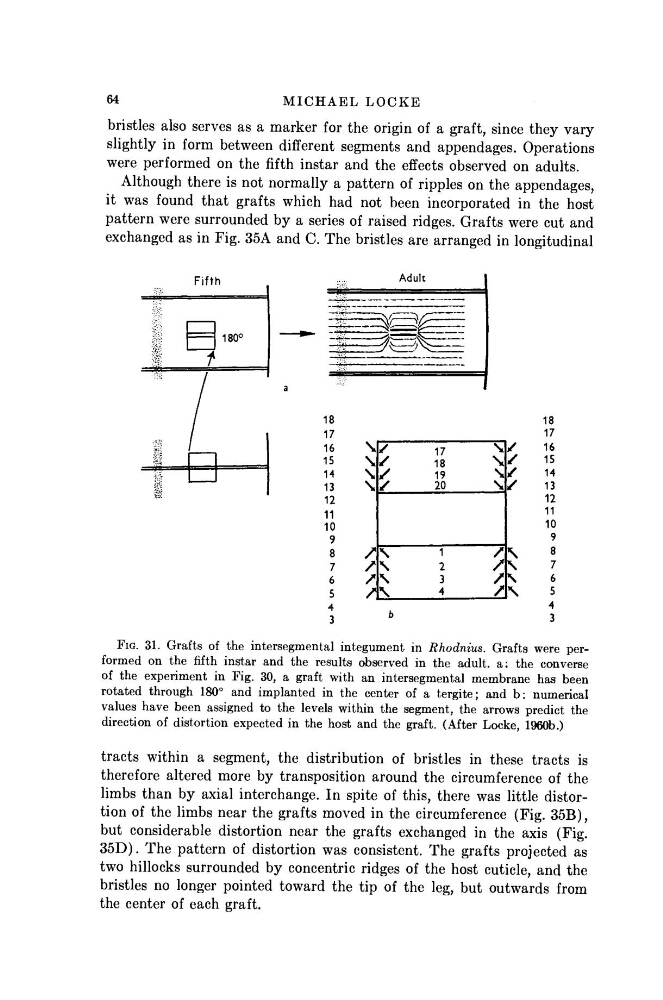
FIG. 31. Grafts of the intersegmental integument in Rhodnius. Grafts were performed on the fifth instar and the results observed in the adult, a: the converse
of the experiment in Fig. 30, a graft with an intersegmental membrane has been
rotated through 180° and implanted in the center of a tergite; and b: numerical
values have been assigned to the levels within the segment, the arrows predict the
direction of distortion expected in the host and the graft. (After Locke, 1960b.)
tracts within a segment, the distribution of bristles in these tracts is
therefore altered more by transposition around the circumference of the
limbs than by axial interchange. In spite of this, there was little distortion of the limbs near the grafts moved in the circumference (Fig. 35B),
but considerable distortion near the grafts exchanged in the axis (Fig.
35D). The pattern of distortion was consistent. The grafts projected as
two hillocks surrounded by concentric ridges of the host cuticle, and the
bristles no longer pointed toward the tip of the leg, but outwards from
the center of each graft.
MICHAEL LOCKE
bristles also serves as a marker for the origin of a graft, since they vary
slightly in form between different segments and appendages. Operations
were performed on the fifth instar and the effects observed on adults.
Although there is not normally a pattern of ripples on the appendages,
it was found that grafts which had not been incorporated in the host
pattern were surrounded by a series of raised ridges. Grafts were cut and
exchanged as in Fig. 35A and C. The bristles are arranged in longitudinal
Fifth
r i
=^=
A<
_f
180°
Adult
18
17
16
15
14
13
12
11
10
9
8
7
6
5
4
3
A
A
A
p
k
k is
k
K
S
k
17
18
19
20
Ï
2
3
4
~^l
N \
NJ
A
A
A /\
/
/
/
/
\
s
s
\
18
17
16
15
14
13
12
11
10
9
8
7
6
5
4
3
FIG. 31. Grafts of the intersegmental integument in Rhodnius. Grafts were performed on the fifth instar and the results observed in the adult, a: the converse
of the experiment in Fig. 30, a graft with an intersegmental membrane has been
rotated through 180° and implanted in the center of a tergite; and b: numerical
values have been assigned to the levels within the segment, the arrows predict the
direction of distortion expected in the host and the graft. (After Locke, 1960b.)
tracts within a segment, the distribution of bristles in these tracts is
therefore altered more by transposition around the circumference of the
limbs than by axial interchange. In spite of this, there was little distortion of the limbs near the grafts moved in the circumference (Fig. 35B),
but considerable distortion near the grafts exchanged in the axis (Fig.
35D). The pattern of distortion was consistent. The grafts projected as
two hillocks surrounded by concentric ridges of the host cuticle, and the
bristles no longer pointed toward the tip of the leg, but outwards from
the center of each graft.