

C Y T O G E N E T I C M E C H A N I S M S I N S I L K W O R M S
219
42°-55°C. The zone of effective temperature lies above 40°C. Temperatures of 40°-43°C produce a very weak activating effect, which becomes
more pronounced with the elevation of temperature.
Complete parthenogenesis is most readily produced by temperatures
between 45°-47°C while the best results are obtained with unfertilized
eggs immersed for 18 min in hot water at precisely 46.0°C.
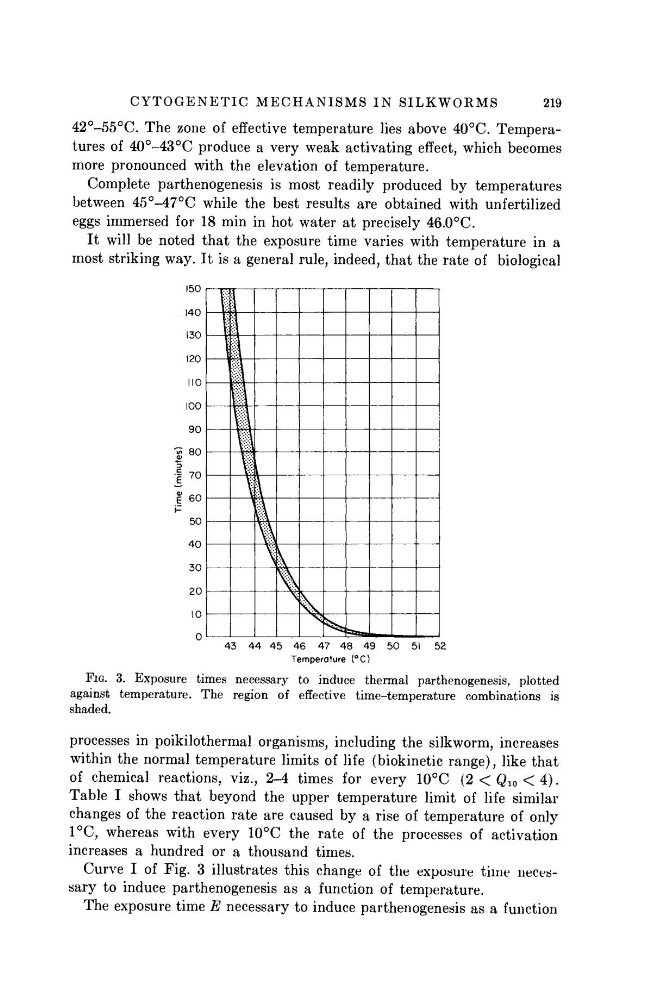
It will be noted that the exposure time varies with temperature in a
most striking way. It is a general rule, indeed, that the rate of biological
150
140
130
120
110
100
90
| 80
l
7 0
1 60
I50
40
30
20
10
0
43 44 45 46 47 48 49 50 51 52
Temperature (°C)
FIG. 3. Exposure times necessary to induce thermal parthenogenesis, plotted
against temperature. The region of effective time-temperature combinations is
shaded.
processes in poikilothermal organisms, including the silkworm, increases
within the normal temperature limits of life (biokinetic range), like that
of chemical reactions, viz., 2-4 times for every 10°C ( 2 < Q 1 0 < 4 ) .
Table I shows that beyond the upper temperature limit of life similar
changes of the reaction rate are caused by a rise of temperature of only
1°C, whereas with every 10°C the rate of the processes of activation
increases a hundred or a thousand times.
Curve I of Fig. 3 illustrates this change of the exposure time necessary to induce parthenogenesis as a function of temperature.
The exposure time E necessary to induce parthenogenesis as a function
219
42°-55°C. The zone of effective temperature lies above 40°C. Temperatures of 40°-43°C produce a very weak activating effect, which becomes
more pronounced with the elevation of temperature.
Complete parthenogenesis is most readily produced by temperatures
between 45°-47°C while the best results are obtained with unfertilized
eggs immersed for 18 min in hot water at precisely 46.0°C.
It will be noted that the exposure time varies with temperature in a
most striking way. It is a general rule, indeed, that the rate of biological
150
140
130
120
110
100
90
| 80
l
7 0
1 60
I50
40
30
20
10
0
43 44 45 46 47 48 49 50 51 52
Temperature (°C)
FIG. 3. Exposure times necessary to induce thermal parthenogenesis, plotted
against temperature. The region of effective time-temperature combinations is
shaded.
processes in poikilothermal organisms, including the silkworm, increases
within the normal temperature limits of life (biokinetic range), like that
of chemical reactions, viz., 2-4 times for every 10°C ( 2 < Q 1 0 < 4 ) .
Table I shows that beyond the upper temperature limit of life similar
changes of the reaction rate are caused by a rise of temperature of only
1°C, whereas with every 10°C the rate of the processes of activation
increases a hundred or a thousand times.
Curve I of Fig. 3 illustrates this change of the exposure time necessary to induce parthenogenesis as a function of temperature.
The exposure time E necessary to induce parthenogenesis as a function