

218
B. L. ASTAUROV
later experiments (1902), but he succeeded only in inducing the beginning
of development. It took a lot of research work described in the author's
monograph (Astaurov, 1940) to elucidate the principal conditions of a
successful application of thermal activation and to develop a simple and
reliable method for producing caterpillars, cocoons, and moths of B. mori
without fertilization. A successful method of parthenogenesis consists in
activation of unfertilized eggs by immersing them in a hot water bath.
One has to extract ovaries from the body of a virgin female moth,
release the ova from the ovarial tubes by squeezing them through the
tulle, rinse the ova in tap water, dry on filter paper, and subject them
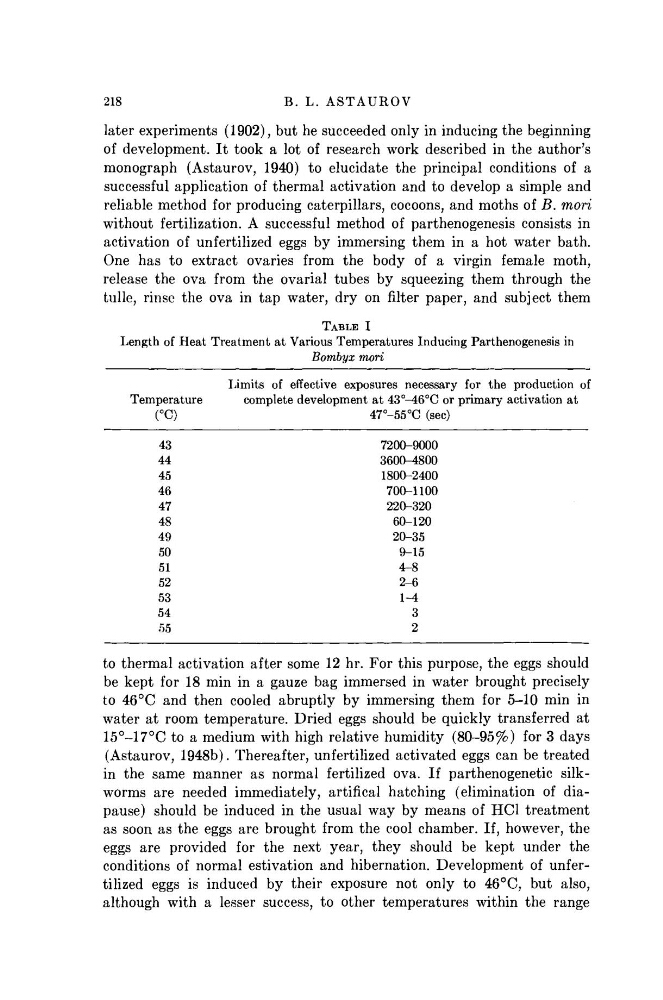
TABLE I
Length of Heat Treatment at Various Temperatures Inducing Parthenogenesis in
Bombyx mori
Limits of effective exposures necessary for the production of
Temperature
complete development at 43°-46°C or primary activation at
(°C)
43
44
45
46
47
48
49
50
51
52
53
54
55
47°-55°C (se
7200-9000
3600-4800
1800-2400
700-1100
220-320
60-120
20-35
9-15
4-8
2-6
1-4
3
2
to thermal activation after some 12 hr. For this purpose, the eggs should
be kept for 18 min in a gauze bag immersed in water brought precisely
to 46°C and then cooled abruptly by immersing them for 5-10 min in
water at room temperature. Dried eggs should be quickly transferred at
15°-17°C to a medium with high relative humidity (80-95%) for 3 days
(Astaurov, 1948b). Thereafter, unfertilized activated eggs can be treated
in the same manner as normal fertilized ova. If parthenogenetic silkworms are needed immediately, artifical hatching (elimination of diapause) should be induced in the usual way by means of HC1 treatment
as soon as the eggs are brought from the cool chamber. If, however, the
eggs are provided for the next year, they should be kept under the
conditions of normal estivation and hibernation. Development of unfertilized eggs is induced by their exposure not only to 46°C, but also,
although with a lesser success, to other temperatures within the range
B. L. ASTAUROV
later experiments (1902), but he succeeded only in inducing the beginning
of development. It took a lot of research work described in the author's
monograph (Astaurov, 1940) to elucidate the principal conditions of a
successful application of thermal activation and to develop a simple and
reliable method for producing caterpillars, cocoons, and moths of B. mori
without fertilization. A successful method of parthenogenesis consists in
activation of unfertilized eggs by immersing them in a hot water bath.
One has to extract ovaries from the body of a virgin female moth,
release the ova from the ovarial tubes by squeezing them through the
tulle, rinse the ova in tap water, dry on filter paper, and subject them
TABLE I
Length of Heat Treatment at Various Temperatures Inducing Parthenogenesis in
Bombyx mori
Limits of effective exposures necessary for the production of
Temperature
complete development at 43°-46°C or primary activation at
(°C)
43
44
45
46
47
48
49
50
51
52
53
54
55
47°-55°C (se
7200-9000
3600-4800
1800-2400
700-1100
220-320
60-120
20-35
9-15
4-8
2-6
1-4
3
2
to thermal activation after some 12 hr. For this purpose, the eggs should
be kept for 18 min in a gauze bag immersed in water brought precisely
to 46°C and then cooled abruptly by immersing them for 5-10 min in
water at room temperature. Dried eggs should be quickly transferred at
15°-17°C to a medium with high relative humidity (80-95%) for 3 days
(Astaurov, 1948b). Thereafter, unfertilized activated eggs can be treated
in the same manner as normal fertilized ova. If parthenogenetic silkworms are needed immediately, artifical hatching (elimination of diapause) should be induced in the usual way by means of HC1 treatment
as soon as the eggs are brought from the cool chamber. If, however, the
eggs are provided for the next year, they should be kept under the
conditions of normal estivation and hibernation. Development of unfertilized eggs is induced by their exposure not only to 46°C, but also,
although with a lesser success, to other temperatures within the range