

220
B. L. ASTAUROV
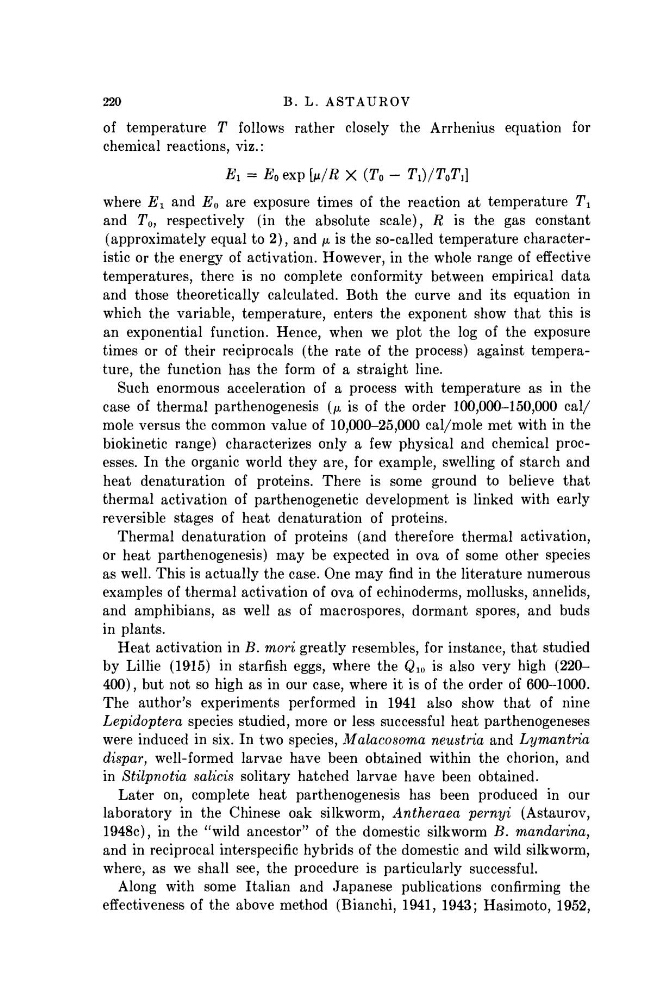
of temperature T follows rather closely the Arrhenius equation for
chemical reactions, viz.:
E x = E 0 exp [μ/R X (To - ΓΟ/ΓοΤ,]
where E 1 and E 0 are exposure times of the reaction at temperature Τ λ
and T 0 , respectively (in the absolute scale), R is the gas constant
(approximately equal to 2), and μ is the so-called temperature characteristic or the energy of activation. However, in the whole range of effective
temperatures, there is no complete conformity between empirical data
and those theoretically calculated. Both the curve and its equation in
which the variable, temperature, enters the exponent show that this is
an exponential function. Hence, when we plot the log of the exposure
times or of their reciprocals (the rate of the process) against temperature, the function has the form of a straight line.
Such enormous acceleration of a process with temperature as in the
case of thermal parthenogenesis (μ is of the order 100,000-150,000 cal/
mole versus the common value of 10,000-25,000 cal/mole met with in the
biokinetic range) characterizes only a few physical and chemical processes. In the organic world they are, for example, swelling of starch and
heat denaturation of proteins. There is some ground to believe that
thermal activation of parthenogenetic development is linked with early
reversible stages of heat denaturation of proteins.
Thermal denaturation of proteins (and therefore thermal activation,
or heat parthenogenesis) may be expected in ova of some other species
as well. This is actually the case. One may find in the literature numerous
examples of thermal activation of ova of echinoderms, mollusks, annelids,
and amphibians, as well as of macrospores, dormant spores, and buds
in plants.
Heat activation in B. mori greatly resembles, for instance, that studied
by Lillie (1915) in starfish eggs, where the Q 10 is also very high (220400), but not so high as in our case, where it is of the order of 600-1000.
The author's experiments performed in 1941 also show that of nine
Lepidoptera species studied, more or less successful heat parthénogenèses
were induced in six. In two species, Malacosoma neustria and Lymantna
dispar, well-formed larvae have been obtained within the chorion, and
in Stilpnotia salicis solitary hatched larvae have been obtained.
Later on, complete heat parthenogenesis has been produced in our
laboratory in the Chinese oak silkworm, Antheraea pernyi (Astaurov,
1948c), in the "wild ancestor" of the domestic silkworm B. mandarina,
and in reciprocal interspecific hybrids of the domestic and wild silkworm,
where, as we shall see, the procedure is particularly successful.
Along with some Italian and Japanese publications confirming the
effectiveness of the above method (Bianchi, 1941, 1943; Hasimoto, 1952,
B. L. ASTAUROV
of temperature T follows rather closely the Arrhenius equation for
chemical reactions, viz.:
E x = E 0 exp [μ/R X (To - ΓΟ/ΓοΤ,]
where E 1 and E 0 are exposure times of the reaction at temperature Τ λ
and T 0 , respectively (in the absolute scale), R is the gas constant
(approximately equal to 2), and μ is the so-called temperature characteristic or the energy of activation. However, in the whole range of effective
temperatures, there is no complete conformity between empirical data
and those theoretically calculated. Both the curve and its equation in
which the variable, temperature, enters the exponent show that this is
an exponential function. Hence, when we plot the log of the exposure
times or of their reciprocals (the rate of the process) against temperature, the function has the form of a straight line.
Such enormous acceleration of a process with temperature as in the
case of thermal parthenogenesis (μ is of the order 100,000-150,000 cal/
mole versus the common value of 10,000-25,000 cal/mole met with in the
biokinetic range) characterizes only a few physical and chemical processes. In the organic world they are, for example, swelling of starch and
heat denaturation of proteins. There is some ground to believe that
thermal activation of parthenogenetic development is linked with early
reversible stages of heat denaturation of proteins.
Thermal denaturation of proteins (and therefore thermal activation,
or heat parthenogenesis) may be expected in ova of some other species
as well. This is actually the case. One may find in the literature numerous
examples of thermal activation of ova of echinoderms, mollusks, annelids,
and amphibians, as well as of macrospores, dormant spores, and buds
in plants.
Heat activation in B. mori greatly resembles, for instance, that studied
by Lillie (1915) in starfish eggs, where the Q 10 is also very high (220400), but not so high as in our case, where it is of the order of 600-1000.
The author's experiments performed in 1941 also show that of nine
Lepidoptera species studied, more or less successful heat parthénogenèses
were induced in six. In two species, Malacosoma neustria and Lymantna
dispar, well-formed larvae have been obtained within the chorion, and
in Stilpnotia salicis solitary hatched larvae have been obtained.
Later on, complete heat parthenogenesis has been produced in our
laboratory in the Chinese oak silkworm, Antheraea pernyi (Astaurov,
1948c), in the "wild ancestor" of the domestic silkworm B. mandarina,
and in reciprocal interspecific hybrids of the domestic and wild silkworm,
where, as we shall see, the procedure is particularly successful.
Along with some Italian and Japanese publications confirming the
effectiveness of the above method (Bianchi, 1941, 1943; Hasimoto, 1952,