

IX.
DEVELOPMENT OF THE TÉLEOSTE AN EGG
393
Centrifuging of the egg (Tung et al., 1955b) just after fertilization
concentrates the determining 'plasm' in the animal hemisphere. The
latter, when isolated from the rest of the egg immediately after the
operation and cultivated, can then grow into a well differentiated embryo
(41 per cent of cases).
C
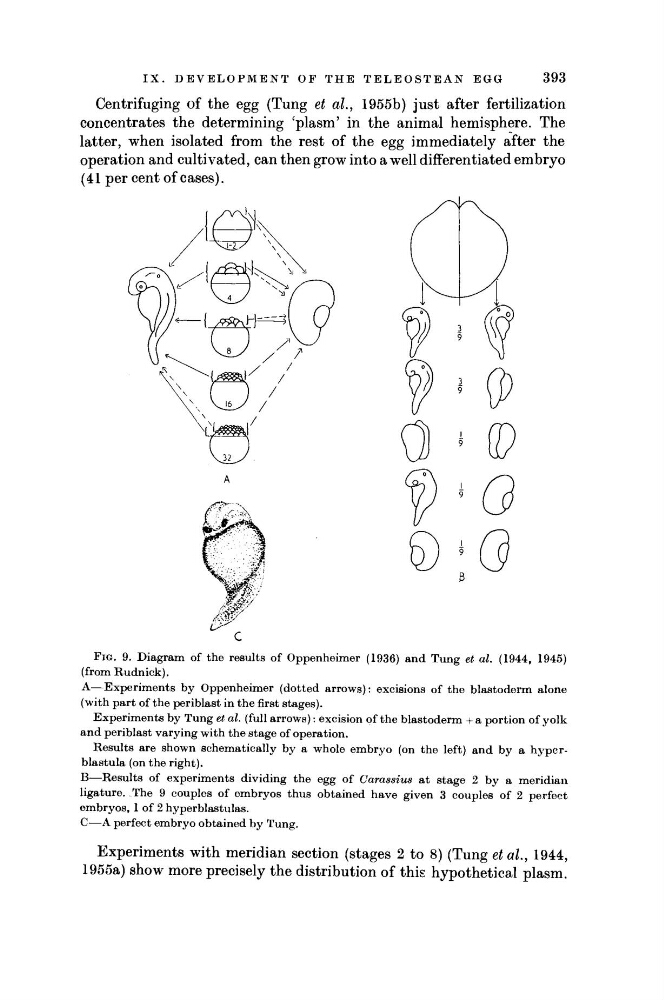
FIG. 9. Diagram of the results of Oppenheimer (1936) and Tung et al. (1944, 1945)
(from Rudnick).
A—Experiments by Oppenheimer (dotted arrows): excisions of the blastoderm alone
(with part of the periblast in the first stages).
Experiments by Tung et al. (full arrows): excision of the blastoderm + a portion of yolk
and periblast varying with the stage of operation.
Results are shown schematically by a whole embryo (on the left) and by a hyperblastula (on the right).
Β—Results of experiments dividing the egg of Carassius
at stage 2 by a meridian
ligature. The 9 couples of embryos thus obtained have given 3 couples of 2 perfect
embryos, 1 of 2 hyperblastulas.
C—A perfect embryo obtained by Tung.
Experiments with meridian section (stages 2 to 8) (Tung et al., 1944,
1955a) show more precisely the distribution of this hypothetical plasm.
DEVELOPMENT OF THE TÉLEOSTE AN EGG
393
Centrifuging of the egg (Tung et al., 1955b) just after fertilization
concentrates the determining 'plasm' in the animal hemisphere. The
latter, when isolated from the rest of the egg immediately after the
operation and cultivated, can then grow into a well differentiated embryo
(41 per cent of cases).
C
FIG. 9. Diagram of the results of Oppenheimer (1936) and Tung et al. (1944, 1945)
(from Rudnick).
A—Experiments by Oppenheimer (dotted arrows): excisions of the blastoderm alone
(with part of the periblast in the first stages).
Experiments by Tung et al. (full arrows): excision of the blastoderm + a portion of yolk
and periblast varying with the stage of operation.
Results are shown schematically by a whole embryo (on the left) and by a hyperblastula (on the right).
Β—Results of experiments dividing the egg of Carassius
at stage 2 by a meridian
ligature. The 9 couples of embryos thus obtained have given 3 couples of 2 perfect
embryos, 1 of 2 hyperblastulas.
C—A perfect embryo obtained by Tung.
Experiments with meridian section (stages 2 to 8) (Tung et al., 1944,
1955a) show more precisely the distribution of this hypothetical plasm.