

392
C H . D E V I L L E R S
A
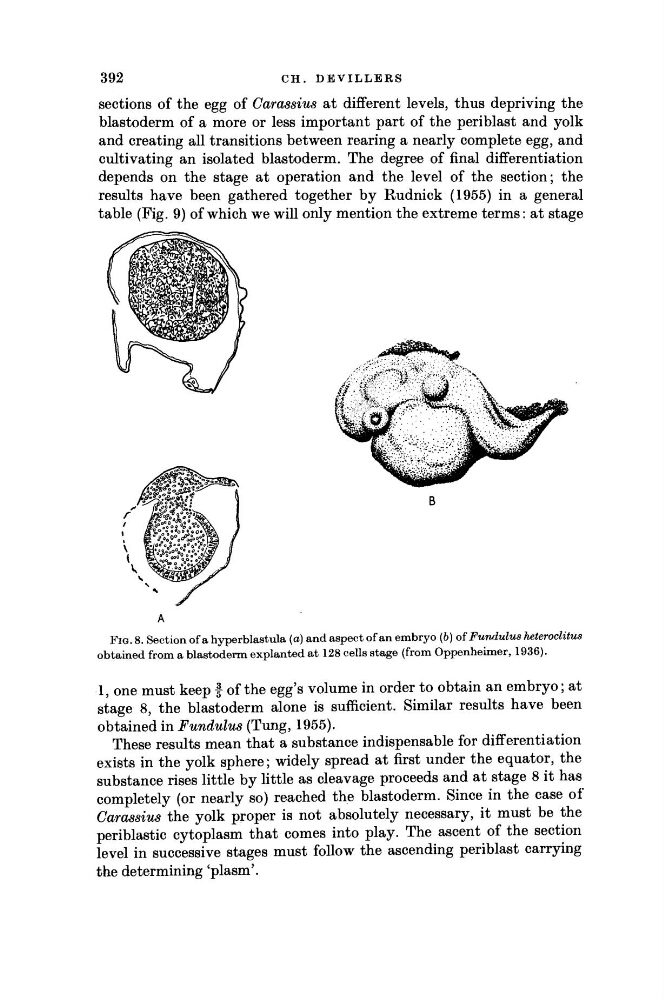
F I G . 8 . Section of a hyperblastula (a) and aspect of an embryo (b) of Fundulus heteroclitus
obtained from a blastoderm expían ted at 1 2 8 cells stage (from Oppenheimer, 1 9 3 6 ) .
•1, one must keep f of the egg's volume in order to obtain an embryo; at
stage 8, the blastoderm alone is sufficient. Similar results have been
obtained in Fundulus (Tung, 1955).
These results mean that a substance indispensable for differentiation
exists in the yolk sphere; widely spread at first under the equator, the
substance rises little by little as cleavage proceeds and at stage 8 it has
completely (or nearly so) reached the blastoderm. Since in the case o f
Carassius the yolk proper is not absolutely necessary, it must be the
periblastic cytoplasm that comes into play. The ascent of the section
level in successive stages must follow the ascending periblast carrying
the determining 'plasm'.
sections of the egg of Carassius at different levels, thus depriving the
blastoderm of a more or less important part of the periblast and yolk
and creating all transitions between rearing a nearly complete egg, and
cultivating an isolated blastoderm. The degree of final differentiation
depends on the stage at operation and the level of the section; the
results have been gathered together by Rudnick (1955) in a general
table (Fig. 9) of which we will only mention the extreme terms: at stage
C H . D E V I L L E R S
A
F I G . 8 . Section of a hyperblastula (a) and aspect of an embryo (b) of Fundulus heteroclitus
obtained from a blastoderm expían ted at 1 2 8 cells stage (from Oppenheimer, 1 9 3 6 ) .
•1, one must keep f of the egg's volume in order to obtain an embryo; at
stage 8, the blastoderm alone is sufficient. Similar results have been
obtained in Fundulus (Tung, 1955).
These results mean that a substance indispensable for differentiation
exists in the yolk sphere; widely spread at first under the equator, the
substance rises little by little as cleavage proceeds and at stage 8 it has
completely (or nearly so) reached the blastoderm. Since in the case o f
Carassius the yolk proper is not absolutely necessary, it must be the
periblastic cytoplasm that comes into play. The ascent of the section
level in successive stages must follow the ascending periblast carrying
the determining 'plasm'.
sections of the egg of Carassius at different levels, thus depriving the
blastoderm of a more or less important part of the periblast and yolk
and creating all transitions between rearing a nearly complete egg, and
cultivating an isolated blastoderm. The degree of final differentiation
depends on the stage at operation and the level of the section; the
results have been gathered together by Rudnick (1955) in a general
table (Fig. 9) of which we will only mention the extreme terms: at stage