

394
CH.
DEVILLERS
A section made at stage 2 following the cleavage plane gives results which
can be compared to those of Spemann with Amphibia. According to the
case, one obtains: two complete embryos, a complete embryo and an
atypical embryo with asymmetries of structure; or a complete embryo
and a shapeless mass (equivalent to a Bauchstück). As early as stage 2,
therefore, the whole egg has a symmetrized structure; but the blastoderm taken alone has not. It seems that the factors of this symmetrization and of the determination of the marginal zone, localized in
the periblast, must be distributed in each half as a function of the angle
formed by the symmetry plane with the plane of the first cleavage. The
differences in distribution lead to the different pairs of embryos.
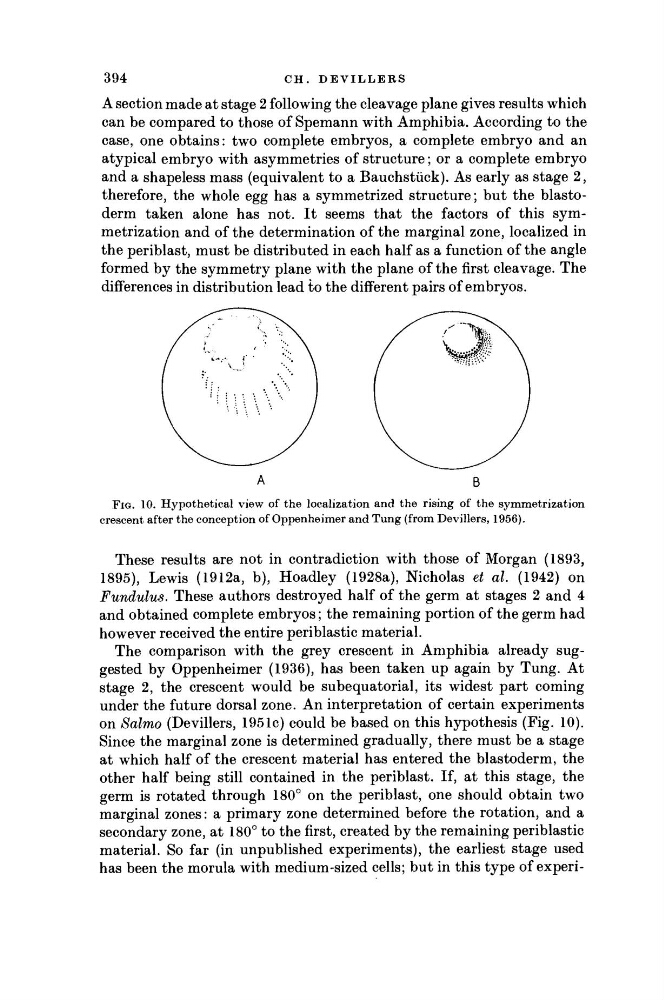
FIG. 10. Hypothetical view of the localization and the rising of the symmetrization
crescent after the conception of Oppenheimer and Tung (from Devillers, 1956).
These results are not in contradiction with those of Morgan (1893,
1895), Lewis (1912a, b), Hoadley (1928a), Nicholas et al (1942) on
Fundulus. These authors destroyed half of the germ at stages 2 and 4
and obtained complete embryos; the remaining portion of the germ had
however received the entire periblastic material.
The comparison with the grey crescent in Amphibia already suggested by Oppenheimer (1936), has been taken up again by Tung. At
stage 2, the crescent would be subequatorial, its widest part coming
under the future dorsal zone. An interpretation of certain experiments
on Salmo (Devillers, 1951c) could be based on this hypothesis (Fig. 10).
Since the marginal zone is determined gradually, there must be a stage
at which half of the crescent material has entered the blastoderm, the
other half being still contained in the periblast. If, at this stage, the
germ is rotated through 180° on the periblast, one should obtain two
marginal zones: a primary zone determined before the rotation, and a
secondary zone, at 180° to the first, created by the remaining periblastic
material. So far (in unpublished experiments), the earliest stage used
has been the morula with medium-sized cells; but in this type of experiA
Β
CH.
DEVILLERS
A section made at stage 2 following the cleavage plane gives results which
can be compared to those of Spemann with Amphibia. According to the
case, one obtains: two complete embryos, a complete embryo and an
atypical embryo with asymmetries of structure; or a complete embryo
and a shapeless mass (equivalent to a Bauchstück). As early as stage 2,
therefore, the whole egg has a symmetrized structure; but the blastoderm taken alone has not. It seems that the factors of this symmetrization and of the determination of the marginal zone, localized in
the periblast, must be distributed in each half as a function of the angle
formed by the symmetry plane with the plane of the first cleavage. The
differences in distribution lead to the different pairs of embryos.
FIG. 10. Hypothetical view of the localization and the rising of the symmetrization
crescent after the conception of Oppenheimer and Tung (from Devillers, 1956).
These results are not in contradiction with those of Morgan (1893,
1895), Lewis (1912a, b), Hoadley (1928a), Nicholas et al (1942) on
Fundulus. These authors destroyed half of the germ at stages 2 and 4
and obtained complete embryos; the remaining portion of the germ had
however received the entire periblastic material.
The comparison with the grey crescent in Amphibia already suggested by Oppenheimer (1936), has been taken up again by Tung. At
stage 2, the crescent would be subequatorial, its widest part coming
under the future dorsal zone. An interpretation of certain experiments
on Salmo (Devillers, 1951c) could be based on this hypothesis (Fig. 10).
Since the marginal zone is determined gradually, there must be a stage
at which half of the crescent material has entered the blastoderm, the
other half being still contained in the periblast. If, at this stage, the
germ is rotated through 180° on the periblast, one should obtain two
marginal zones: a primary zone determined before the rotation, and a
secondary zone, at 180° to the first, created by the remaining periblastic
material. So far (in unpublished experiments), the earliest stage used
has been the morula with medium-sized cells; but in this type of experiA
Β