

I V .
A C T I O N
O F
M O R P H O S T A T I C S U B S T A N C E S
163
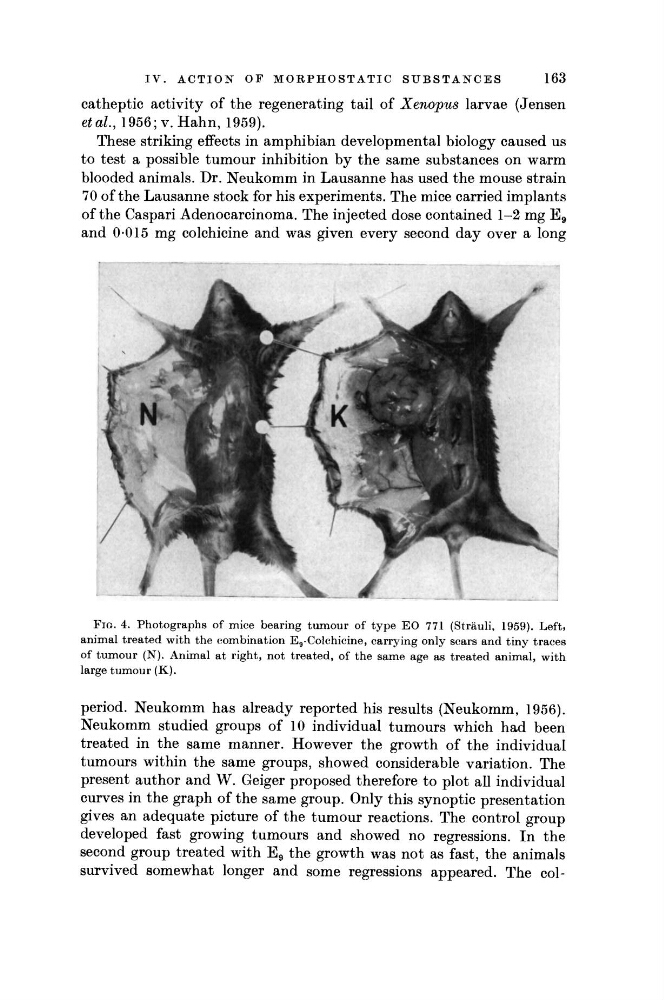
F I G . 4 . Photographs of mice bearing tumour of type E O 7 7 1 (Sträuli, 1 9 5 9 ) . Left,
animal treated with the combination E9-Colchicine, carrying only scars and tiny traces
of tumour ( N ) . Animal at right, not treated, of the same age as treated animal, with
large tumour ( K ) .
period. Neukomm has already reported his results (Neukomm, 1956).
Neukomm studied groups of 10 individual tumours which had been
treated in the same manner. However the growth of the individual
tumours within the same groups, showed considerable variation. The
present author and W . Geiger proposed therefore to plot all individual
curves in the graph of the same group. Only this synoptic presentation
gives an adequate picture of the tumour reactions. The control group
developed fast growing tumours and showed no regressions. In the
second group treated with E 9 the growth was not as fast, the animals
survived somewhat longer and some regressions appeared. The colcatheptic activity of the regenerating tail of Xenopus larvae (Jensen
etal, 1956; v. Hahn, 1959).
These striking effects in amphibian developmental biology caused us
to test a possible tumour inhibition by the same substances on warm
blooded animals. Dr. Neukomm in Lausanne has used the mouse strain
70 of the Lausanne stock for his experiments. The mice carried implants
of the Caspari Adenocarcinoma. The injected dose contained 1-2 mg E 9
and 0-015 mg colchicine and was given every second day over a long
A C T I O N
O F
M O R P H O S T A T I C S U B S T A N C E S
163
F I G . 4 . Photographs of mice bearing tumour of type E O 7 7 1 (Sträuli, 1 9 5 9 ) . Left,
animal treated with the combination E9-Colchicine, carrying only scars and tiny traces
of tumour ( N ) . Animal at right, not treated, of the same age as treated animal, with
large tumour ( K ) .
period. Neukomm has already reported his results (Neukomm, 1956).
Neukomm studied groups of 10 individual tumours which had been
treated in the same manner. However the growth of the individual
tumours within the same groups, showed considerable variation. The
present author and W . Geiger proposed therefore to plot all individual
curves in the graph of the same group. Only this synoptic presentation
gives an adequate picture of the tumour reactions. The control group
developed fast growing tumours and showed no regressions. In the
second group treated with E 9 the growth was not as fast, the animals
survived somewhat longer and some regressions appeared. The colcatheptic activity of the regenerating tail of Xenopus larvae (Jensen
etal, 1956; v. Hahn, 1959).
These striking effects in amphibian developmental biology caused us
to test a possible tumour inhibition by the same substances on warm
blooded animals. Dr. Neukomm in Lausanne has used the mouse strain
70 of the Lausanne stock for his experiments. The mice carried implants
of the Caspari Adenocarcinoma. The injected dose contained 1-2 mg E 9
and 0-015 mg colchicine and was given every second day over a long