

128
LUISE STANGE
different rates of increase in chloroplast number cannot be related only
to the fact that the number of chloroplasts per cell before isolation is
much less in the basal leaves than in the apical leaves. Chloroplast size
is about the same in the two types of leaves.
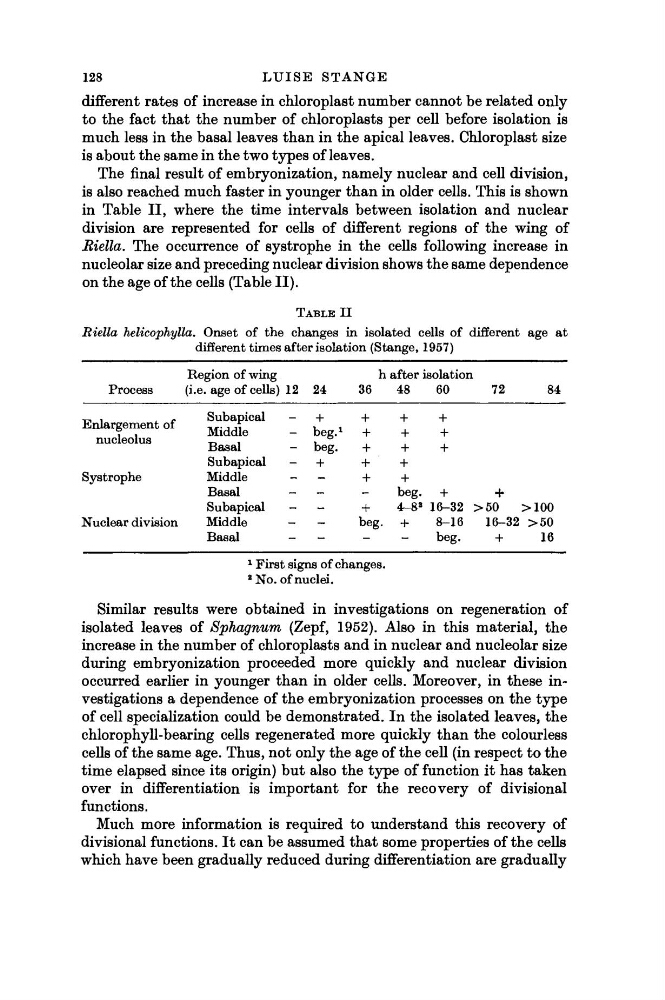
The final result of embryonization, namely nuclear and cell division,
is also reached much faster in younger than in older cells. This is shown
in Table II, where the time intervals between isolation and nuclear
division are represented for cells of different regions of the wing of
Biella. The occurrence of systrophe in the cells following increase in
nucleolar size and preceding nuclear division shows the same dependence
on the age of the cells (Table II).
TABLE I I
Riella helicophylla. Onset of the changes in isolated cells of different age at
different times after isolation (Stange, 1957)
Region of wing
h after isolation
Process
(i.e. age of cells) 12 24
36
48
60
72
84
+
+
+
+
beg.
1
+
+
+
beg.
+
+
+
+
+
+
+
+
beg. +
+
+
4-8
a 16-32 >50
>100
beg. +
8-16
16-32 >50
-
beg.
+
16
1 First signs of changes.
2 No. of nuclei.
Similar results were obtained in investigations on regeneration of
isolated leaves of Sphagnum (Zepf, 1952). Also in this material, the
increase in the number of chloroplasts and in nuclear and nucleolar size
during embryonization proceeded more quickly and nuclear division
occurred earlier in younger than in older cells. Moreover, in these investigations a dependence of the embryonization processes on the type
of cell specialization could be demonstrated. In the isolated leaves, the
chlorophyll-bearing cells regenerated more quickly than the colourless
cells of the same age. Thus, not only the age of the cell (in respect to the
time elapsed since its origin) but also the type of function it has taken
over in differentiation is important for the recovery of divisional
functions.
Much more information is required to understand this recovery of
divisional functions. It can be assumed that some properties of the cells
which have been gradually reduced during differentiation are gradually
Enlargement of
nucleolus
Systrophe
Nuclear division
Subapical
Middle
Basal
Subapical
Middle
Basal
Subapical
Middle
Basal
LUISE STANGE
different rates of increase in chloroplast number cannot be related only
to the fact that the number of chloroplasts per cell before isolation is
much less in the basal leaves than in the apical leaves. Chloroplast size
is about the same in the two types of leaves.
The final result of embryonization, namely nuclear and cell division,
is also reached much faster in younger than in older cells. This is shown
in Table II, where the time intervals between isolation and nuclear
division are represented for cells of different regions of the wing of
Biella. The occurrence of systrophe in the cells following increase in
nucleolar size and preceding nuclear division shows the same dependence
on the age of the cells (Table II).
TABLE I I
Riella helicophylla. Onset of the changes in isolated cells of different age at
different times after isolation (Stange, 1957)
Region of wing
h after isolation
Process
(i.e. age of cells) 12 24
36
48
60
72
84
+
+
+
+
beg.
1
+
+
+
beg.
+
+
+
+
+
+
+
+
beg. +
+
+
4-8
a 16-32 >50
>100
beg. +
8-16
16-32 >50
-
beg.
+
16
1 First signs of changes.
2 No. of nuclei.
Similar results were obtained in investigations on regeneration of
isolated leaves of Sphagnum (Zepf, 1952). Also in this material, the
increase in the number of chloroplasts and in nuclear and nucleolar size
during embryonization proceeded more quickly and nuclear division
occurred earlier in younger than in older cells. Moreover, in these investigations a dependence of the embryonization processes on the type
of cell specialization could be demonstrated. In the isolated leaves, the
chlorophyll-bearing cells regenerated more quickly than the colourless
cells of the same age. Thus, not only the age of the cell (in respect to the
time elapsed since its origin) but also the type of function it has taken
over in differentiation is important for the recovery of divisional
functions.
Much more information is required to understand this recovery of
divisional functions. It can be assumed that some properties of the cells
which have been gradually reduced during differentiation are gradually
Enlargement of
nucleolus
Systrophe
Nuclear division
Subapical
Middle
Basal
Subapical
Middle
Basal
Subapical
Middle
Basal