

REGENERATION IN LOWER PLANTS
129
restored. Division can occur only after these properties have exceeded
a definite threshold value. In this connexion it is interesting that it was
possible in Riella to influence the process of ageing as far as withdrawal
from divisional functions is concerned (Karsten, 1963, and in preparation). Plants of Riella were precultured under light and dark changes of
12 : 12 h. At the beginning of the experiment, a small incision was made
in the margin of the wing in all plants at a short equal distance from the
apical meristem. The tissue directly below this incision was used for the
regeneration experiments by cutting out fragments of equal size and
determining the time until the first nuclear divisions occurred. The
effect of different pretreatments of the plants was compared. In the
control, fragments were cut at the beginning of the experiment. Other
plants were kept in the dark for 3, 6 or 12 days or under further lightdark changes for 12 days. After 12 days the incision was displaced from
the apical region to the basal region in all plants both in the light and in
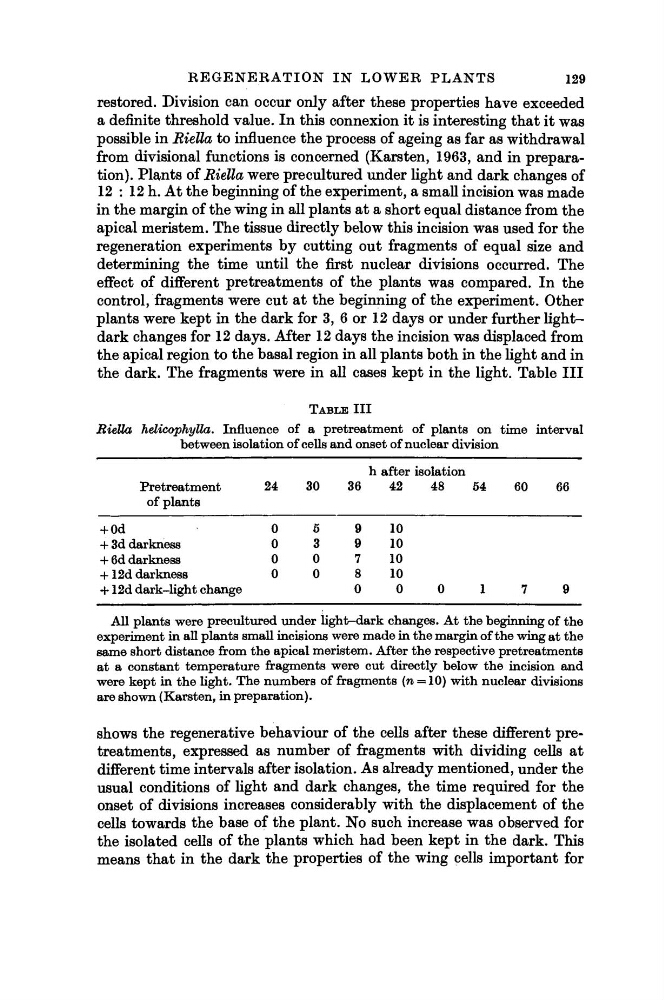
the dark. The fragments were in all cases kept in the light. Table III
TABLE III
Riella helicophylla. Influence of a pretreatment of plants on time interval
between isolation of cells and onset of nuclear division
Pretreatment
of plants
+ 0d
+ 3d darkness
+ 6d darkness
4- 12d darkness
+ 12d dark-light change
24
0
0
0
0
30
5
3
0
0
36
9
9
7
8
0
h after isolation
42
10
10
10
10
0
48
0
54
1
60
7
66
9
All plants were precultured under light-dark changes. At the beginning of the
experiment in all plants small incisions were made in the margin of the wing at the
same short distance from the apical meristem. After the respective pretreatments
at a constant temperature fragments were cut directly below the incision and
were kept in the light. The numbers of fragments (n = 10) with nuclear divisions
are shown (Karsten, in preparation).
shows the regenerative behaviour of the cells after these different pretreatments, expressed as number of fragments with dividing cells at
different time intervals after isolation. As already mentioned, under the
usual conditions of light and dark changes, the time required for the
onset of divisions increases considerably with the displacement of the
cells towards the base of the plant. No such increase was observed for
the isolated cells of the plants which had been kept in the dark. This
means that in the dark the properties of the wing cells important for
129
restored. Division can occur only after these properties have exceeded
a definite threshold value. In this connexion it is interesting that it was
possible in Riella to influence the process of ageing as far as withdrawal
from divisional functions is concerned (Karsten, 1963, and in preparation). Plants of Riella were precultured under light and dark changes of
12 : 12 h. At the beginning of the experiment, a small incision was made
in the margin of the wing in all plants at a short equal distance from the
apical meristem. The tissue directly below this incision was used for the
regeneration experiments by cutting out fragments of equal size and
determining the time until the first nuclear divisions occurred. The
effect of different pretreatments of the plants was compared. In the
control, fragments were cut at the beginning of the experiment. Other
plants were kept in the dark for 3, 6 or 12 days or under further lightdark changes for 12 days. After 12 days the incision was displaced from
the apical region to the basal region in all plants both in the light and in
the dark. The fragments were in all cases kept in the light. Table III
TABLE III
Riella helicophylla. Influence of a pretreatment of plants on time interval
between isolation of cells and onset of nuclear division
Pretreatment
of plants
+ 0d
+ 3d darkness
+ 6d darkness
4- 12d darkness
+ 12d dark-light change
24
0
0
0
0
30
5
3
0
0
36
9
9
7
8
0
h after isolation
42
10
10
10
10
0
48
0
54
1
60
7
66
9
All plants were precultured under light-dark changes. At the beginning of the
experiment in all plants small incisions were made in the margin of the wing at the
same short distance from the apical meristem. After the respective pretreatments
at a constant temperature fragments were cut directly below the incision and
were kept in the light. The numbers of fragments (n = 10) with nuclear divisions
are shown (Karsten, in preparation).
shows the regenerative behaviour of the cells after these different pretreatments, expressed as number of fragments with dividing cells at
different time intervals after isolation. As already mentioned, under the
usual conditions of light and dark changes, the time required for the
onset of divisions increases considerably with the displacement of the
cells towards the base of the plant. No such increase was observed for
the isolated cells of the plants which had been kept in the dark. This
means that in the dark the properties of the wing cells important for