

REGENERATION IN LOWER PLANTS
127
cells of apical and basal regions are clearly expressed by different rates
of the changes. The curves for the changes in the younger cells are
steeper than those for the older cells. Consequently, the chloroplasts
CO
o
UJ
o
o
Q:
Lu
K,
UJ
24
48
TIME
AFTER
72
915
ISOLATION
120 h
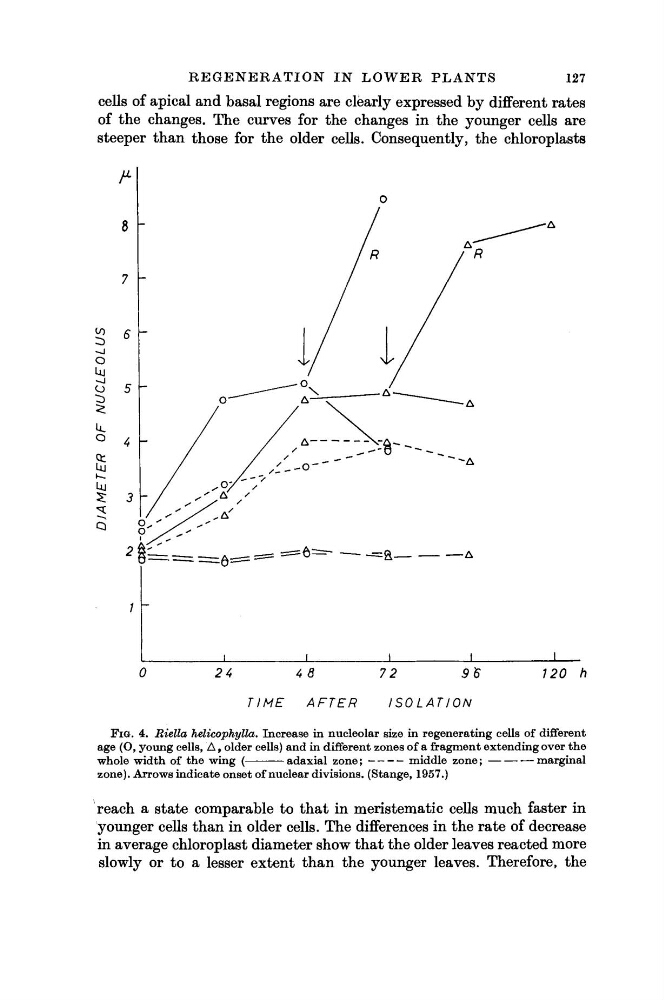
FIG. 4. Riella helicophylla. Increase in nucleolar size in regenerating cells of different
age (O, young cells, Δ , older cells) and in different zones of a fragment extending over the
whole width of the wing (
adaxial zone ;
middle zone ;
marginal
zone). Arrows indicate onset of nuclear divisions. (Stange, 1957.)
reach a state comparable to that in meristematic cells much faster in
younger cells than in older cells. The differences in the rate of decrease
in average chloroplast diameter show that the older leaves reacted more
slowly or to a lesser extent than the younger leaves. Therefore, the
127
cells of apical and basal regions are clearly expressed by different rates
of the changes. The curves for the changes in the younger cells are
steeper than those for the older cells. Consequently, the chloroplasts
CO
o
UJ
o
o
Q:
Lu
K,
UJ
24
48
TIME
AFTER
72
915
ISOLATION
120 h
FIG. 4. Riella helicophylla. Increase in nucleolar size in regenerating cells of different
age (O, young cells, Δ , older cells) and in different zones of a fragment extending over the
whole width of the wing (
adaxial zone ;
middle zone ;
marginal
zone). Arrows indicate onset of nuclear divisions. (Stange, 1957.)
reach a state comparable to that in meristematic cells much faster in
younger cells than in older cells. The differences in the rate of decrease
in average chloroplast diameter show that the older leaves reacted more
slowly or to a lesser extent than the younger leaves. Therefore, the