

344
Z. RYCHTER
examined the question of their mutual dependence. They stated that if
either the two 6th aortic arches or the arcus aortae (4D in the chick; 4s
in the rat) failed to form, a ventricular septal defect constantly developed. Rychter and Lemez (1958a, b) examined a large sample of
material and found that a constant disturbance of ventricular septation
occurred only after suppression of both pulmonary arches (6 D 6 S and
other combinations containing them) or after elimination of all left
ventricular aortic arches (4D3D3S4S and other combinations containing
them). On the contrary, after the suppression of 4 D alone a ventricular
septal defect was present in 34-0%, in the combination 4D4S a defect
was present in 30-5%, in 4 D 3 D it was present in 38-3%, and in 4 D 3s
25*5% showed a defect. In the last combination, as mentioned above,
the substitute arcus aortae developed more frequently from 4 S and
therefore the frequency of the ventricular defects begins to decrease.
In the combination of 6 D 4 D the defect rate was 17-7% and in the
combination 6 S 4 D it was 3-2%. The simultaneous elimination of one
pulmonary arch led to a better equilibrium between the two ventricles,
the haemodynamic significance of 6s being again more pronounced.
The incidence of ventricular septal defect was higher (82-7%) in cases
of dissociation, regardless of the combination which led to its occurrence
(Rychter and Lemez, 1960b).
3. Haemodynamic Effects of the Suppression of Both Pulmonary
Arches Analysed by Coloured Laminar Blood Streams
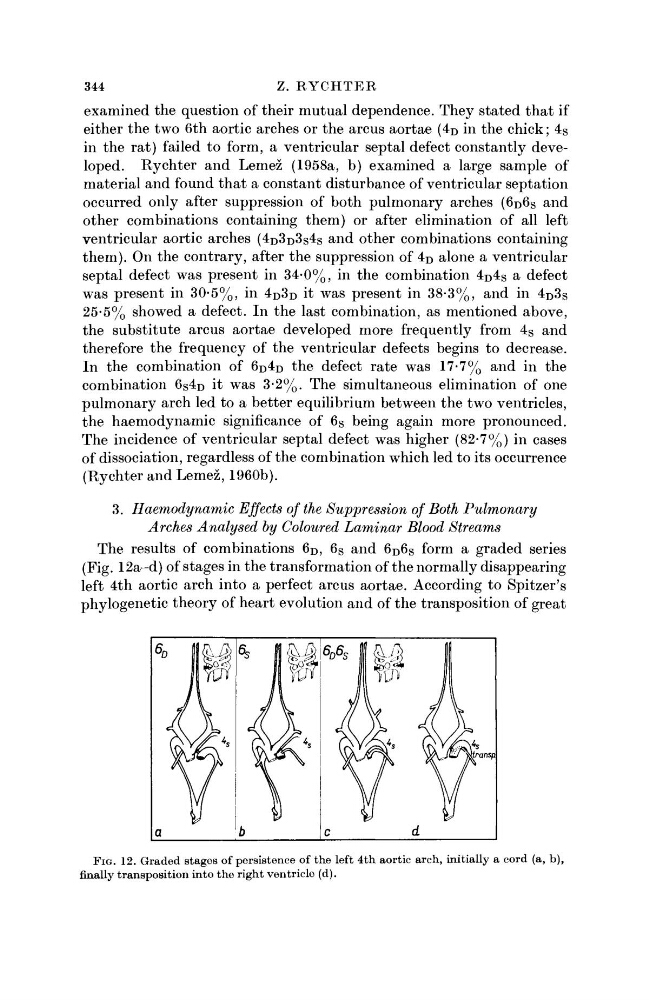
The results of combinations 6 D , 6 S and 6 D 6s form a graded series
(Fig. 12a-d) of stages in the transformation of the normally disappearing
left 4th aortic arch into a perfect arcus aortae. According to Spitzer's
phylogenetic theory of heart evolution and of the transposition of great
FIG. 12. Graded stages of persistence of the left 4th aortic arch, initially a cord (a, b),
finally transposition into the right ventricle (d).
Z. RYCHTER
examined the question of their mutual dependence. They stated that if
either the two 6th aortic arches or the arcus aortae (4D in the chick; 4s
in the rat) failed to form, a ventricular septal defect constantly developed. Rychter and Lemez (1958a, b) examined a large sample of
material and found that a constant disturbance of ventricular septation
occurred only after suppression of both pulmonary arches (6 D 6 S and
other combinations containing them) or after elimination of all left
ventricular aortic arches (4D3D3S4S and other combinations containing
them). On the contrary, after the suppression of 4 D alone a ventricular
septal defect was present in 34-0%, in the combination 4D4S a defect
was present in 30-5%, in 4 D 3 D it was present in 38-3%, and in 4 D 3s
25*5% showed a defect. In the last combination, as mentioned above,
the substitute arcus aortae developed more frequently from 4 S and
therefore the frequency of the ventricular defects begins to decrease.
In the combination of 6 D 4 D the defect rate was 17-7% and in the
combination 6 S 4 D it was 3-2%. The simultaneous elimination of one
pulmonary arch led to a better equilibrium between the two ventricles,
the haemodynamic significance of 6s being again more pronounced.
The incidence of ventricular septal defect was higher (82-7%) in cases
of dissociation, regardless of the combination which led to its occurrence
(Rychter and Lemez, 1960b).
3. Haemodynamic Effects of the Suppression of Both Pulmonary
Arches Analysed by Coloured Laminar Blood Streams
The results of combinations 6 D , 6 S and 6 D 6s form a graded series
(Fig. 12a-d) of stages in the transformation of the normally disappearing
left 4th aortic arch into a perfect arcus aortae. According to Spitzer's
phylogenetic theory of heart evolution and of the transposition of great
FIG. 12. Graded stages of persistence of the left 4th aortic arch, initially a cord (a, b),
finally transposition into the right ventricle (d).