

2 1 8
S I L V I O R A N Z I
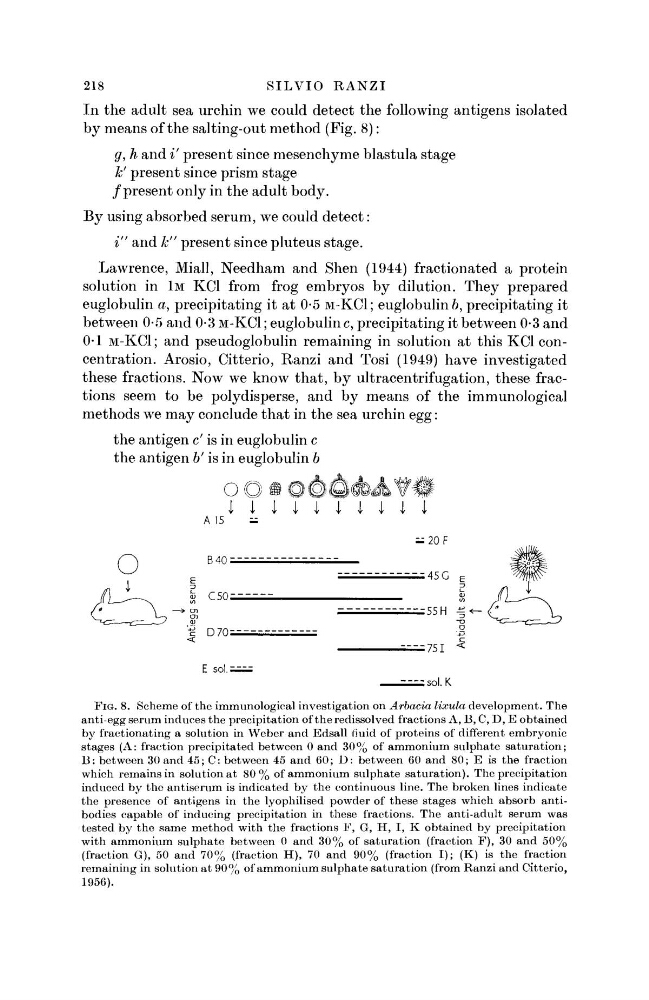
In the adult sea urchin we could detect the following antigens isolated
by means of the salting-out method (Fig. 8):
g, In and V present since mesenchyme blastula stage
¥ present since prism stage
/present only in the adult body.
By using absorbed serum, we could detect:
i" and k" present since pluteus stage.
Lawrence, Miall, Needham and Shen (1944) fractionated a protein
solution in IM KC1 from frog embryos by dilution. They prepared
euglobulin a, precipitating it at 0-5 M-KC1; euglobulin 6, precipitating it
between 0-5 and 0-3 M-KC1; euglobulin c, precipitating it between 0-3 and
0-1 M - K C I ; and pseudoglobulin remaining in solution at this KC1 concentration. Arosio, Citterio, Ranzi and Tosi (1949) have investigated
these fractions. Now we know that, by ultracentrifugation, these fractions seem to be polydisperse, and by means of the immunological
methods we may conclude that in the sea urchin egg:
the antigen c' is in euglobulin c
the antigen b' is in euglobulin b
A 15
oQi ÜiÄAff
O
M 0 :
e
D70 =
<
E s o l . = =
— 20 F
— 45 G
— 55 H
— 751
= sol.K
FIG. 8. Scheme of the immunological investigation on Arbacia lixula development. The
anti-egg serum induces the precipitation of theredissolved fractions A, B, C, D, E obtained
by fractionating a solution in Weber and Edsall fluid of proteins of different embryonic
stages (A: fraction precipitated between 0 and 30% of ammonium sulphate saturation;
B : between 30 and 45; C: between 45 and 60; D: between 60 and 80; E is the fraction
which remains in solution at 8 0 % of ammonium sulphate saturation). The precipitation
induced by the antiserum is indicated by the continuous line. The broken lines indicate
the presence of antigens in the lyophilised powder of these stages which absorb antibodies capable of inducing precipitation in these fractions. The anti-adult serum was
tested by the same method with the fractions F, G, H, I, K obtained by precipitation
with ammonium sulphate between 0 and 30% of saturation (fraction F), 30 and 50%
(fraction G), 50 and 70% (fraction H), 70 and 90% (fraction I); (K) is the fraction
remaining in solution at 90% of ammonium sulphate saturation (from Ranzi and Citterio,
1956).
S I L V I O R A N Z I
In the adult sea urchin we could detect the following antigens isolated
by means of the salting-out method (Fig. 8):
g, In and V present since mesenchyme blastula stage
¥ present since prism stage
/present only in the adult body.
By using absorbed serum, we could detect:
i" and k" present since pluteus stage.
Lawrence, Miall, Needham and Shen (1944) fractionated a protein
solution in IM KC1 from frog embryos by dilution. They prepared
euglobulin a, precipitating it at 0-5 M-KC1; euglobulin 6, precipitating it
between 0-5 and 0-3 M-KC1; euglobulin c, precipitating it between 0-3 and
0-1 M - K C I ; and pseudoglobulin remaining in solution at this KC1 concentration. Arosio, Citterio, Ranzi and Tosi (1949) have investigated
these fractions. Now we know that, by ultracentrifugation, these fractions seem to be polydisperse, and by means of the immunological
methods we may conclude that in the sea urchin egg:
the antigen c' is in euglobulin c
the antigen b' is in euglobulin b
A 15
oQi ÜiÄAff
O
M 0 :
e
D70 =
<
E s o l . = =
— 20 F
— 45 G
— 55 H
— 751
= sol.K
FIG. 8. Scheme of the immunological investigation on Arbacia lixula development. The
anti-egg serum induces the precipitation of theredissolved fractions A, B, C, D, E obtained
by fractionating a solution in Weber and Edsall fluid of proteins of different embryonic
stages (A: fraction precipitated between 0 and 30% of ammonium sulphate saturation;
B : between 30 and 45; C: between 45 and 60; D: between 60 and 80; E is the fraction
which remains in solution at 8 0 % of ammonium sulphate saturation). The precipitation
induced by the antiserum is indicated by the continuous line. The broken lines indicate
the presence of antigens in the lyophilised powder of these stages which absorb antibodies capable of inducing precipitation in these fractions. The anti-adult serum was
tested by the same method with the fractions F, G, H, I, K obtained by precipitation
with ammonium sulphate between 0 and 30% of saturation (fraction F), 30 and 50%
(fraction G), 50 and 70% (fraction H), 70 and 90% (fraction I); (K) is the fraction
remaining in solution at 90% of ammonium sulphate saturation (from Ranzi and Citterio,
1956).