

P R O T E I N S I N D E V E L O P M E N T
217
By the same procedure we obtained from the adult sea urchin four
fractions precipitating respectively at 20, 45, 55 and 75% of ammonium
sulphate saturation plus the fraction which remains in solution at 90%
of ammonium sulphate saturation. Experiments were made to study
(1) precipitation obtained by a non-absorbed antiserum; (2) precipitation obtained by an antiserum absorbed on the powder of the different
stages.
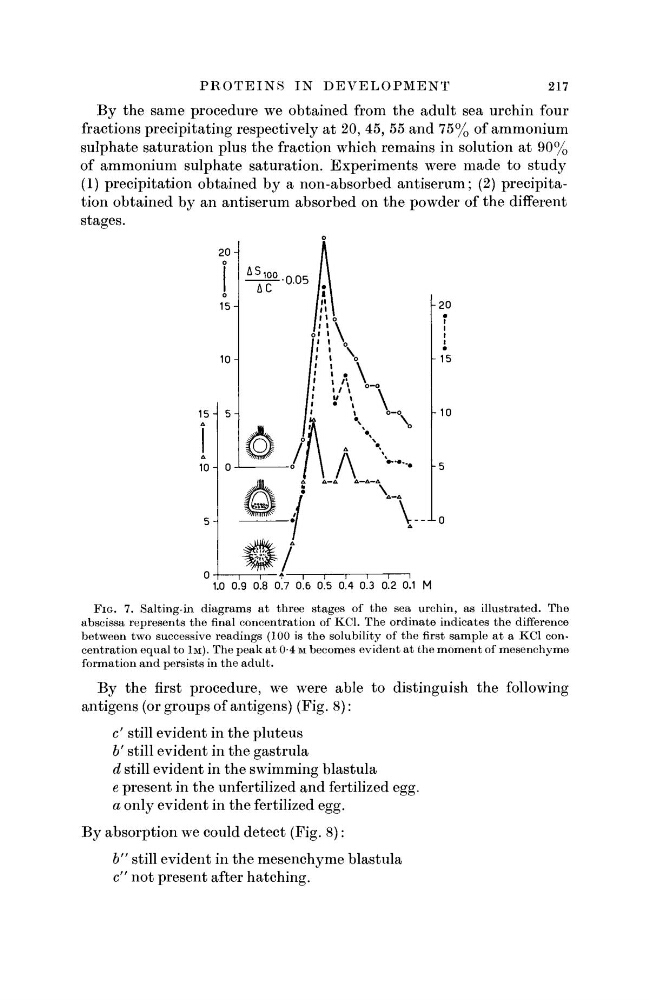
FIG. 7. Salting-in diagrams at three stages of the sea urchin, as illustrated. The
abscissa represents the final concentration of KCl. The ordinate indicates the difference
between two successive readings (100 is the solubility of the first sample at a KCl concentration equal to 1M). The peak at 0-4 M becomes evident at the moment of mesenchyme
formation and persists in the adult.
By the first procedure, we were able to distinguish the following
antigens (or groups of antigens) (Fig. 8):
c' still evident in the pluteus
V still evident in the gastrula
d still evident in the swimming blastula
e present in the unfertilized and fertilized egg.
a only evident in the fertilized egg.
By absorption we could detect (Fig. 8):
b" still evident in the mesenchyme blastula
c" not present after hatching.
217
By the same procedure we obtained from the adult sea urchin four
fractions precipitating respectively at 20, 45, 55 and 75% of ammonium
sulphate saturation plus the fraction which remains in solution at 90%
of ammonium sulphate saturation. Experiments were made to study
(1) precipitation obtained by a non-absorbed antiserum; (2) precipitation obtained by an antiserum absorbed on the powder of the different
stages.
FIG. 7. Salting-in diagrams at three stages of the sea urchin, as illustrated. The
abscissa represents the final concentration of KCl. The ordinate indicates the difference
between two successive readings (100 is the solubility of the first sample at a KCl concentration equal to 1M). The peak at 0-4 M becomes evident at the moment of mesenchyme
formation and persists in the adult.
By the first procedure, we were able to distinguish the following
antigens (or groups of antigens) (Fig. 8):
c' still evident in the pluteus
V still evident in the gastrula
d still evident in the swimming blastula
e present in the unfertilized and fertilized egg.
a only evident in the fertilized egg.
By absorption we could detect (Fig. 8):
b" still evident in the mesenchyme blastula
c" not present after hatching.