

114
ALBERTO MONROY AND RACHELE MAGGIO
animalizing agents) are electively bound to the cells of the vegetative
territory of the sea urchin larva are also worth quoting here, as this
would indicate that in these territories proteins are present which differ
from those of the rest of the embryo.
The most prominent, i.e., easily recognizable process of differentiation
that begins at the gastrula stage is the formation of the skeleton. This
has been shown to take place within a matrix which is secreted by the
cells of the primary mesenchyme (Okazaki, 1960). Although the chemical
nature of the matrix is at present unknown, it has been suggested
(Okazaki, 1960), by analogy with the process of shell formation in
I
1
I
!
!
i
S.B. M.B.
E.G.
M.G.
L.G.
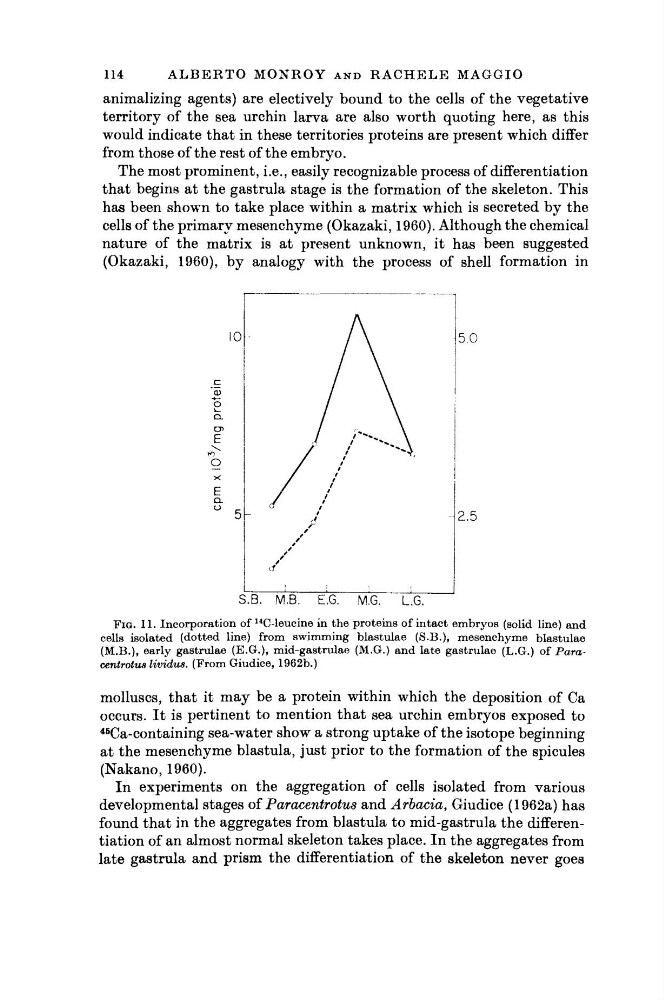
FIG. 11. Incorporation of
14
C-leucine in the proteins of intact embryos (solid line) and
cells isolated (dotted line) from swimming blastulae (S.B.), mesenchyme blastulae
(M.B.), early gastrulae (E.G.), mid-gastrulae (M.G.) and late gastrulae (L.G.) of Paracentrotue lividus. (From Giudice, 1962b.)
molluscs, that it may be a protein within which the deposition of Ca
occurs. It is pertinent to mention that sea urchin embryos exposed to
45
Ca-containing sea-water show a strong uptake of the isotope beginning
at the mesenchyme blastula, just prior to the formation of the spicules
(Nakano, 1960).
In experiments on the aggregation of cells isolated from various
developmental stages of Paracentrotus and Arbacia, Giudice (1962a) has
found that in the aggregates from blastula to mid-gastrula the differentiation of an almost normal skeleton takes place. In the aggregates from
late gastrula and prism the differentiation of the skeleton never goes
ALBERTO MONROY AND RACHELE MAGGIO
animalizing agents) are electively bound to the cells of the vegetative
territory of the sea urchin larva are also worth quoting here, as this
would indicate that in these territories proteins are present which differ
from those of the rest of the embryo.
The most prominent, i.e., easily recognizable process of differentiation
that begins at the gastrula stage is the formation of the skeleton. This
has been shown to take place within a matrix which is secreted by the
cells of the primary mesenchyme (Okazaki, 1960). Although the chemical
nature of the matrix is at present unknown, it has been suggested
(Okazaki, 1960), by analogy with the process of shell formation in
I
1
I
!
!
i
S.B. M.B.
E.G.
M.G.
L.G.
FIG. 11. Incorporation of
14
C-leucine in the proteins of intact embryos (solid line) and
cells isolated (dotted line) from swimming blastulae (S.B.), mesenchyme blastulae
(M.B.), early gastrulae (E.G.), mid-gastrulae (M.G.) and late gastrulae (L.G.) of Paracentrotue lividus. (From Giudice, 1962b.)
molluscs, that it may be a protein within which the deposition of Ca
occurs. It is pertinent to mention that sea urchin embryos exposed to
45
Ca-containing sea-water show a strong uptake of the isotope beginning
at the mesenchyme blastula, just prior to the formation of the spicules
(Nakano, 1960).
In experiments on the aggregation of cells isolated from various
developmental stages of Paracentrotus and Arbacia, Giudice (1962a) has
found that in the aggregates from blastula to mid-gastrula the differentiation of an almost normal skeleton takes place. In the aggregates from
late gastrula and prism the differentiation of the skeleton never goes