

MECHANISMS OF HORMONE ACTIONS
193
strate which was expected to be affected by insulin, and an animal
preparation in which the rate of metabolism of that substrate was as
close to zero as possible. Galactose was chosen, since it is a naturally
occurring isomer of glucose and also because the work of Wierzuchowski (1931) had shown an influence of insulin on the galactose tolerance
of dogs. The test preparation was the eviscerated nephrectomized dog,
since galactose is metabolized primarily by liver, gut, and kidney. It can
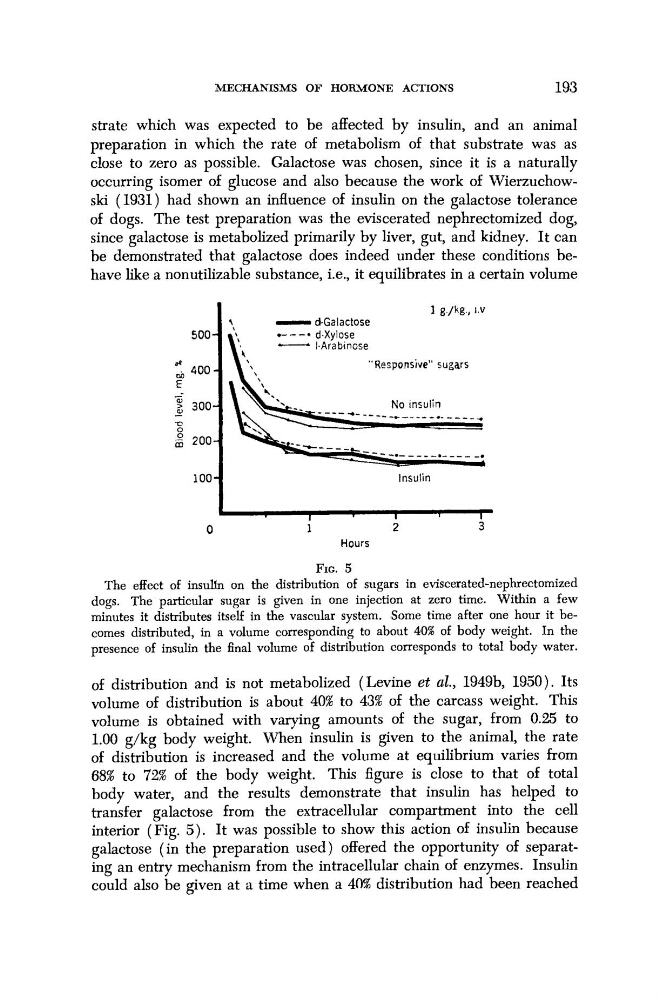
be demonstrated that galactose does indeed under these conditions behave like a nonutilizable substance, i.e., it equilibrates in a certain volume
5001 400
ε
I 300
1 200
100
0
1
2
3
Hours
FIG. 5
The effect of insulin on the distribution of sugars in eviscerated-nephrectomized
dogs. The particular sugar is given in one injection at zero time. Within a few
minutes it distributes itself in the vascular system. Some time after one hour it becomes distributed, in a volume corresponding to about 40% of body weight. In the
presence of insulin the final volume of distribution corresponds to total body water.
of distribution and is not metabolized (Levine et al, 1949b, 1950). Its
volume of distribution is about 40% to 43% of the carcass weight. This
volume is obtained with varying amounts of the sugar, from 0.25 to
1.00 g/kg body weight. When insulin is given to the animal, the rate
of distribution is increased and the volume at equilibrium varies from
68% to 72% of the body weight. This figure is close to that of total
body water, and the results demonstrate that insulin has helped to
transfer galactose from the extracellular compartment into the cell
interior (Fig. 5). It was possible to show this action of insulin because
galactose (in the preparation used) offered the opportunity of separating an entry mechanism from the intracellular chain of enzymes. Insulin
could also be given at a time when a 40% distribution had been reached
1 g/kg., IV
Insulin
193
strate which was expected to be affected by insulin, and an animal
preparation in which the rate of metabolism of that substrate was as
close to zero as possible. Galactose was chosen, since it is a naturally
occurring isomer of glucose and also because the work of Wierzuchowski (1931) had shown an influence of insulin on the galactose tolerance
of dogs. The test preparation was the eviscerated nephrectomized dog,
since galactose is metabolized primarily by liver, gut, and kidney. It can
be demonstrated that galactose does indeed under these conditions behave like a nonutilizable substance, i.e., it equilibrates in a certain volume
5001 400
ε
I 300
1 200
100
0
1
2
3
Hours
FIG. 5
The effect of insulin on the distribution of sugars in eviscerated-nephrectomized
dogs. The particular sugar is given in one injection at zero time. Within a few
minutes it distributes itself in the vascular system. Some time after one hour it becomes distributed, in a volume corresponding to about 40% of body weight. In the
presence of insulin the final volume of distribution corresponds to total body water.
of distribution and is not metabolized (Levine et al, 1949b, 1950). Its
volume of distribution is about 40% to 43% of the carcass weight. This
volume is obtained with varying amounts of the sugar, from 0.25 to
1.00 g/kg body weight. When insulin is given to the animal, the rate
of distribution is increased and the volume at equilibrium varies from
68% to 72% of the body weight. This figure is close to that of total
body water, and the results demonstrate that insulin has helped to
transfer galactose from the extracellular compartment into the cell
interior (Fig. 5). It was possible to show this action of insulin because
galactose (in the preparation used) offered the opportunity of separating an entry mechanism from the intracellular chain of enzymes. Insulin
could also be given at a time when a 40% distribution had been reached
1 g/kg., IV
Insulin