

194
RACHMIEL LEVINE
and that it would open up an intracellular area for galactose which had
previously been inaccessible. Using eviscerated nephrectomized rats, the
above phenomena were reproduced, and in addition it was shown that
no appreciable loss of galactose occurred during the experiment (Levine
et al, 1950).
In other experiments it was demonstrated that the described "transfer"
action of insulin must be specific for a certain group of substances. It
did not affect the rate or the volume of distribution of urea, alanine,
creatinine, sucrose, or sodium chloride. In order to gain some insight
into the system affected by the hormone the volume of distribution of a
100 Η
1
1
I
1 I
0
1
2
3
Hours
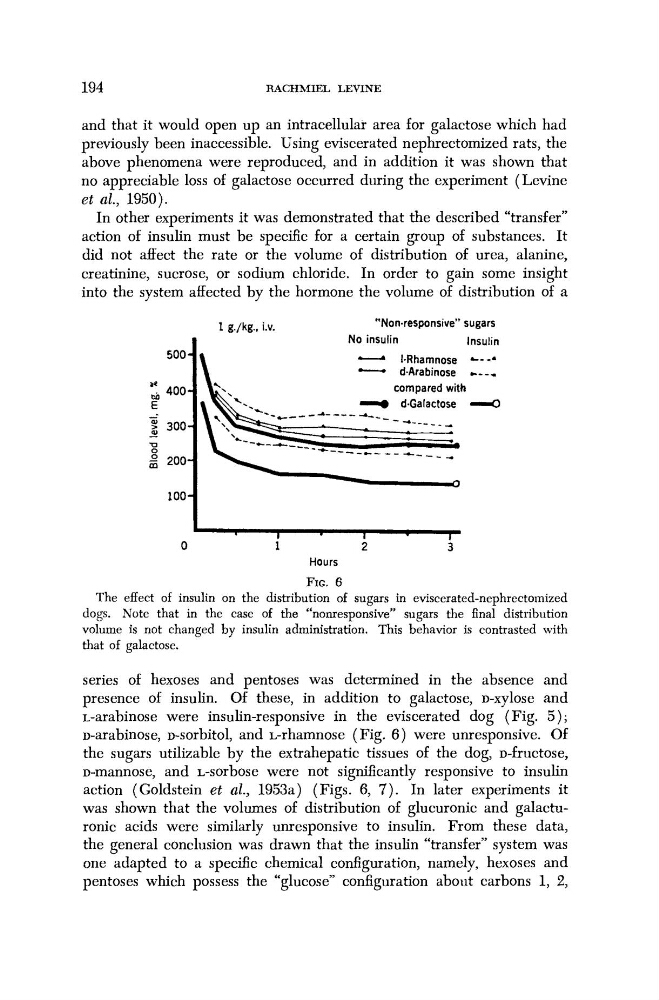
FIG. 6
The effect of insulin on the distribution of sugars in eviscerated-nephrectomized
dogs. Note that in the case of the "nonresponsive" sugars the final distribution
volume is not changed by insulin administration. This behavior is contrasted with
that of galactose.
series of hexoses and pentoses was determined in the absence and
presence of insulin. Of these, in addition to galactose, D-xylose and
L-arabinose were insulin-responsive in the eviscerated dog (Fig. 5);
D-arabinose, D-sorbitol, and L-rhamnose (Fig. 6) were unresponsive. Of
the sugars utilizable by the extrahepatic tissues of the dog, D-fructose,
D-mannose, and L-sorbose were not significantly responsive to insulin
action (Goldstein et al, 1953a) (Figs. 6, 7). In later experiments it
was shown that the volumes of distribution of glucuronic and galacturonic acids were similarly unresponsive to insulin. From these data,
the general conclusion was drawn that the insulin "transfer" system was
one adapted to a specific chemical configuration, namely, hexoses and
pentoses which possess the "glucose" configuration about carbons 1, 2,
RACHMIEL LEVINE
and that it would open up an intracellular area for galactose which had
previously been inaccessible. Using eviscerated nephrectomized rats, the
above phenomena were reproduced, and in addition it was shown that
no appreciable loss of galactose occurred during the experiment (Levine
et al, 1950).
In other experiments it was demonstrated that the described "transfer"
action of insulin must be specific for a certain group of substances. It
did not affect the rate or the volume of distribution of urea, alanine,
creatinine, sucrose, or sodium chloride. In order to gain some insight
into the system affected by the hormone the volume of distribution of a
100 Η
1
1
I
1 I
0
1
2
3
Hours
FIG. 6
The effect of insulin on the distribution of sugars in eviscerated-nephrectomized
dogs. Note that in the case of the "nonresponsive" sugars the final distribution
volume is not changed by insulin administration. This behavior is contrasted with
that of galactose.
series of hexoses and pentoses was determined in the absence and
presence of insulin. Of these, in addition to galactose, D-xylose and
L-arabinose were insulin-responsive in the eviscerated dog (Fig. 5);
D-arabinose, D-sorbitol, and L-rhamnose (Fig. 6) were unresponsive. Of
the sugars utilizable by the extrahepatic tissues of the dog, D-fructose,
D-mannose, and L-sorbose were not significantly responsive to insulin
action (Goldstein et al, 1953a) (Figs. 6, 7). In later experiments it
was shown that the volumes of distribution of glucuronic and galacturonic acids were similarly unresponsive to insulin. From these data,
the general conclusion was drawn that the insulin "transfer" system was
one adapted to a specific chemical configuration, namely, hexoses and
pentoses which possess the "glucose" configuration about carbons 1, 2,