

192
RACHMIEL LEVINE
Christensen et ah, 1949; Reid et al., 1948). The adrenal and pituitary
factors shown to be inhibitory in this test did not correlate with the
hormonal preparations which were diabetogenic in vivo (Smith, 1949).
And yet, logic dictated that the locus of insulin action must be sought
at or about the hexokinase level. In the usual presentation of the scheme
of intermediary carbohydrate metabolism the first reaction is that catalyzed by hexokinase. The tacit assumption has thereby been made
that the rate of glucose transfer from the extracellular compartment into
the cell interior was not limiting. In the earlier years of the history of
Cell interior
Glycogen
3
Glucose
—• Glucose-6-phosphate
4
Pyruvic acid
/
\
C0 2
Fat
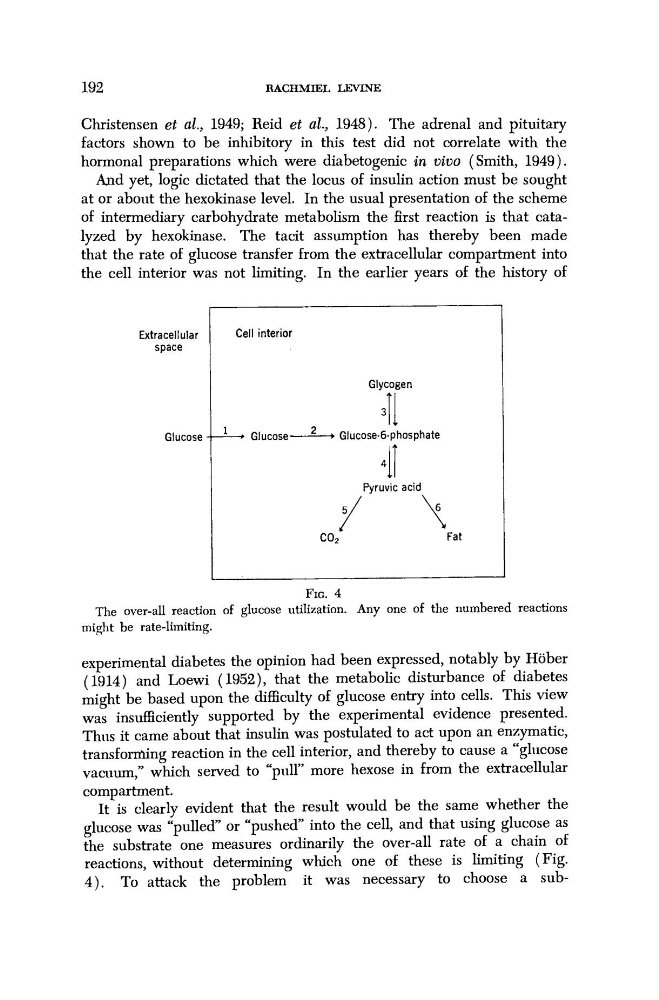
FIG. 4
The over-all reaction of glucose utilization. Any one of the numbered reactions
might be rate-limiting.
experimental diabetes the opinion had been expressed, notably by Höber
(1914) and Loewi (1952), that the metabolic disturbance of diabetes
might be based upon the difficulty of glucose entry into cells. This view
was insufficiently supported by the experimental evidence presented.
Thus it came about that insulin was postulated to act upon an enzymatic,
transforming reaction in the cell interior, and thereby to cause a "glucose
vacuum," which served to "pull" more hexose in from the extracellular
compartment.
It is clearly evident that the result would be the same whether the
glucose was "pulled" or "pushed" into the cell, and that using glucose as
the substrate one measures ordinarily the over-all rate of a chain of
reactions, without determining which one of these is limiting (Fig.
4). To attack the problem it was necessary to choose a subExtracellular
space
Glucose
RACHMIEL LEVINE
Christensen et ah, 1949; Reid et al., 1948). The adrenal and pituitary
factors shown to be inhibitory in this test did not correlate with the
hormonal preparations which were diabetogenic in vivo (Smith, 1949).
And yet, logic dictated that the locus of insulin action must be sought
at or about the hexokinase level. In the usual presentation of the scheme
of intermediary carbohydrate metabolism the first reaction is that catalyzed by hexokinase. The tacit assumption has thereby been made
that the rate of glucose transfer from the extracellular compartment into
the cell interior was not limiting. In the earlier years of the history of
Cell interior
Glycogen
3
Glucose
—• Glucose-6-phosphate
4
Pyruvic acid
/
\
C0 2
Fat
FIG. 4
The over-all reaction of glucose utilization. Any one of the numbered reactions
might be rate-limiting.
experimental diabetes the opinion had been expressed, notably by Höber
(1914) and Loewi (1952), that the metabolic disturbance of diabetes
might be based upon the difficulty of glucose entry into cells. This view
was insufficiently supported by the experimental evidence presented.
Thus it came about that insulin was postulated to act upon an enzymatic,
transforming reaction in the cell interior, and thereby to cause a "glucose
vacuum," which served to "pull" more hexose in from the extracellular
compartment.
It is clearly evident that the result would be the same whether the
glucose was "pulled" or "pushed" into the cell, and that using glucose as
the substrate one measures ordinarily the over-all rate of a chain of
reactions, without determining which one of these is limiting (Fig.
4). To attack the problem it was necessary to choose a subExtracellular
space
Glucose