

MECHANISMS OF HORMONE ACTIONS
191
Taking account of the demonstration that insulin increased the rate of
glucose transformations in all of the quantitatively important ways, it
was reasonable to assume that directly or indirectly the hormone stimulated the formation of glucose-6-phosphate, since this ester is the branch
point of the metabolic scheme. This was the conclusion arrived at in
reviews published in 1945 (de Duve), 1946 (Soskin and Levine), and
1947 (Bouckaert and de Duve).
¿§2
υ „πώ°· 0.8
OSE
0
7
όοΞ
1.0
1^1- 09
o. El δ 0.8
ο ο Ε
0.7
2.0
12?, 1.5
% El™ LO
" ct¿a
S«E
0.5
·
_
·
__J*_
-·
¿§2
υ „πώ°· 0.8
OSE
0
7
όοΞ
1.0
1^1- 09
o. El δ 0.8
ο ο Ε
0.7
2.0
12?, 1.5
% El™ LO
" ct¿a
S«E
0.5
-
· -
¿§2
υ „πώ°· 0.8
OSE
0
7
όοΞ
1.0
1^1- 09
o. El δ 0.8
ο ο Ε
0.7
2.0
12?, 1.5
% El™ LO
" ct¿a
S«E
0.5
-
^.m
··
•·
¿§2
υ „πώ°· 0.8
OSE
0
7
όοΞ
1.0
1^1- 09
o. El δ 0.8
ο ο Ε
0.7
2.0
12?, 1.5
% El™ LO
" ct¿a
S«E
0.5
^»
Glucose in
medium
0
200 mg. χ 200 mg. χ 500 mg. χ
500 mg. X
Insulin (800
units/100 cc.)
0
0
0
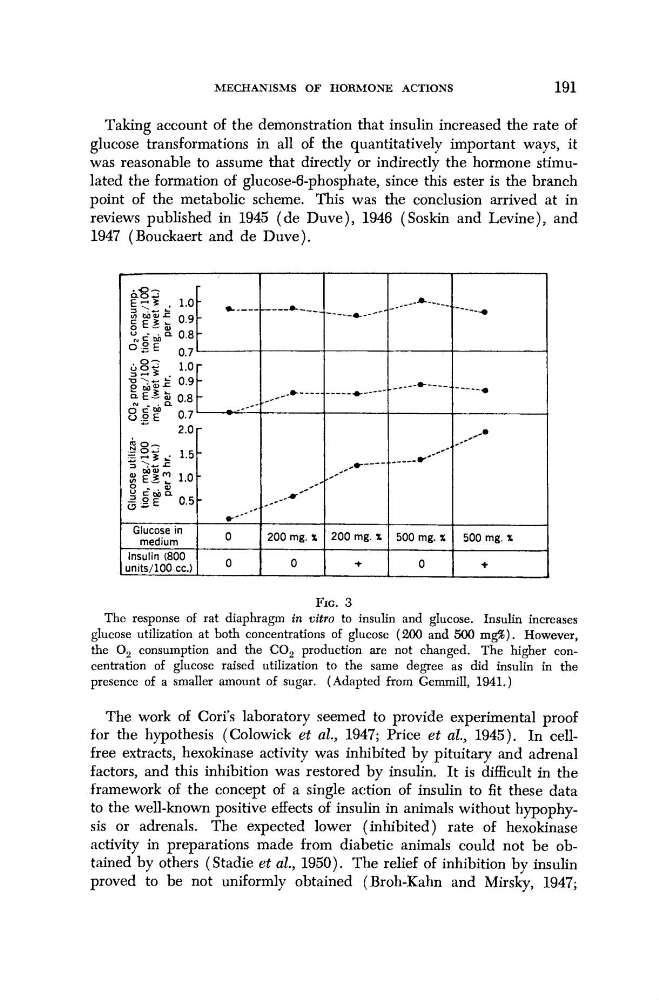
FIG. 3
The response of rat diaphragm in vitro to insulin and glucose. Insulin increases
glucose utilization at both concentrations of glucose (200 and 500 mg%). However,
the 0 2 consumption and the C0 2 production are not changed. The higher concentration of glucose raised utilization to the same degree as did insulin in the
presence of a smaller amount of sugar. (Adapted from Gemmill, 1941.)
The work of Corfs laboratory seemed to provide experimental proof
for the hypothesis (Colowick et al, 1947; Price et al, 1945). In cellfree extracts, hexokinase activity was inhibited by pituitary and adrenal
factors, and this inhibition was restored by insulin. It is difficult in the
framework of the concept of a single action of insulin to fit these data
to the well-known positive effects of insulin in animals without hypophysis or adrenals. The expected lower (inhibited) rate of hexokinase
activity in preparations made from diabetic animals could not be obtained by others (Stadie et al, 1950). The relief of inhibition by insulin
proved to be not uniformly obtained (Broh-Kahn and Mirsky, 1947;
191
Taking account of the demonstration that insulin increased the rate of
glucose transformations in all of the quantitatively important ways, it
was reasonable to assume that directly or indirectly the hormone stimulated the formation of glucose-6-phosphate, since this ester is the branch
point of the metabolic scheme. This was the conclusion arrived at in
reviews published in 1945 (de Duve), 1946 (Soskin and Levine), and
1947 (Bouckaert and de Duve).
¿§2
υ „πώ°· 0.8
OSE
0
7
όοΞ
1.0
1^1- 09
o. El δ 0.8
ο ο Ε
0.7
2.0
12?, 1.5
% El™ LO
" ct¿a
S«E
0.5
·
_
·
__J*_
-·
¿§2
υ „πώ°· 0.8
OSE
0
7
όοΞ
1.0
1^1- 09
o. El δ 0.8
ο ο Ε
0.7
2.0
12?, 1.5
% El™ LO
" ct¿a
S«E
0.5
-
· -
¿§2
υ „πώ°· 0.8
OSE
0
7
όοΞ
1.0
1^1- 09
o. El δ 0.8
ο ο Ε
0.7
2.0
12?, 1.5
% El™ LO
" ct¿a
S«E
0.5
-
^.m
··
•·
¿§2
υ „πώ°· 0.8
OSE
0
7
όοΞ
1.0
1^1- 09
o. El δ 0.8
ο ο Ε
0.7
2.0
12?, 1.5
% El™ LO
" ct¿a
S«E
0.5
^»
Glucose in
medium
0
200 mg. χ 200 mg. χ 500 mg. χ
500 mg. X
Insulin (800
units/100 cc.)
0
0
0
FIG. 3
The response of rat diaphragm in vitro to insulin and glucose. Insulin increases
glucose utilization at both concentrations of glucose (200 and 500 mg%). However,
the 0 2 consumption and the C0 2 production are not changed. The higher concentration of glucose raised utilization to the same degree as did insulin in the
presence of a smaller amount of sugar. (Adapted from Gemmill, 1941.)
The work of Corfs laboratory seemed to provide experimental proof
for the hypothesis (Colowick et al, 1947; Price et al, 1945). In cellfree extracts, hexokinase activity was inhibited by pituitary and adrenal
factors, and this inhibition was restored by insulin. It is difficult in the
framework of the concept of a single action of insulin to fit these data
to the well-known positive effects of insulin in animals without hypophysis or adrenals. The expected lower (inhibited) rate of hexokinase
activity in preparations made from diabetic animals could not be obtained by others (Stadie et al, 1950). The relief of inhibition by insulin
proved to be not uniformly obtained (Broh-Kahn and Mirsky, 1947;