

190
RACHMIEL LEVINE
The review of events thus far leads plainly to the conclusion that
insulin in some manner facilitates the uptake of sugar, at least by the
extrahepatic tissues. The development of our knowledge of intermediary
metabolism lent impetus to a search for the step or steps in the enzymatic machinery in which insulin participated, in such a manner as
would lead to greater glucose utilization. The possibilities were in
theory as many as there are steps in the metabolic scheme, but certain
areas could be excluded en bloc. Thus the breakdown of glycogen to
lactic acid was unimpaired in tissues of depancreatized animals (Lukens,
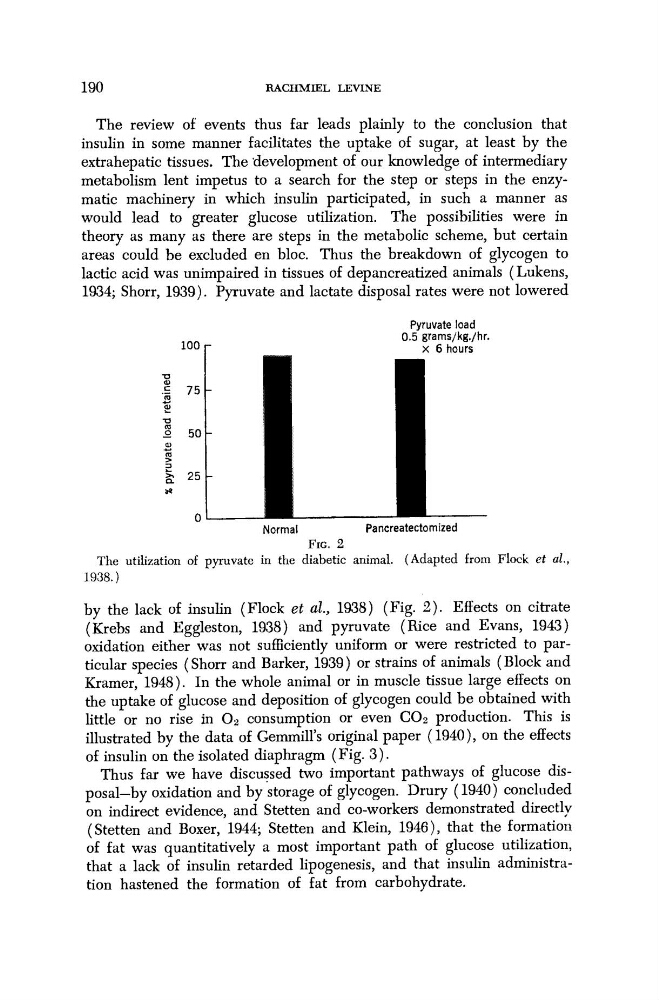
1934; Shorr, 1939). Pyruvate and lactate disposal rates were not lowered
Pyruvate load
0.5 grams/kg./hr.
χ 6 hours
I I
Normal
Pancreatectomized
FIG. 2
The utilization of pyruvate in the diabetic animal. (Adapted from Flock et al.,
1938.)
by the lack of insulin (Flock et al, 1938) (Fig. 2). Effects on citrate
(Krebs and Eggleston, 1938) and pyruvate (Rice and Evans, 1943)
oxidation either was not sufficiently uniform or were restricted to particular species (Shorr and Barker, 1939) or strains of animals (Block and
Kramer, 1948). In the whole animal or in muscle tissue large effects on
the uptake of glucose and deposition of glycogen could be obtained with
little or no rise in 0 2 consumption or even C0 2 production. This is
illustrated by the data of GemmiU's original paper (1940), on the effects
of insulin on the isolated diaphragm (Fig. 3).
Thus far we have discussed two important pathways of glucose disposal—by oxidation and by storage of glycogen. Drury (1940) concluded
on indirect evidence, and Stetten and co-workers demonstrated directly
(Stetten and Boxer, 1944; Stetten and Klein, 1946), that the formation
of fat was quantitatively a most important path of glucose utilization,
that a lack of insulin retarded lipogenesis, and that insulin administration hastened the formation of fat from carbohydrate.
RACHMIEL LEVINE
The review of events thus far leads plainly to the conclusion that
insulin in some manner facilitates the uptake of sugar, at least by the
extrahepatic tissues. The development of our knowledge of intermediary
metabolism lent impetus to a search for the step or steps in the enzymatic machinery in which insulin participated, in such a manner as
would lead to greater glucose utilization. The possibilities were in
theory as many as there are steps in the metabolic scheme, but certain
areas could be excluded en bloc. Thus the breakdown of glycogen to
lactic acid was unimpaired in tissues of depancreatized animals (Lukens,
1934; Shorr, 1939). Pyruvate and lactate disposal rates were not lowered
Pyruvate load
0.5 grams/kg./hr.
χ 6 hours
I I
Normal
Pancreatectomized
FIG. 2
The utilization of pyruvate in the diabetic animal. (Adapted from Flock et al.,
1938.)
by the lack of insulin (Flock et al, 1938) (Fig. 2). Effects on citrate
(Krebs and Eggleston, 1938) and pyruvate (Rice and Evans, 1943)
oxidation either was not sufficiently uniform or were restricted to particular species (Shorr and Barker, 1939) or strains of animals (Block and
Kramer, 1948). In the whole animal or in muscle tissue large effects on
the uptake of glucose and deposition of glycogen could be obtained with
little or no rise in 0 2 consumption or even C0 2 production. This is
illustrated by the data of GemmiU's original paper (1940), on the effects
of insulin on the isolated diaphragm (Fig. 3).
Thus far we have discussed two important pathways of glucose disposal—by oxidation and by storage of glycogen. Drury (1940) concluded
on indirect evidence, and Stetten and co-workers demonstrated directly
(Stetten and Boxer, 1944; Stetten and Klein, 1946), that the formation
of fat was quantitatively a most important path of glucose utilization,
that a lack of insulin retarded lipogenesis, and that insulin administration hastened the formation of fat from carbohydrate.