

MECHANISMS OF HORMONE ACTIONS
189
and derivative effects of insulin. It seems entirely logical to assume that
any observed effect of insulin which can be duplicated by the administration of large amounts of glucose (maintenance of a high blood glucose
level) to the depancreatized animal (devoid of insulin) could be classified as a derivative effect. Such an effect is due to the forced uptake of
sugar by tissues and is not a direct and immediate consequence of insulin
action. Thus it was shown by Mirsky et al. (1937a, b) that glucose can
and does lower the increased nitrogen excretion and the ketonemia of the
depancreatized dog.
Soon after the discovery of insulin, it was shown that its administration is followed by a lowering of the serum and urine inorganic phos100 r
og
75
• o
o £
3 00
00 «Λ
50
o-o
c 2
fc?
25
Glucose load
1.5 g./kg./hr.x6 hr.
Muscle
Liver
mm
Control
Insulin (1.5 units/kg./hr.) Insulin (6 units/kg./hr.)
330
255
378
Blood glucose, mg. X
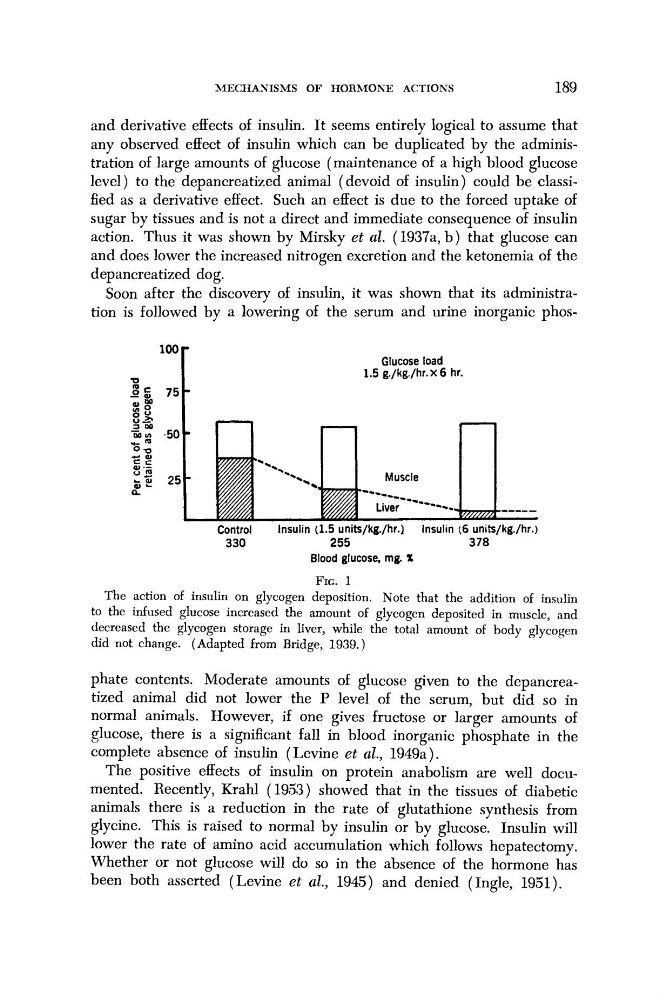
FIG. 1
The action of insulin on glycogen deposition. Note that the addition of insulin
to the infused glucose increased the amount of glycogen deposited in muscle, and
decreased the glycogen storage in liver, while the total amount of body glycogen
did not change. (Adapted from Bridge, 1939.)
phate contents. Moderate amounts of glucose given to the depancreatized animal did not lower the Ρ level of the serum, but did so in
normal animals. However, if one gives fructose or larger amounts of
glucose, there is a significant fall in blood inorganic phosphate in the
complete absence of insulin (Levine et al., 1949a).
The positive effects of insulin on protein anabolism are well documented. Recently, Krahl (1953) showed that in the tissues of diabetic
animals there is a reduction in the rate of glutathione synthesis from
glycine. This is raised to normal by insulin or by glucose. Insulin will
lower the rate of amino acid accumulation which follows hepatectomy.
Whether or not glucose will do so in the absence of the hormone has
been both asserted (Levine et al., 1945) and denied (Ingle, 1951).
189
and derivative effects of insulin. It seems entirely logical to assume that
any observed effect of insulin which can be duplicated by the administration of large amounts of glucose (maintenance of a high blood glucose
level) to the depancreatized animal (devoid of insulin) could be classified as a derivative effect. Such an effect is due to the forced uptake of
sugar by tissues and is not a direct and immediate consequence of insulin
action. Thus it was shown by Mirsky et al. (1937a, b) that glucose can
and does lower the increased nitrogen excretion and the ketonemia of the
depancreatized dog.
Soon after the discovery of insulin, it was shown that its administration is followed by a lowering of the serum and urine inorganic phos100 r
og
75
• o
o £
3 00
00 «Λ
50
o-o
c 2
fc?
25
Glucose load
1.5 g./kg./hr.x6 hr.
Muscle
Liver
mm
Control
Insulin (1.5 units/kg./hr.) Insulin (6 units/kg./hr.)
330
255
378
Blood glucose, mg. X
FIG. 1
The action of insulin on glycogen deposition. Note that the addition of insulin
to the infused glucose increased the amount of glycogen deposited in muscle, and
decreased the glycogen storage in liver, while the total amount of body glycogen
did not change. (Adapted from Bridge, 1939.)
phate contents. Moderate amounts of glucose given to the depancreatized animal did not lower the Ρ level of the serum, but did so in
normal animals. However, if one gives fructose or larger amounts of
glucose, there is a significant fall in blood inorganic phosphate in the
complete absence of insulin (Levine et al., 1949a).
The positive effects of insulin on protein anabolism are well documented. Recently, Krahl (1953) showed that in the tissues of diabetic
animals there is a reduction in the rate of glutathione synthesis from
glycine. This is raised to normal by insulin or by glucose. Insulin will
lower the rate of amino acid accumulation which follows hepatectomy.
Whether or not glucose will do so in the absence of the hormone has
been both asserted (Levine et al., 1945) and denied (Ingle, 1951).