

186
T. BERGAN
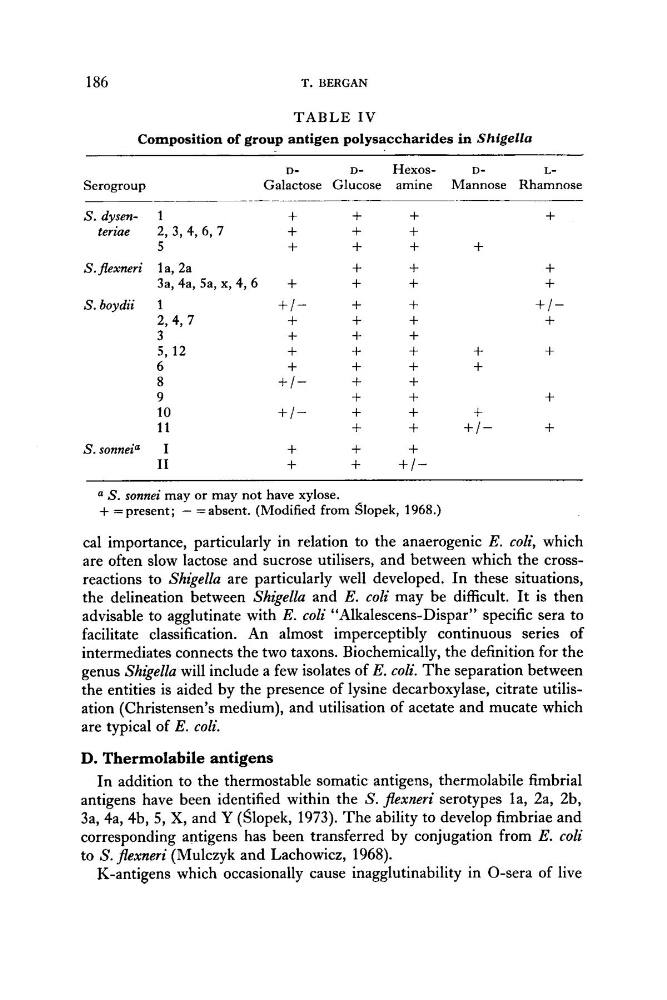
T A B L E IV
Composition of group antigen polysaccharides in Shigella
Serogroup
LGalactose Glucose amine Mannose Rhamnose
S . dysen- 1
+
+
+
+
5
+
+
+
+
teriae
2, 3, 4, 6, 7
+
+
+
S.Jlexneri la, 2a
+
3a, 4a, 5a, x, 4, 6
+
+
S.boydii
1
+ / -
+
2,437
+
+
3
+
+
5,12
+
+
6
+
+
8
+ / -
+
9
+
l o
+ / -
+
11
+
+
+
+
+
+
+
+
+
+
+
+
+
+
+ / -
+
+
+
+
+
+
+ / -
+
S.sonneia
I
+
+
+
I1
+
+ + / -
a S. sonnei may or may not have xylose.
+ =present; - =absent. (Modified from Slopek, 1968.)
cal importance, particularly in relation to the anaerogenic E. coli, which
are often slow lactose and sucrose utilisers, and between which the crossreactions to Shigella are particularly well developed. In these situations,
the delineation between Shigella and E. coli may be difficult. It is then
advisable to agglutinate with E. coli “Alkalescens-Dispar” specific sera to
facilitate classification. An almost imperceptibly continuous series of
intermediates connects the two taxons. Biochemically, the definition for the
genus Shigella will include a few isolates of E. coli. The separation between
the entities is aided by the presence of lysine decarboxylase, citrate utilisation (Christensen’s medium), and utilisation of acetate and mucate which
are typical of E. coli.
D. Thermolabile antigens
In addition to the thermostable somatic antigens, thermolabile fimbrial
antigens have been identified within the S. jexneri serotypes la, 2a, 2b,
3a, 4a, 4b, 5, X, and Y (Slopek, 1973). The ability to develop fimbriae and
corresponding antigens has been transferred by conjugation from E. coli
to S. jexneri (Mulczyk and Lachowicz, 1968).
K-antigens which occasionally cause inagglutinability in 0-sera of live
T. BERGAN
T A B L E IV
Composition of group antigen polysaccharides in Shigella
Serogroup
LGalactose Glucose amine Mannose Rhamnose
S . dysen- 1
+
+
+
+
5
+
+
+
+
teriae
2, 3, 4, 6, 7
+
+
+
S.Jlexneri la, 2a
+
3a, 4a, 5a, x, 4, 6
+
+
S.boydii
1
+ / -
+
2,437
+
+
3
+
+
5,12
+
+
6
+
+
8
+ / -
+
9
+
l o
+ / -
+
11
+
+
+
+
+
+
+
+
+
+
+
+
+
+
+ / -
+
+
+
+
+
+
+ / -
+
S.sonneia
I
+
+
+
I1
+
+ + / -
a S. sonnei may or may not have xylose.
+ =present; - =absent. (Modified from Slopek, 1968.)
cal importance, particularly in relation to the anaerogenic E. coli, which
are often slow lactose and sucrose utilisers, and between which the crossreactions to Shigella are particularly well developed. In these situations,
the delineation between Shigella and E. coli may be difficult. It is then
advisable to agglutinate with E. coli “Alkalescens-Dispar” specific sera to
facilitate classification. An almost imperceptibly continuous series of
intermediates connects the two taxons. Biochemically, the definition for the
genus Shigella will include a few isolates of E. coli. The separation between
the entities is aided by the presence of lysine decarboxylase, citrate utilisation (Christensen’s medium), and utilisation of acetate and mucate which
are typical of E. coli.
D. Thermolabile antigens
In addition to the thermostable somatic antigens, thermolabile fimbrial
antigens have been identified within the S. jexneri serotypes la, 2a, 2b,
3a, 4a, 4b, 5, X, and Y (Slopek, 1973). The ability to develop fimbriae and
corresponding antigens has been transferred by conjugation from E. coli
to S. jexneri (Mulczyk and Lachowicz, 1968).
K-antigens which occasionally cause inagglutinability in 0-sera of live