

V. BACTERIOPHAGE TYPING OF SHIG'ELL.4
185
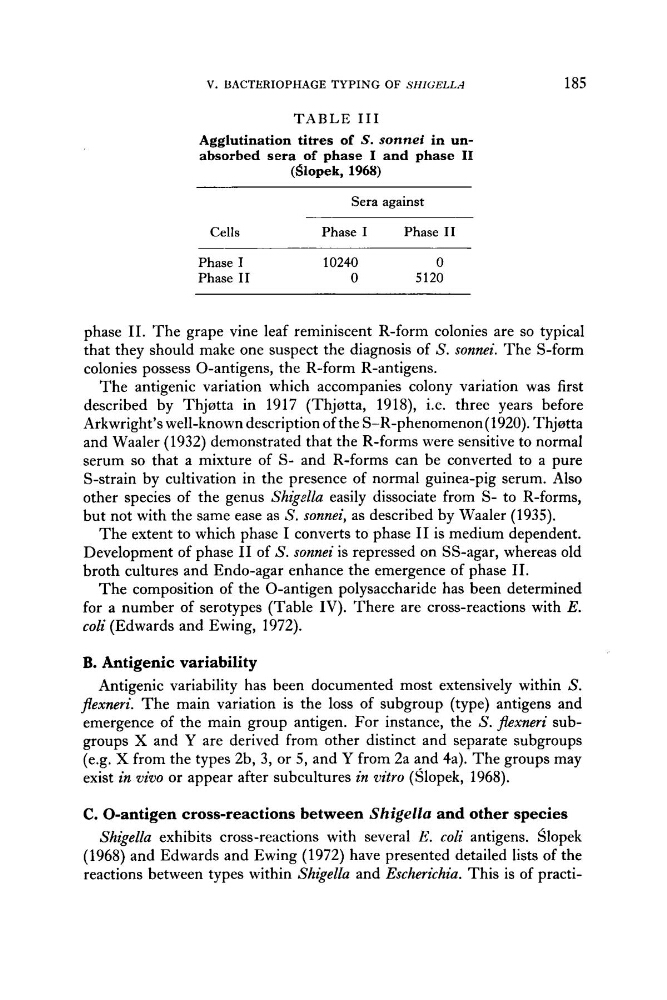
T A B L E I11
Agglutination titres of S. sonnei in unabsorbed sera of phase I and phase I1
(Slopek, 1968)
Sera against
Cells
Phase I
Phase I1
Phase I
10240
0
Phase I1
0
5120
phase 11. The grape vine leaf reminiscent R-form colonies are so typical
that they should make one suspect the diagnosis of S. sonnei. The S-form
colonies possess 0-antigens, the R-form R-antigens.
The antigenic variation which accompanies colony variation was first
described by Thjetta in 1917 (Thjetta, 1918), i.e. three years before
Arkwright's well-known description of the S-R-phenomenon (1920). Thjratta
and Waaler (1932) demonstrated that the R-forms were sensitive to normal
serum so that a mixture of S- and R-forms can be converted to a pure
S-strain by cultivation in the presence of normal guinea-pig serum. Also
other species of the genus Shigtlla easily dissociate from S- to R-forms,
but not with the same ease as S. sonnei, as described by Waaler (1935).
The extent to which phase I converts to phase I1 is medium dependent.
Development of phase I1 of S. sonnei is repressed on SS-agar, whereas old
broth cultures and Endo-agar enhance the emergence of phase 11.
The composition of the 0-antigen polysaccharide has been determined
for a number of serotypes (Table IV). There are cross-reactions with E.
coli (Edwards and Ewing, 1972).
B. Antigenic variability
Antigenic variability has been documented most extensively within S.
flexneri. The main variation is the loss of subgroup (type) antigens and
emergence of the main group antigen. For instance, the S. j7exneri subgroups X and Y are derived from other distinct and separate subgroups
(e.g. X from the types 2b, 3, or 5, and Y from 2a and 4a). The groups may
exist in vivo or appear after subcultures in vitro (Slopek, 1968).
C. 0-antigen cross-reactions between Shigella and other species
Shigella exhibits cross-reactions with several E. coli antigens. Slopek
(1968) and Edwards and Ewing (1972) have presented detailed lists of the
reactions between types within Shigella and Escherichia. This is of practi-
185
T A B L E I11
Agglutination titres of S. sonnei in unabsorbed sera of phase I and phase I1
(Slopek, 1968)
Sera against
Cells
Phase I
Phase I1
Phase I
10240
0
Phase I1
0
5120
phase 11. The grape vine leaf reminiscent R-form colonies are so typical
that they should make one suspect the diagnosis of S. sonnei. The S-form
colonies possess 0-antigens, the R-form R-antigens.
The antigenic variation which accompanies colony variation was first
described by Thjetta in 1917 (Thjetta, 1918), i.e. three years before
Arkwright's well-known description of the S-R-phenomenon (1920). Thjratta
and Waaler (1932) demonstrated that the R-forms were sensitive to normal
serum so that a mixture of S- and R-forms can be converted to a pure
S-strain by cultivation in the presence of normal guinea-pig serum. Also
other species of the genus Shigtlla easily dissociate from S- to R-forms,
but not with the same ease as S. sonnei, as described by Waaler (1935).
The extent to which phase I converts to phase I1 is medium dependent.
Development of phase I1 of S. sonnei is repressed on SS-agar, whereas old
broth cultures and Endo-agar enhance the emergence of phase 11.
The composition of the 0-antigen polysaccharide has been determined
for a number of serotypes (Table IV). There are cross-reactions with E.
coli (Edwards and Ewing, 1972).
B. Antigenic variability
Antigenic variability has been documented most extensively within S.
flexneri. The main variation is the loss of subgroup (type) antigens and
emergence of the main group antigen. For instance, the S. j7exneri subgroups X and Y are derived from other distinct and separate subgroups
(e.g. X from the types 2b, 3, or 5, and Y from 2a and 4a). The groups may
exist in vivo or appear after subcultures in vitro (Slopek, 1968).
C. 0-antigen cross-reactions between Shigella and other species
Shigella exhibits cross-reactions with several E. coli antigens. Slopek
(1968) and Edwards and Ewing (1972) have presented detailed lists of the
reactions between types within Shigella and Escherichia. This is of practi-