

126
A. SARAGEA ET AL.
activity, serological specificity and morphology. They showed that C .
hofmannii phages do not cross-react with C. diphtheriae phages, display
large haloed plaques (Fig. 28), a higher multiplicity, and smaller electron
microscopic size than C. diphtheriae phages, or the phages specific for
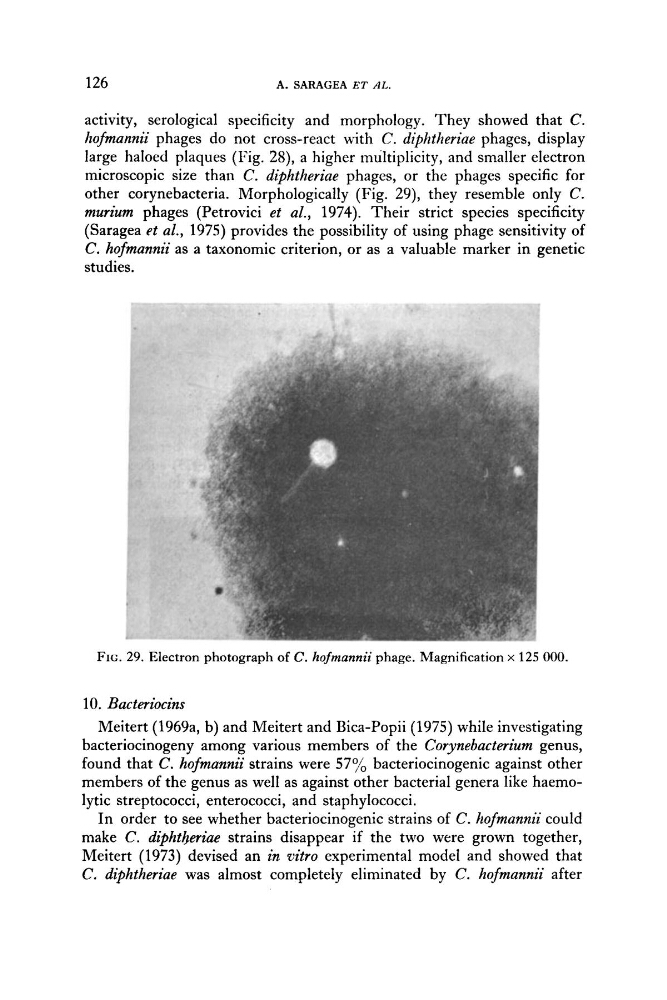
other corynebacteria. Morphologically (Fig. 29), they resemble only C .
murium phages (Petrovici et al., 1974). Their strict species specificity
(Saragea t t al., 1975) provides the possibility of using phage sensitivity of
C . hofmannii as a taxonomic criterion, or as a valuable marker in genetic
studies.
FIG. 29. Electron photograph of C. hofmannii phage. Magnification x 125 000.
10. Bacteriocins
Meitert (1969a, b) and Meitert and Bica-Popii (1975) while investigating
bacteriocinogeny among various members of the Corynebacterium genus,
found that C. hofmannii strains were 57% bacteriocinogenic against other
members of the genus as well as against other bacterial genera like haemolytic streptococci, enterococci, and staphylococci.
In order to see whether bacteriocinogenic strains of C. hofmannii could
make C. diphtberiae strains disappear if the two were grown together,
Meitert (1973) devised an in vitro experimental model and showed that
C. diphtheriae was almost completely eliminated by C. hofmannii after
A. SARAGEA ET AL.
activity, serological specificity and morphology. They showed that C .
hofmannii phages do not cross-react with C. diphtheriae phages, display
large haloed plaques (Fig. 28), a higher multiplicity, and smaller electron
microscopic size than C. diphtheriae phages, or the phages specific for
other corynebacteria. Morphologically (Fig. 29), they resemble only C .
murium phages (Petrovici et al., 1974). Their strict species specificity
(Saragea t t al., 1975) provides the possibility of using phage sensitivity of
C . hofmannii as a taxonomic criterion, or as a valuable marker in genetic
studies.
FIG. 29. Electron photograph of C. hofmannii phage. Magnification x 125 000.
10. Bacteriocins
Meitert (1969a, b) and Meitert and Bica-Popii (1975) while investigating
bacteriocinogeny among various members of the Corynebacterium genus,
found that C. hofmannii strains were 57% bacteriocinogenic against other
members of the genus as well as against other bacterial genera like haemolytic streptococci, enterococci, and staphylococci.
In order to see whether bacteriocinogenic strains of C. hofmannii could
make C. diphtberiae strains disappear if the two were grown together,
Meitert (1973) devised an in vitro experimental model and showed that
C. diphtheriae was almost completely eliminated by C. hofmannii after