

IV. INVESTIGATION OF C. DIPHTHERIAE
127
80 days, in contrast to pure culture controls where each bacterium survived
for that period.
Bacteriocinogenic C. hofmaranii strains are included in the set of bacteriocinogenic strains used in the proposed scheme for bacteriocin typing which
was described earlier.
C . Corynebacterium xerosis
Described by Reymond et al. in 1881 (cited by Wilson and Miles, 1966).
1. Habitat
C. xerosis is isolated from normal and diseased conjunctiva, ear and
occasionally from the throat, although much less frequently than C.
hofmannii.
2. Morphology
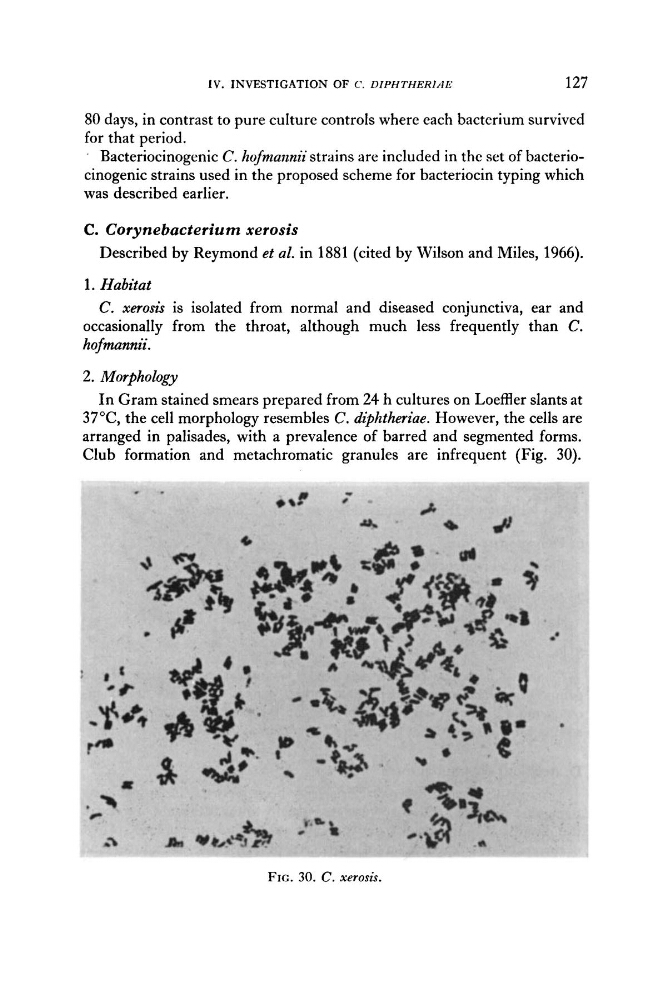
I n Gram stained smears prepared from 24 h cultures on Loeffler slants at
37"C, the cell morphology resembles C. diphtheriae. However, the cells are
arranged in palisades, with a prevalence of barred and segmented forms.
Club formation and metachromatic granules are infrequent (Fig. 30).
FIG. 30. C . xerosis.
127
80 days, in contrast to pure culture controls where each bacterium survived
for that period.
Bacteriocinogenic C. hofmaranii strains are included in the set of bacteriocinogenic strains used in the proposed scheme for bacteriocin typing which
was described earlier.
C . Corynebacterium xerosis
Described by Reymond et al. in 1881 (cited by Wilson and Miles, 1966).
1. Habitat
C. xerosis is isolated from normal and diseased conjunctiva, ear and
occasionally from the throat, although much less frequently than C.
hofmannii.
2. Morphology
I n Gram stained smears prepared from 24 h cultures on Loeffler slants at
37"C, the cell morphology resembles C. diphtheriae. However, the cells are
arranged in palisades, with a prevalence of barred and segmented forms.
Club formation and metachromatic granules are infrequent (Fig. 30).
FIG. 30. C . xerosis.